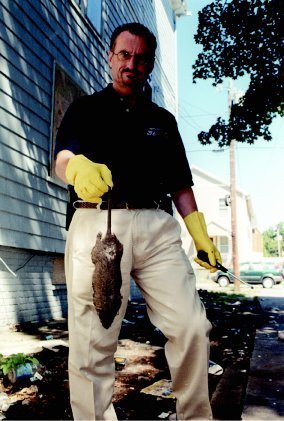
Control finds victim in battle between
rodent and man.
Rats are literally running wild in Providence.
This summer, the city is experiencing one of its worst rat infestations in memory, according to public health officials and numerous neighborhood groups. The rat problem is worst in the city’s core of blue-collar neighborhoods, where a record number of residents and businesses are reporting seeing rats rummaging through backyards, ransacking garbage piles and roaming the streets. The city’s new rat hotline, 454-PEST, has received more than 300 calls since it started taking calls in July.
“People are calling in at a rate of three to five calls a day,” said Fred Ihenacho, director of the Dept. of Public Works – the agency responsible for dealing with the city’s rodent problem.
Building a Strong Data Foundation in the Age of AI
Artificial intelligence (AI) has become a key priority in the boardroom and across management —…
Learn More
The city recently launched a major offensive against rats, in the hopes of drastically reducing the rodent population before it possibly causes a public health nightmare. On July 2, the city launched its rat hotline. This week, Mayor Vincent A. Cianci, Jr.’s office is expected to send flyers in both English and Spanish to every household in the city to alert residents about the rat problem and inform them about the hotline. The flyers will offer safety tips and explain what the city is doing to fight the outbreak, said Ihenacho.
The outbreak of the rat population is a result of two mild winters, major construction and demolition projects throughout the city, and bad garbage management in the inner many parts of the city, say experts. In particular, demolition associated with the relocation of Interstate 195 and other construction projects in the center of Providence has caused many rats to head elsewhere, said Anthony DeJesus, spokesman for New England Pest Control in Providence, the company hired by the city to combat the rat problem.
“You’re disturbing habitat. You’re taking the places where they live and uprooting them. They’ll travel in search of food and shelter,” he said.
Since July, the city has been paying a private rodent-control company to eradicate rats at residencies that have a reported infestation. The rodent-control teams are even inspecting and baiting private properties without permission of the landlord – a new development made possible by changes made to the city’s rat policy.
The city’s rat program does not allow New England Pest Control to eradicate rats at business properties.
“Businesses are on their own,” said DeJesus.
People with knowledge of the rat problem in Providence say many businesses in the city have rat infestations. Several businesses that operate on streets with documented rat infestation declined to be interviewed.
“We will write up any businesses that have code violations. But I don’t know of any businesses in the city being shut down because of rats,” said Lisa Powers, environmental coordinator for city.
The City Council amended the city’s rat ordinance in February, following months of debate over landlord rights and the dollar cost of the changes. The new ordinance also makes landlords responsible for garbage code violations, regardless of who created the violation, and requires landlords to provide two garbage containers, covered and labeled, for each household unit.
Providence officials have also been urging the city’s garbage contractor, Waste Management Co., to do a better job of clearing all debris and returning garbage cans and lids to the curb and when they do garbage pickup. Garbage left behind on streets and lost or damaged garbage cans and lids have contributed to the rat problem this summer, said Ihenacho.
“We have a very good program dealing with rats now, even though it doesn’t seem that way,” he said. “It’s a very comprehensive approach. We’re attacking it through sewers, attacking through burrows in abandoned lots and backyards of homes.”
New England Pest Control Co. has baited and set traps on 140 properties where there have been reported rat sightings, said Ron Campellone, a company spokesman. The company will return to each site once a month for two months to re-bait, if necessary, said Campellone. The teams are also inspecting abutting properties of infested sites, and baiting them if necessary, he said.
New England Pest Control secured the city contract for $120,000 in April, in a bid process. The one-year contract is renewable for the next two years, according to Campellone. New England Pest Control worked with city officials to fashion its program before the bid process, and was the only company to bid on the contract, he said.
The species of rat invading the city is the Norway rat – a common city rat with coarse gray hair, small ears, and the ability to gnaw cinderblocks, tread water for days, fit through an opening the size of a quarter and leap three feet into the air, say rat experts.
Rats ordinarily avoid humans, but will fight a person who corners it.
Another possible health threat associated with rats is Leptospirosis, a disease transmitted through contact with contaminated rat urine. The illness has been documented in New England cities in the past.
There have been no reported incidents in Providence of anyone getting bitten by a rat or becoming ill as a result of contact with rat feces or urine, say city officials. Still, rats pose a major concern for many residents and business owners – particularly in the poorest, densest neighborhoods in the city.
The rat problem is reportedly worst in South Providence, Olneyville, Silver Lake and the West End – a result of excessive litter, illegal dumping on abandoned lots, the close proximity of properties, high rates of properties with absentee landlords, and bad garbage management by residents, say experts.
“Getting the public to do what we need them to do is tough,” said Ward 15 City Councilwoman Josephine DiRuzzo, who championed the new, tougher rat ordinance.
At the same time, the city needs to maintain its financial commitment to fighting the rat problem, she said. The city’s budget for next year has yet to be approved, and the money dedicated to fighting rats could still be slashed, she said.
“As far I’m concerned, it’s one of the most important problems we have in the city. This is a health and safety issue,” said DiRuzzo.
The City of Providence is not doing enough to improve garbage management in these neighborhoods, according to a report published in May on the Internet by a Brown University undergraduate student.
The study of waste management in Providence’s inner-city, and the difference in recycling and waste disposal compliance between wealthy and lower-income city residents, was conducted last year by Jessica Intrator as a senior thesis project.
Intrator found that cost of service for garbage removal, and reliability and quality of pickup are often worse in the city’s poorer neighborhoods than in its more affluent neighborhoods. She documented a direct correlation between poor garbage management and rates of rat infestation.
“During my research, it became clear to me that residents of inner city or urban core areas are burdened by poor garbage management in their neighborhoods. This is a problem that’s getting worse. Over and over people told me, ‘there’s rats running to and fro across my yard, and it’s really disgusting and I don’t know what to do about it,” said Intrator. “Now that the new garbage ordinance has gone into effect, the DPW has got to be supported in its rat abatement efforts,” she said.
And residents in Providence’s poorer neighborhoods are often less willing to get help when rats appear, said DeJesus, of New England Pest Control. In comparison, one rat seen by residents on the city’s East Side will typically prompt calls from the entire neighborhood.
“In some neighborhoods where the report level is low, the actual activity may be high, but the city doesn’t know that,” said DeJesus. “The tragedy in the inner-city is that people who live with rats don’t know there’s another way. They’re embarrassed to call and say there’s a rat in their home, or they’re afraid they’re going to get in trouble,” he said.
For their part, city officials say the success of the rodent eradication program will hinge on how much cooperation the city gets from its residents. Residents must keep their garbage in sealed bins, landlords must rat-proof their buildings and businesses with a problem must hire an exterminator or bait for rats on their properties, they said.
New England Pest Control said they expect the fight against rats to take on another dimension in the fall. When it gets colder and food is less plentiful, the rats start going indoors, they said.