When the economy slumps into a recession – as it has in the last year – many companies have to make tough decisions about whether to cut staff or close a facility. And the results of those decisions can have an effect on the company’s property and the amount of risk that it faces.
“What most companies are dealing with now is the economy,” FM Global Assistant Vice President Steven Zenofsky said in a recent interview. “And when there’s an economic downturn that can create increased property risks.”
Property damage during a recession can affect a business through a loss of customers or time, even if a company has insurance. “If your insurance company has to write you a check because you suffered property damage, then likely there are business consequences that will result,” Zenofsky said.
But FM Global’s corporate motto is that most property damage isn’t inevitable and that best practices and knowing when you’re at risk can cut down on the possibility of most disasters affecting a company.
“We have an uncommon approach in insurance, because we start from the premise or belief that all property damage is preventable,” Zenofsky said of FM Global, the Johnston-based insurer that covers more than 3,000 clients with more than $7 trillion in property around the world. “Most companies have the philosophy that property loss is inevitable and that’s what insurance is for.”
So Zenofsky took a few minutes recently to run through the potential dangers from three scenarios that are more common in a recession: a lack of staffing, an increased use of contractors and an idled building.
Lack of Staffing
At every company, there are senior employees. They are the ones that carry the institutional knowledge – and they are usually best acquainted with the company’s safety procedures.
But those employees are often the first to be cut when layoffs start, Zenofsky said.
He added that while it might not be the best idea to lay off those senior employees, it is the trend. So if they do leave the company, training the newer employees to avoid disasters becomes essential.
“It becomes even more paramount, if you have less experienced staff, to ensure that they know your company’s risk management procedures,” he said.
The difference in training – what Zenofsky said is one of the “simplest” things for a company to do – could stop a “business distraction” from becoming a “business disaster,” he said.
Increased Contractor Use
And when employees are laid off, there usually is some leftover work. There are things that staffers might have done before, but now there’s not enough time for them to do it. For that reason, many companies increase their use of contractors during a recession, Zenofsky said.
“And the increased use of – and also the lack of supervision of – contractors has the potential to create a threat of property damage, too,” he said. “One of the key reasons why … is because contractors are not familiar with your business or your facility.”
And if a contractor is brought in to do some needed work – such as fixing machines – they’re also going to be focused on profitability, Zenofsky said. That means they’ll want to do the work as quickly as possible and move on to the next job.
“But if they’re not familiar with your facility, they may cut corners and put your facility at risk,” he added.
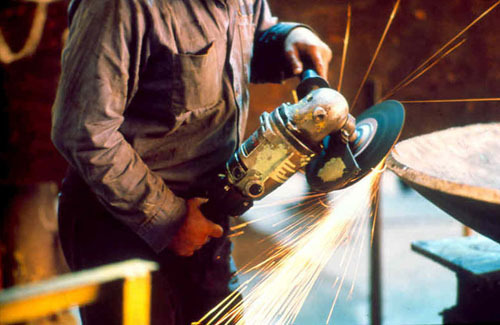
The biggest contractor-related property loss comes from problems with “hot work,” an insurance industry term for welding, using a torch or any other controlled burn. A fire or explosion caused by a subcontractor’s failure to control a welding torch or other equipment averages $1.3 million in damage per incident, Zenofsky said.
“We find that, generally speaking, about 70 percent of all property damage is caused by human error,” he said. “That can be your own staff or that could be contractors.”
So to limit those potential risks, it’s important first to review a contractor’s insurance policies. Then look into their safety and loss records. If they still pass muster, the hiring company should then sit down with contractors and go through internal safety procedures, Zenofsky said.
But before they start work at your facility, all contractors should be required to sign a contract that states that “they are responsible for any and all damage resulting from their actions.”
Those seem like simple steps, but they can be easily overlooked, Zenofsky said.
But keeping a close eye on a contractor shouldn’t stop when the company finally gets to work – that’s when there should be “strict” controls to ward against potential disasters. Contracted employees should have to log in and log out and should be monitored by staffers the whole time they are there, Zenofsky said.
Idle Facilities
If a company has an underused warehouse or building – and many of the Fortune 1000 companies represented by FM Global do have such buildings – it might close it down during a downturn to save costs. That warehouse could be “idled” with all the equipment locked inside. Or it could be empty.
“One may think there’s probably less of a need for insurance if that facility is not running. One might think there’s less risk,” Zenofsky said. “But, actually, there’s more risk. Risk is more prevalent, more often than not, when you have an idled facility.”
One of the most common risks stems from an intended cost-cutting measure: turning the heat off to cut down on the bill. To turn the heat off during the winter, the building’s sprinkler system must also be shut off, so the water pipes don’t freeze and burst, causing more damage.
“But now, should you have a fire, you have no protection,” Zenofsky said, adding that fire departments in the United States take an average of 19 minutes to get to a fire. “And then you would have the issue of a burning building with fire spreading to other buildings nearby. You might have shut down your production facility, but then you have another key building right next door that could be a victim of the vacant building.”
And there’s risk of fires from having too many “unnecessary combustibles,” including flammable liquids and wooden palates or cardboard stacked inside or outside the unused building. Zenofsky even recommends trimming or removing any outside vegetation, which if dried out could create a fire hazard.
“And a lot of these tips don’t cost a lot of money, if any at all. These are very inexpensive things,” he said. “But they could have a dramatic effect.”
If a building is going to be sitting idle for a while, a company might want to call the fire department to let them know. And keeping a security detail or maintenance staff to keep the building locked and safe will curb vandalism – a leading cause of commercial property damage.
The average loss caused by an idle facility catching fire is about $700,000, according to a 20-year study done by FM Global. Weather-related damage averages $125,000 and arson and vandalism combined average $164,000.
But the potential for disasters caused by an idle facility – along with less staff and more contractors – can usually be stopped with managerial oversight and a few simple steps, Zenofsky said.
He added that companies likely become more vulnerable to disruptions in tougher economic times, so vigilance in preparing for disasters becomes more important.
“And the reason for that is that we believe that there are things that insurance can’t cover you for,” Zenofsky said. “Insurance is not going to bring back your customers. It’s not going to bring back your market share. And insurance will not repair your reputation.” •