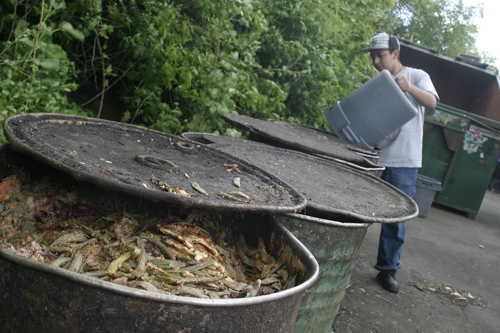
Almost every morning during the summer, a worker from Fox Meadow Farm in Tiverton drives a pickup truck to the Aquidneck Corporate Park in Middletown and hauls away hundreds of gallons of food scraps generated the day before by Blackstone Caterers.
The caterer’s garbage is used to feed pigs and make compost on the farm and is part of a comprehensive recycling program at Blackstone Caterers, a business unit of Newport Harbor Corp.
“For us it’s not just a matter of doing something that’s good for the environment, it also actually does save us money,” said Jessica Kriss, a sales and operations manager at Blackstone Caterers.
Recycling has been mandatory for all businesses in Rhode Island since 1996 and companies with more than 50 employees are required by law to report their recycling efforts annually to the state.
But because of a limited budget and staff, environmental officials have never been able to enforce the state’s commercial recycling regulations, said Terry Gray, assistant director for air, waste and compliance at the R.I. Department of Environmental Management.
Rhode Island businesses generate about 660,000 tons of garbage a year – 60 percent of all waste buried in the state’s Central Landfill in Johnston. Now, with the landfill projected to hit capacity within just a few years at the current rate, the DEM and the R.I. Resource Recovery Corporation have launched a joint program aimed at increasing commercial recycling.
“It became pretty clear that households and municipalities were doing their part on the recycling side,” Gray said. “But we really didn’t know what was going on in the business community, and anecdotally we kind of understood that not much was really happening.”
Called the “Green Zone,” the free program offers businesses advice on how to comply with the law and potentially save money through recycling and increased energy efficiency.
The program has a Web site – www.GreenZoneRI.org – that offers comprehensive information and a list of services, including waste assessments for companies.
Late last year, Gray noted, the DEM sent letters to all Rhode Island businesses with more than 50 employees announcing the commercial recycling initiative, and directing them to report their current recycling program to the agency through an online form at the Green Zone Web site. (READ MORE) Out of about 3,000 businesses that got the letters, about 1,000 have reported, he said.
The DEM will begin enforcing the state’s commercial recycling and reporting regulations next year, Gray said. But he acknowledged the agency’s enforcement efforts would be limited, given the state’s ongoing budget crisis.
“We’re not going to have a lot of resources, so we’ve got to invest them intelligently,” Gray said.
On April 30, DEM and the Recource Recovery Corporation’s Green Zone staff delivered almost 100 recycling bins to the Aquidneck Corporate Park, after spending three days performing waste assessments at a majority of the more than 40 businesses in the park.
McGreavy, an associate vice president at DPS Sporting Club Development Company LLC, which is headquartered in the office park, sent out e-mails to every business in the park pitching the idea that they could all significantly lower their waste-removal bills by committing to recycling and negotiating collectively with garbage haulers.
Eventually, McGreavy said, she hopes that every business in the office park will conduct an energy audit that will lead to reduced energy consumption and lower electricity bills in the park’s 30-year-old buildings.
A few property owners have even expressed interest in developing small-scale renewable energy sources at the park, including wind and solar power, said McGreavy, who recently incorporated her own “green” consulting practice, Conserve By Design LLC.
McGreavy’s efforts to make Aquidneck Corporate Park more environmentally friendly have illustrated both the opportunities and challenges that businesses face in “going green,” she said.
Almost every company doing business in the park responded enthusiastically to McGreavy’s e-mail and agreed to have their waste-management process assessed by the Green Zone team. Following its assessment, Advance Solutions for Tomorrow Inc. ordered desk-side recycling bins for every employee who works at the company’s facility in the office park.
About three other companies in the park already have comprehensive recycling programs in place. In particular, Blackstone Caterers recycles everything it possibly can as part of a companywide environmental and energy-efficiency program at Newport Harbor Corp. – including glass, plastic, paper, cardboard, compact fluorescent bulbs, batteries, old computers and cell phones, and even used cooking grease, which is taken by a biodiesel manufacturer.
But many companies in the office park – especially the smaller businesses – have no recycling program at all, McGreavy said. In some cases, employees of these businesses take paper and other recyclables generated at work home to their own curbside recycling bin.
And several businesses that thought they had an adequate recycling program in place actually did not, she said. In some cases, contract cleaners who came to the office at night threw recyclables that had been put in separate bins into the trash, McGreavy learned by looking in Dumpsters at the office park.
“A lot of people who think that they were doing it right really weren’t, and it wasn’t through any fault of their own,” she said.
And an agreement among all businesses in the park to drive down waste-management costs by negotiating collectively with trash haulers will be difficult to achieve among multiple property owners and tenants with varying lease agreements, McGreavy said. In many cases, commercial tenants at the park that don’t own their own buildings have the cost of trash removal included in their lease agreement, removing any financial incentive for them to participate.
“The tricky part about working with office parks is that you have a mixture of property owners and tenants, and they don’t always operate according to the same principles, and not everybody can make the same decisions,” she said. •