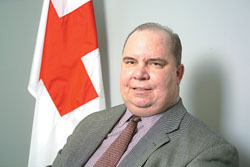
Cuts in funding and competition with worldwide disasters have impacted American Red Cross of Rhode Island, says CEO Daniel S. Samborn.
Daniel S. Samborn
Position: Chief executive officer, American Red Cross of Rhode Island
Building a Strong Data Foundation in the Age of AI
Artificial intelligence (AI) has become a key priority in the boardroom and across management —…
Learn More
Background: A Red Cross veteran with 20 years in the organization, Samborn took over Sept. 7 as CEO of the Rhode Island chapter. Before this, he had worked for several Red Cross chapters in Florida and, most recently, served as director of development/marketing and communications for the Charlotte, N.C., chapter. Samborn received the national fund-raiser of the year award in 2000. Before joining the Red Cross, Samborn worked 10 years as a fire department captain in charge of training at the Jetport in Ft. Myers, Fla.
Education: Bachelor’s degree in fire administration from Edison College, Ft. Myers, Fla.
Residence: Barrington
Age: 46
When, earlier this year, the United Way announced it would only give $100,000 to the local Red Cross chapter for the next 12 months, rather than the $600,000 it had requested (and roughly $265,000 it got last year), it was a doubly hard blow: Not only did it slash the chapter’s budget for disaster relief, a central part of its mission, but it came just as the Red Cross was preparing to expand its work in several areas.
PBN: You’ve worked for Red Cross chapters in Florida and North Carolina. What’s Rhode Island like in comparison? I’ve heard, for example, we have more fires.
SAMBORN: You sure do. Rhode Island being a little bit more than a million population, there’s a lot of cities that fall into that, but you have more than double the fires than most the places I’ve seen. For example in Charlotte, we had less than 200 a year, and here we have about 400. I think it has to do with the Northeast, where you have three families living in a dwelling. In a lot of other areas, if you had a fire it would only be one family. If you have a fire in a three- or four-unit apartment, chances are you’re going to have four families you have to help out.
PBN: The Red Cross has always been involved in emergency response. How has your role changed since Sept. 11?
SAMBORN: Sept. 11 has a lot to do with how we look at preparedness today. Preparedness was a word that few people could spell at that point in time, but it’s a very common term now. We’re going to launch something this fall called Prepare Rhode Island. We’re going to ask every family to make a plan – a disaster, emergency plan – and build a kit, and get trained.
PBN: Is this national or local?
SAMBORN: Local. National has some initiatives out there, but we’re trying to make it more personal for the people of this state. … We’ve also got a 10-year vision that we’re going to have someone in everybody’s family trained in first aid or CPR.
PBN: Do you have any sense of how many people in Rhode Island know CPR now?
SAMBORN: From our training, we know of about 30,000. (To have one in each family), it would be around 300,000 or 400,000.
PBN: Your budget is about $1.7 million?
SAMBORN: A little over $1.7 million. It all comes from individuals, corporations, foundations and some from the United Way.
PBN: A lot less from the United Way now. How big a hit was that for you?
SAMBORN: It was huge. I was new on the job, and it came at a time when fire season was at its peak, monies were being diverted to tsunami victims that people would’ve given locally, but that had everybody’s heart. War – our caseload for dealing with military families has more than doubled. And then you had the hit from the United Way. It sort of created the perfect storm.
PBN: How much support do you get from businesses?
SAMBORN: We get corporate dollars through most of our events. We have four events a year. The golf tournament (May 2, at Tournament Players Club Boston) is new. I think that’s going to be our signature event.
PBN: You don’t get money from the national Red Cross?
SAMBORN: No, the biggest support we get from our national organization is in disaster response. If there’s a disaster in Rhode Island that’s bigger than we can take care of, both in financial resources and on the human side, our national kicks in. The hurricanes last fall – that was the national organization paying for that.
PBN: Part of what happened to you with the United Way was a matter of competing with other nonprofits in the state. To what extent do we have nonprofits here overlapping and competing for the same funds?
SAMBORN: There is quite a bit of duplication: organizations that deal with the homeless, food banking, AIDS, so there’s a competitive process, that’s for sure. Nobody does what the Red Cross does, though. We’re unduplicated. …
PBN: How do you expect to deal with your budget problems?
SAMBORN: We’re going to recover. We’re just getting the word out more and more. We’re trying to localize our message more and more, get away from national and international scenes and really tell Rhode Islanders what we’re doing here. We’re going after some new sources of dollars that we’ve never gone for before…
PBN: Such as?
SAMBORN: The General Assembly. We’re going to ask for $200,000. We’re also going to businesses that have not supported us in the past, and individuals. And we’re asking those who have supported us in the past to make a larger gift. All of that together, hopefully, will make up the shortfall. It’s not an option for us to cut services. We have to be there when the fire department calls us.