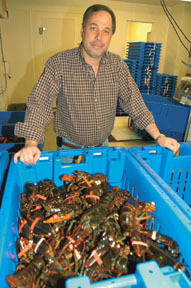
has lost business due to the dwindling
lobster population.
It’s shaping up to be another rough year for Rhode Island’s lobster fleet.
The industry has been in decline for the last three years, as the lobster population in southern New England has been in free fall, according to fisheries regulators.
In February, the Washington, D.C.-based Atlantic States Marine Fisheries Commission reported that lobster populations off Rhode Island and Massachusetts have “dropped substantially” in recent years.
Your Business Has Gone Global. Has Your Insurance?
A decade ago, “doing business internationally” was mostly a large-company concern. Today, a manufacturer in…
Learn More
Although explanations for the collapse vary, the most commonly cited culprits include overfishing, disease and warmer water temperatures.
“All indications are the (lobster) resource is in trouble, and the situation is getting worse,” said Bob Ballou, chief of staff of the Rhode Island Department of Environmental Management.
The decline already has decimated the state’s lobster industry. Landings in Rhode Island have plummeted from a peak of 8.1 million pounds in 1999, with a value of nearly $32 million, to 4.3 million pounds and a value of $17.9 million in 2001. (Figures for 2002 will be available later this month).
Now, new size restrictions being put in place to help regenerate the immature lobster population will cut the industry’s take even more.
“It will hurt us for sure,” said Rhode Island Lobstermen’s Association President Michael Marchetti, who, like most Rhode Island lobstermen, works out of Point Judith. “This has the potential of being a very difficult year for us.”
In March, the commission increased the minimum size for lobsters in what’s known as “Area 2,” which encompasses the waters from the tip of Long Island to southern Cape Cod, including roughly 30 miles off the coast of Rhode Island and southern Massachusetts. Another increase will take effect in July.
Combined, the two gauge increases will boost the minimum size just 1/16th of an inch, to 3 and 3/8 inches. But that could have a big impact on lobster harvests.
Research indicates that 26 percent of Area 2 lobsters that would have been legal before the increases now will have to be tossed back. (The commission is planning further conservation measures for the area in 2004).
The lobster industry largely agreed to the changes as a painful necessity. But the regulations already have wrought inadvertent problems for both fishermen and lobster dealers.
The allowable catch size for what’s known as “Area 3,” the vast swath of deep ocean that runs from the Carolinas up to Maine, remains unchanged. Boats in that area now are able to keep some lobsters that boats fishing the near-shore waters of Rhode Island and southeastern Massachusetts must toss back.
And the law prohibits even the possession of the smaller lobsters in Area 2. The result: Many lobster boats can legally trap lobsters in the deeper waters of Area 3, but it’s illegal to land them here. The discrepancy has prompted some boats to land their catches at ports in other states.
That has created perhaps an even bigger problem for Rhode Island’s lobster dealers.
“Dealers have been losing business because these lobsters are going elsewhere,” said Bob Ballou, chief of staff at DEM.
Kevin B. Bates, managing partner at Ocean State Lobster, a dealer in Point Judith, said two of his seven suppliers that fish Area 3 have started landing their catches at ports in Connecticut and New York.
“With all these offshore boats talking about leaving, I had been looking for real estate in Connecticut,” Bates said.
But emergency regulations filed by DEM earlier this month have eased the situation, Bates said.
Fishermen who ply the deeper waters of Area 3 now can apply for an exemption that allows them to land smaller lobsters in Rhode Island. Regulators said they hope the move will keep offshore lobster boats from bolting for ports in other states.
But that wasn’t the end of Bates’ problems.
Rhode Island law also prohibits dealers from importing lobsters that don’t meet the state’s size requirements – even if they were caught legally elsewhere. So, after the size requirements changed in March, dealers taking imports suddenly found themselves in violation.
Bates still was able to import lobsters from Maine or Canada – but only after paying an extra 25 cents per pound for exporters to weed out the lobsters that don’t meet Rhode Island’s size minimum.
“Economically it was destroying us,” Bates said.
Now, dealers can apply to DEM for an exemption that allows them to import the smaller lobsters, as long as they keep separate tanks for lobsters that don’t meet Rhode Island’s minimum size. Dealers also must keep diligent records that show where the crustaceans were caught.
“DEM did a fabulous job on this,” Bates said of the exemption. “It basically has saved three lobster companies from leaving the state.”
Bates says most of the offshore boats that supply him also have received exemptions to land their hauls in Rhode Island. Ocean State Lobster, which has 120,000 gallons of refrigerated seawater with the capacity to hold 50,000 pounds of lobster, exports most of its product to Europe, Asia and locations on the East and West coasts.
Even without the recent headaches, the gradual depletion of the local lobster population has eroded the bottom lines of Rhode Island lobster dealers.
Bates said his business has dropped by one-third in recent years because local lobster landings have dropped off. He is now forced to import 50 percent of his product from Maine and Canada, which has driven up costs.
And dealers have not been able to make up for the local shortfall by raising prices, Bates said, because ample supply remains in Maine, Nova Scotia and elsewhere.
“Rhode Island is losing market share, and Maine is picking it up,” Bates said.
Rhode Island’s $17.9-million lobster industry is dwarfed by Maine’s, which took in a record 57.2 million pounds with a value of $188.5 million last year.
There’s no telling whether the new size limits will help regenerate the dwindling lobster population in southern New England. In the meantime, though, it will take a toll on area lobster boats, Marchetti said.
“Guys are still kind of scratching out a living, but that’s about it,” said
Marchetti. “Some of the marginal operators will be going away.”
For the complete current issue, visit our subscription Web site, or call (401) 273-2201, ext. 227 or 234.