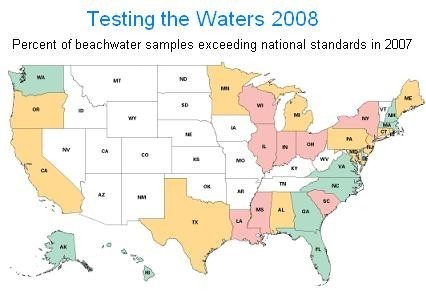
NEW YORK – Popular beaches in Rhode Island and Connecticut exceeded federal pollution standards in 5 to 10 percent of testing last summer, while Massachusetts beaches exceeded standards less than 5 percent of the time, the Natural Resources Defense Council says in its latest report.
“Testing the Waters 2008” – the nonprofit’s annual survey of water quality and public notification – notes that U.S. beach closings and advisories in 2007 hit their second-highest level in the report’s 18 years.
“Aging and poorly designed sewage and stormwater systems hold much of the blame for beachwater pollution,” the NRDC said.
“The number of closing and advisory days due to sewage spills and overflows more than tripled” compared with 2006, to 4,097 last year, “but the largest known source of pollution continues to be contamination from stormwater, which caused more than 10,000 closing and advisory days in 2007,” the nonprofit said. “Unknown sources of pollution caused more than 8,000 closing and advisory days.”
In its state-by-state Beach Rating Table and Beachgoers’ Water Quality Map, the report gives specific data for several Rhode Island beaches:
• Goddard Memorial State Park in Warwick, which got two stars, one for 2007 water quality that “rarely, if ever,” violated national standards; and another for testing frequency, for thrice-weekly testing that exceeded the federal BEACH Act’s once-a-week minimum recommendation for popular and oft-polluted beaches. Contamination at the park exceeded federal standards 3 percent of the time in 2007, 9 percent of the time in 2006 and 12 percent in 2005, the report said.
• Narragansett Town Beach got one star, for 2007 water quality. In testing three times per month, pollution there never exceeded the federal standard last summer or in 2005, although it exceeded the standard 6 percent of the time in the locally problematic summer of 2006.
• The north and south stretches of Scarborough State Beach, which got one star apiece for their twice-weekly frequency of testing last year. The northern portion of the beach violated federal standards in 12 percent of the 2007 tests, 11 percent of 2006 testing and 9 percent in 2005; the southern portion violated standards 10 percent of the time in 2007 and 2005, and 12 percent in 2006.
Sixty-eight beaches statewide are the subject of regular monitoring – at intervals of three times per week, once per week, three times per month and once per month, depending on the beach – according to data compiled by Gannett News Service in cooperation with the NRDC. To notify the public of any problems, the R.I. Department of Health relies on signs, a telephone hotline, e-mail, news releases and its Web site.
Ocean State beach “closings and advisories lasting six consecutive weeks or less decreased 66 percent – to 86 days in 2007 from 256 days in 2006,” the NRDC found, as the “percent of samples exceeding the standard decreased to 8 percent in 2007 from 12 percent in 2006.”
Meanwhile, the NRDC report said, “outdated science and monitoring methods … leave beachgoers vulnerable to a range of waterborne illnesses such as gastroenteritis, dysentery and hepatitis along with respiratory ailments and other serious health problems.”
The U.S. Centers for Disease Control and Prevention “have concluded that the incidence of infections associated with recreational water use has steadily increased over the past several decades,” the report continued. “With the population in U.S. coastal areas growing, we can expect to see more Americans getting sick until the sources of beachwater contamination are addressed.”
The impact of such pollution goes beyond public health, the nonprofit noted. “Polluted beaches also have a serious impact on coastal economies that depend on beaches for tourism revenue. Without a commitment to renewing the health of our coastal waters we will put at risk the long-term health of our coastal economies.”
The NRDC called upon the federal government and its U.S. Environmental Protection Agency to establish stricter regulations.
The National Resources Defense Council is an environmental action group with 1.2 million members nationwide “and online activists with the courtroom clout and expertise of more than 350 lawyers, scientists and other professionals.” Additional information – including the full NRDC report “Testing the Waters 2008” – is available at www.nrdc.org.
Information about the water quality at local beaches is available from the R.I. Department of Health at www.RIbeaches.org or by calling 222-2751.