Gov. Donald L. Carcieri is eying state aid to cities and towns – already cut by $12.5 million in the 2008 supplemental budget – for further reductions next fiscal year to close a bigger-than-projected deficit.
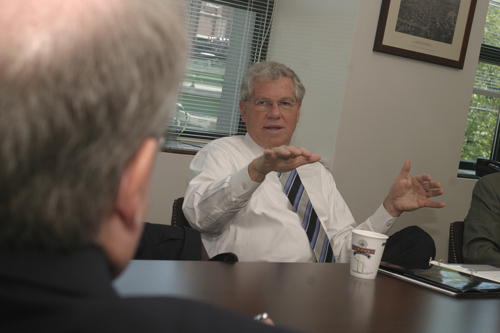
In an interview with Providence Business News’ editorial board last week, Carcieri said he is proposing that legislators cut local aid now that state budget analysts have concluded that the shortfall for the year beginning in July would be as much as $48 million larger than initially projected because of lagging tax collections for the first 10 months of fiscal 2008. (READ MORE about the state’s revised revenue projections.)
The governor acknowledged that his recommendation will be a “hot-button issue” for legislators, particularly because it comes just a few weeks after the R.I. General Assembly approved a supplemental budget to close a $168 million deficit for the current year that was largely unchanged from Carcieri’s proposal. (READ MORE) The supplement package included $12.5 million worth of cuts in aid to municipalities, a mid-year move proposed by Carcieri that drew a chorus of protests from local leaders across the state.
“That was the hardest vote for [legislators] because they didn’t want to go back to their districts and listen to the town councils and the school committees saying, ‘You hosed us,’” the governor said last week.
Now Carcieri wants legislators to do it again.
The governor had submitted a $6.89 billion 2009 budget plan in February that addressed a then-projected $384 million deficit without raising major taxes, and it kept aid to local communities at the same level as this year’s supplement package.
But the additional $48 million shortfall had Carcieri changing course last week.
Although still determined to hold the line on taxes, he told PBN that he is proposing the aid be reduced by $14 million, or more, as one component of a balancing-the-budget proposal.
Carcieri didn’t expect the news to go over well in the General Assembly, where the leadership has generally supported the Carcieri administration’s efforts to avoid tax increases.
“This will be the area where we will have the bitterest disagreement,” the governor said. “It’s not going to be an easy sell.”
Through a spokeman, House Finance Committee Chairman Steven M. Costantino, D-Providence, declined to comment on Carcieri’s proposal, saying that the General Assembly is working with the governor’s office to develop a solution.
“The governor is welcome to submit a revised budget, but right now every item is on the table,” said Larry Berman, spokesman for House Speaker William J. Murphy, D-West Warwick.
The idea of cutting aid to communities certainly won’t be popular among local leaders.
“What they’re doing is piling on to an existing tax, that being the property tax,” said Pawtucket Mayor James E. Doyle, who last week proposed a city budget that would raise residential property taxes 2.9 percent and was contingent on obtaining significant concessions from city workers.
City officials said this year’s supplemental state budget cut $1.4 million in aid to Pawtucket. Doyle’s budget proposal assumed the city would be level-funded.
“If the governor is our father and the legislature is our mother, what they’ve done is created some orphans because we have nobody out there to support us,” said Doyle, who is also president of the Rhode Island League of Cities and Towns.
How else can the state close that additional $48 million shortfall?
Carcieri said the state could see some savings by examining when and how it borrows money for the financing the state’s historic tax credit program. He couldn’t specify the amount of those savings last week.
Also, the governor is hopeful that further reductions of the state’s 15,000-member work force will yield more results.
The Carcieri administration is on track to cut 1,000 jobs by July through layoffs, retirements and eliminating vacant jobs. But changes to the health insurance coverage for retirees could persuade many more to retire soon.
While up to 3,000 workers are eligible for retirement, it’s still unclear who will leave. Carcieri said his
initial budget proposal assumed 200 to 300 retirements next year. “It’s very possible 1,000 out of the 3,000 could retire,” he said last week.
Carcieri said he wouldn’t recommend any future cuts in the area of human services, where reductions have already spurred a backlash from advocacy groups. “There were some tough cuts there, tough decisions,” he said. “We can’t do much more.”
The governor noted that legislators have earmarked additional revenue that may be gained from allowing 24-hour gambling on weekends at Twin River and Newport Grand – estimated to be $14 million – for state aid to education.
“I level-funded the school aid, so if they’re going to take $14 million in, then we should be reducing the offset out of the general revenue,” he said.
Carcieri said reducing local aid would serve two purposes: shrinking the projected shortfall and sending a message that local communities need to take cost-cutting seriously.
“They need to do more of the same thing we’re doing at the state level,” he said. “We’ve got to get these cities and towns to be serious about how they’re spending their money.”
Carcieri pointed to an offer earlier this month by UnitedHealthcare of New England in which the company would reduce its rates if a certain number of municipalities joined the state’s health plan. (READ MORE)
If all Rhode Island cities and towns were to participate, the governor said, the savings could be as much as $20 million for those communities. But few municipalities have signed on so far.
“We’ve got to force that kind of action,” Carcieri said. “Why have the taxpayers of this state giving money to the cities and towns when all they’re doing is giving it to [an insurance] provider?”
Daniel L. Beardsley Jr., executive director of the Rhode Island League of Cities and Towns, insisted that communities have done all they can to cut spending.
“What the governor doesn’t understand is that cities and towns have been doing for decades what the state is attempting to do today,” he said.
Many communities are investigating the UnitedHealthcare option, Beardsley added, and others have determined that it would not be cheaper for them to participate.
In other budget matters, Carcieri told PBN that he’s conceding that his plan to have all state employees take off six unpaid days before July 1 – a key part of his supplement budget package – won’t happen this fiscal year after negotiations failed. “They’re digging in,” Carcieri said. “They’re saying no.”
Officials had said the furlough plan would have saved as much as $14 million, but the governor said he was confident the 2008 budget will be balanced by the end of the fiscal year, June 30.
Still, talks are continuing with the unions because a furlough plan is also in the 2009 budget proposal. Carcieri said his 2009 budget proposal assumes $60 million in savings from unpaid work furloughs and from state employees paying higher co-payments for health insurance.
With the governor and General Assembly leaders “on the same sheet of music as to what we need out of them, we’re meeting to see if we can get there,” Carcieri said. “We might not be able to.” And if the unions don’t cooperate? “Then my option is another 500 , for example, not that I want to do that,” the governor said. •