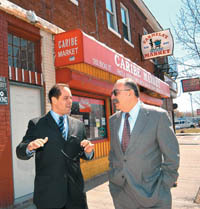
They started small, with ethnic eateries, bodegas, beauty parlors and shipping businesses. But as their numbers have grown, they’ve expanded into bigger storefronts, gone into insurance, finance and real estate, built up a clientele outside their community.
As of 1997, Rhode Island had nearly 2,200 Hispanic-owned firms, employing nearly 2,000 people, with annual receipts of more than $207 million, according to the U.S. Census Bureau. More recent figures aren’t available, but all agree that the numbers have since grown.
A modernized health plan: Supporting cost management and the employee experience.
The Surest health plan came from a group of innovators wondering: What if health care…
Learn More
Armando Ojeda, president and CEO of the U.S. Hispanic Chamber of Commerce, saw it firsthand on a walking tour of Broad Street in Providence last week: a thriving, fast-growing Hispanic business community, revitalizing an area that had been moribund.
Hispanics have long played a major economic role in states like California and Texas, Ojeda said in an interview, but now they’re becoming a force in unexpected new places: Providence, for one, but also Charlotte, N.C., Atlanta, Salt Lake City, even Cheyenne, Wyo.
And while historically, when Hispanics got organized, they rallied around issues such as immigration, education and social services, now they’re promoting business interests as well, Ojeda said. Just since he took office seven months ago, the U.S. Hispanic Chamber of Commerce’s member groups have increased from 132 to 157, he said.
Ojeda came to Providence last week to support one such group, the five-year-old Hispanic American Chamber of Commerce of Rhode Island, which held its annual meeting Tuesday during the 2005 Business Expo. The event drew an array of Hispanic business entrepreneurs as well as top government and economic-development officials.
The group recognized Domestic Bank as corporate leader of the year; José Brito, president of the Southside Merchants Association, as community leader of the year; and Ramaraya Restaurant, owned by Carlos Méndez, as Hispanic business of the year.
But more than just a celebration of Hispanic successes, the event was also meant to rally the troops, to ensure that local entrepreneurs’ burgeoning activism grows stronger and more effective, both at the state level, and as part of a national effort.
“We are growing, and we are visible, and we want to be part of the agenda,” said Chamber founder and president Juana Horton, owner of Horton Interpreting Services, in an interview. “We don’t want to be on the outside looking in.”
Rhode Island’s Hispanic business leaders have “a long way to go” to develop the clout of their counterparts in California or Texas, Horton said, “but as you can see, we’ve made strides” – Rhode Island has its first Hispanic state senator, for example, Juan Pichardo (D-Providence).
About two-thirds of the U.S. Hispanic Chamber’s members are from California and Texas, Ojeda said, but Hispanic business activism is growing across the country.
“The voice of the Hispanic business community is only now emerging and beginning to be heard,” Ojeda said. It’s a good climate for this, he added, because political leaders are more attuned than ever to Hispanics.
The Chamber just had its 15th annual legislative conference, he said, and “it was truly historic,” with two Hispanic Cabinet officials – Atty. Gen. Alberto Gonzales, and Commerce Secretary Carlos Gutiérrez – and two Hispanic U.S. senators – Mel Martínez, a Florida Republican, and Ken Salazar, a Colorado Democrat.
“What we see is, there’s a desire in Washington to hear the voice of Hispanic business, and we’re only now beginning to speak out in a loud and consistent voice,” Ojeda said. “We see quite an openness on both sides of the aisle.”
At the federal level, the Hispanic Chamber is supporting an agenda that includes small-business tax reform, improved access to capital for Hispanic business owners, procurement rules that support minority businesses, more affordable health care – especially through association health plans – and the Central American Free Trade Agreement.
Horton herself travels frequently to Washington and is involved in the national-level efforts. But while some Hispanic business groups are also active in state-level lobbying, for now Horton said her group is allowing the Greater Providence Chamber of Commerce, of which the Hispanic Chamber is a part, to advocate on its behalf.
Horton is promoting Hispanic business interests in other ways, however, such as through the board of Blue Cross & Blue Shield of Rhode Island, of which she is a member, and by helping Brito to develop a small-business center in collaboration with the city of Providence and the Community College of Rhode Island.
Hispanic business groups in some states are doing other things that Ojeda sees as positive. Group purchasing of health insurance – in conjunction with a parent Chamber of commerce or, if the numbers are big enough, among Hispanic businesses alone – can make a big impact on health care affordability, Ojeda said, and at the same time stabilize and strengthen businesses. And in California, Illinois and New York, where Hispanic workers make up a large share of those paying into state pension funds, a new idea has blossomed: getting those funds to invest in Hispanic businesses, putting the dollars back into the community.
Rhode Island’s Hispanic Chamber may still be developing, but it’s on the right track, Ojeda said, strengthened by its relationship with the Greater Providence Chamber and by its ability to collaborate with mainstream businesses, rather than compete with them for resources.
It’s important for Hispanic business groups to retain their own identity, since no one cares more about Hispanic businesses and communities than Hispanics themselves, Ojeda said, but it’s also important to be recognized as a part of the big economic picture.
“My goal is to incorporate Hispanic business into the mainstream of American economic life,” he said. “There’s got to be a recognition that Hispanic business is a segment that’s very energetic, very hard-working, and ready to take the next step economically. And that’s certainly for the benefit of the total community, not just Hispanics.”