Rhode Island met the announcement that New Jersey would withdraw from a regional carbon cap-and-trade program with a yawn.
On May 26, Gov. Chris Christie said the Garden State would leave, by the end of the year, the Regional Greenhouse Gas Initiative, a 10-state program that auctions allowances required to emit carbon dioxide. Christie called the program a “gimmick” that drove up electricity costs and failed to cut greenhouse gas emissions.
A firestorm erupted. Some called Christie’s move the beginning of the end of cap-and-trade programs. Governors in four participating states – including Connecticut and Massachusetts – released statements reaffirming support for the program. So too did New York’s chief energy officer. Some pundits called Christie’s decision a way to curry favor with Republicans in advance of seeking the party’s nomination for president.
In Rhode Island, the response was muted. Gov. Lincoln D. Chafee released no official statement, but through a spokesman said that he remains committed to the program, which held its most recent quarterly auction June 8. Those at the Statehouse and with environmental groups say no one here has latched onto Christie’s argument and campaigned for the Ocean State to follow suit.
“I would be surprised if a lot of my colleagues even know about Gov. Christie’s position,” said Sen. V. Susan Sosnowski, D-South Kingstown, who chairs the Senate Committee on Environment and Agriculture.
Sosnowski said she sensed her colleagues generally supported the program and were bogged down with other issues such as budget discussions. Environmentalists said that they expect neither lawmakers nor the governor to push to leave the regional initiative.
“I think Rhode Islanders know it’s a good thing for the state,” said Kevin Essington, director of government relations and communications for the Nature Conservancy Rhode Island chapter.
Launched in 2007, the initiative, known as RGGI for short, is designed to bring free market principals to an environmental problem. The consortium issues allowances that permit companies that release carbon dioxide, a gas identified by scientists as contributing to global climate change. RGGI sets baseline prices for allowances and emitters purchase them during electronic auctions. Over time the number of allowances shrinks. States are expected to put the money generated by the auctions toward energy-efficiency programs.
In pulling out of the compact, Christie disagreed. He said his staff spent 16 months studying RGGI and “it simply doesn’t work.” The governor said the price of allowances has remained so low – less than $2 a ton – that there is little motivation for polluters to reduce emissions. Citing a state report, Christie said New Jersey had already accomplished the state’s emission-reduction targets set for 2020. The report was conducted before RGGI was implemented.
Tricia Jedele, director of the Conservation Law Foundation’s Rhode Island office, took exception to Christie’s complaints about the low price of allowances.
“That’s like saying so few people vote, why have democracy?” she said. “You don’t back out of something because the price isn’t where it should be.”
Jedele acknowledged, though, that if New Jersey withdraws – some lawmakers have promised to fight the governor’s move – it could drive down allowance prices as fewer power generators participate.
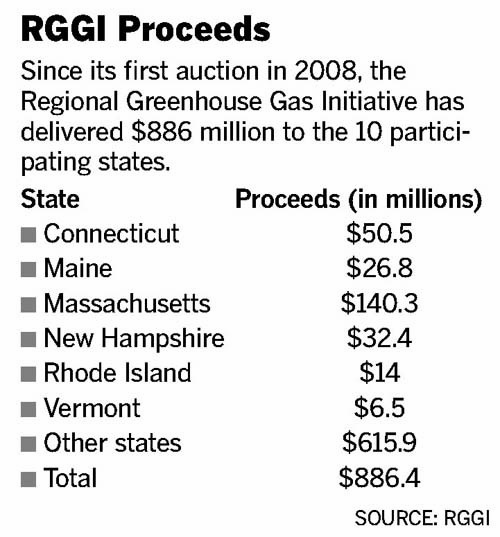
That could translate into less money for states, including Rhode Island, which has received $14 million from the program. Overall, the program has sent $886.4 million to states. Some, like New Jersey, have used the money to cover general government costs. Rhode Island has put the money toward energy efficiency.
The program, however, extends beyond dollars and cents. It’s been held as a national model as the United States debates how to curb greenhouse gas emissions. Bradley Moran, University of Rhode Island oceanography professor, doubts New Jersey’s move will end RGGI. But he does worry about the signal it sends to national policymakers.
“If you can’t make something [like RGGI] work on a regional basis it’s not speaking positively for a national [energy] policy,” he said. •