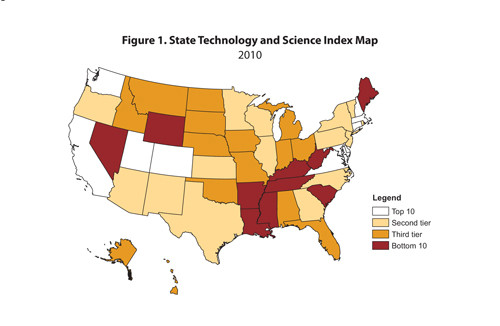
Rhode Island slipped 12 places in the Milken Institute’s 2010 State Technology and Science Index, weighed down by its scores on two indicators: the work force and tech concentration.
“Rhode Island didn’t perform quite as well in the tech work force and the tech-concentration components,” said Ben Yeo, senior research analyst of the economic-research group at the Milken Institute. “That played a considerable role in the decline in Rhode Island’s [22nd-overall] ranking.”
Rhode Island ranked No. 21 on the technology-and-science work force composite index and at No. 34 on the technology-concentration-and-dynamism composite index, two of five major composite indexes which group together 79 different indicators.
Yeo noted that Rhode Island did particularly poorly in the subcategory of life science experts, and said the state could improve its ranking by focusing on that particular area.
He praised the “fairly good success” rate local universities have in attracting National Science Foundation funding.
“Those are the certain things that Rhode Island could perhaps leverage or continue to strengthen to develop further opportunities for growth, while taking into account the challenges on the life science side of things,” he said.
Looming ominously over this year’s index was the Great Recession. The Milken Institute, a Santa Monica, Calif.-based think tank, said that the United States had one of the “most severe” patent dropoffs, 11.4 percent in 2009, while East Asian countries such as China, Singapore, Japan and South Korea recorded gains.
“States must effectively build and leverage their assets to retain human capital that might escape and attract more from abroad,” the Milken Institute said about its 2010 index.
Rhode Island’s best ranking among the five major indexes was in research and development, taking 12th place in 2010 but slipping significantly from previous years. In 2008 and in 2004, the Ocean State took sixth place and fell from the inaugural 2002 index when it debuted in third place.
Since Rhode Island doesn’t have a base of technology-related companies comparable to those of Berkeley and San Francisco, in California, it’s hard for the state to compete.
“What you can do is have a concerted effort to win more grants and have more graduate schools,” Sparkman said.
Sparkman also noted the large drop on the risk-capital and entrepreneurial-infrastructure composite index; Rhode Island plummeted to 28th from 15th in 2008 and third in 2004.
“The Slater Technology Fund [supports] the entrepreneurs that are commercializing this university-based technology so that should be the sweet spot of driving that particular index. When it works, it works really well,” he said.
Speaking on behalf of the R.I. Science and Advisory Council, R.I. Economic Development Corporation Director Keith W. Stokes said “government’s role is to provide the tools and resources within a competitive business climate to support innovation and entrepreneurship as a way to grow the state’s knowledge economy. Rhode Island has made significant gains in recent years.”
And although Rhode Island’s proximity to the shining star of the index, Massachusetts, may overshadow its nascent knowledge economy, that’s not necessarily a bad thing, Yeo said.
“Being close to a vibrant cluster could actually open up many opportunities for growth, for collaborations through various funding opportunities,” he said. •