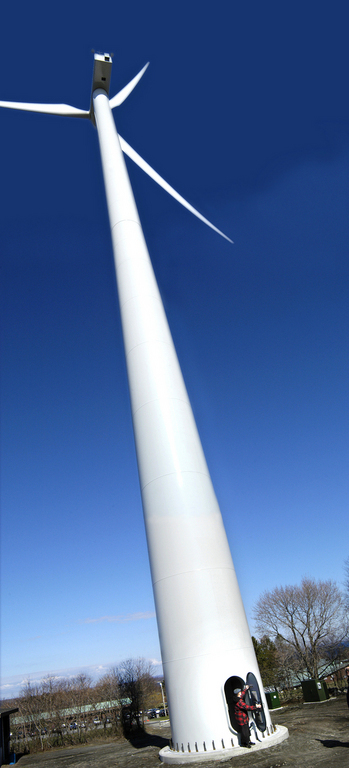
Gov. Donald L. Carcieri’s goal of building a large wind-power project in Rhode Island waters capable of producing 15 percent of the state’s energy needs has not been a breeze for the governor.
A stakeholders group charged with finding a site for a wind energy project in Rhode Island recently concluded its work without making a decision.
The state has no permitting process to approve wind energy proposals such as the one that came in unsolicited in September from a New York energy developer.
And the governor’s plan to create a power authority to oversee a wind-power project and other renewable energy efforts is in limbo – scuttled by the General Assembly before it adjourned in June.
Asked when the state would be ready to permit a private company to build and operate wind turbines in Rhode Island, Andrew Dzykewicz, executive director of the R.I. Office of Energy Resources, replied: “Good question. That’s actually still a little bit up in the air.”
The state was apparently caught off guard when Allco Renewable Energy Group Ltd., an investment bank that specializes in energy projects, submitted a preliminary request to erect 235 to 338 wind turbines in state waters.
Dzykewicz called the proposal unacceptable because Allco wants to sell the electricity it generates in Rhode Island on the open market. Rather, Dzykewicz said he hopes to stabilize electricity prices in Rhode Island by striking a deal with a private developer willing to sell the electricity it generates in Rhode Island exclusively.
The Carcieri administration has been pushing for almost a year to create an independent power authority, which officials say is crucial to reaching such an agreement.
“What the power authority does is enables us to take a lot of risk out of the process and develop a true public-private partnership in this thing,” Dzykewicz said. “I think without it we’ve got to look for a developer that’s going to be willing to do this project the way we’d like to do it.”
But the General Assembly did not act on legislation submitted by the governor that would have created a power authority, primarily over concerns about language in last year’s bill regarding who would pay for the burial of underground lines as part of repairs to the Manchester Street power station in Providence, Dzykewicz said.
The Carcieri administration is still trying to push the power authority bill through this session, but legislators won’t be back until next month.
“I hope it’s going to happen,” Dzykewicz said.
In the meantime, officials from the Office of Energy Resources, the R.I. Department of Environmental Management, the U.S. Army Corps of Engineers and the Coastal Resources Management Council, which regulates the state’s waters, will meet within the next month to start creating a permitting process for wind projects, he said.
Dzykewicz said he did not know when that work would conclude.
The CRMC announced last week it would do a planning study of Rhode Island coastal waters so it can best determine where alternative energy devices should go. Such work would seemingly overlap with an extensive report that Carcieri commissioned, which earlier this year identified 11 possible sites for a wind energy project in the state, including in waters near Block Island, Watch Hill and Little Compton and on land in Little Compton.
Seeking to avoid the types of legal and political battles that have stalled the proposed Cape Wind project in Massachusetts waters, Carcieri assembled a stakeholders group to pick a site for a wind energy project in the state and participate in shaping the project.
The group, which includes business people, environmentalists and community leaders, met four times to choose among 11 potential locations for a wind energy project. Although Oct. 31 was their self-imposed deadline, no decision was made.
Dzykewicz said he is not concerned that the stakeholders failed to pick a location for a project.
“At the end of the process, what the stakeholders said was, ‘There are no show-stoppers on any of the sites,’ ” he said. “So we didn’t eliminate anything. We want to go forward through the design process and through the permitting process with the stakeholders having input along the way.” •