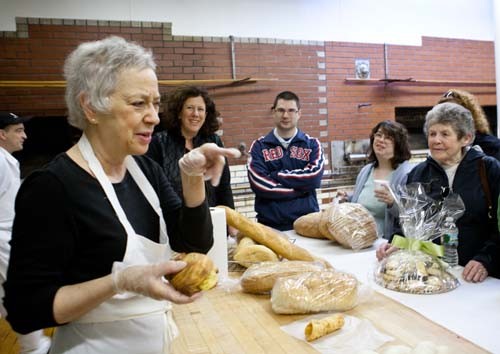
Lois Scialo Ellis, co-owner and co-operator of Scialo Brothers Bakery on Federal Hill in Providence, can remember decades ago when summer was the slowest time at her family business, when the number of customers dwindled to a trickle as temperatures rose.
Those days are long gone.
Today, the old-world bakery on Atwells Avenue – which still uses its original brick ovens dating from 1916 – sees dozens if not hundreds of customers weekly between May and November, many of whom are out-of-town visitors who arrive by bus to sample the cuisine of the capital’s “Little Italy.” Tourist season brings two or three tour buses each week, Ellis said.
“They come from all over New England,” Ellis said of the visitors, and they love to see bakers work their magic in a traditional setting like Scialo’s, where nothing is digitized.
“We have very little machinery,” Ellis said. “Our bread is handmade and all of our decorating, on our cakes and our cookies, is done by hand.”
Ellis and her sister, Carol Scialo Gaeta, took over the bakery started by her father in 1993. It is just one of many places in Rhode Island benefiting from an increased interest in the growing tourism field of culinary travel. As the state – and Providence, in particular – becomes more and more well-known nationally for its food, hungry visitors follow.
In the state, Federal Hill is probably the top destination for tourists who plan vacations around culinary experiences, with Newport second, according to local tourism experts. South County draws folks for its chowder, clam cakes and “stuffies” (stuffed quahogs), “the holy trinity of Rhode Island” food, said Mark Brodeur, state director of tourism, noting that Rhode Island chowder differs from New England (white) or Manhattan (red) because it is made with clear broth.
Ethnic food, from Asian to Hispanic and Portuguese, seems the domain of the Blackstone Valley and some pockets of Providence, such as the West Side and Fox Point.
Buoyed by a steady stream of Johnson & Wales University graduates schooled in the culinary arts, the cuisine in the Ocean State is “world-class,” Brodeur maintained. “Our cuisine is a big draw for our domestic and international tourism markets. It stands out, not just in New England, but in the nation.”
In one of several recent accolades, Travel + Leisure magazine this year ranked Providence third in the United States for its dining experiences, behind only San Francisco and New Orleans. Cable television business channel CNBC in January included the capital in its list of the top 10 “foodie cities” in America, finding that 83.7 percent of its restaurants are locally owned and operated.
Forty percent of dining in Rhode Island is done by tourists, Brodeur said, citing a recent report compiled by the international research firm of IHS Global Insight, based in Englewood, Colo. The same study, Brodeur said, found as much as 70 percent of the dining on Federal Hill can be attributed to out-of-town visitors, depending on the season and day of the week. The state’s last count found 47 “authentic Italian restaurants” on Federal Hill and within one mile of it, according to Brodeur.
Such statistics do not surprise Cindy Salvato.
A native of the Boston area, she founded a business based on the Federal Hill culinary scene, Savoring Rhode Island, about 10 years ago that offers walking tours of Atwells Avenue for aficionados of food and drink.
When she began her business, she offered four walking tours of Federal Hill each year, with each group numbering 14 to 16 people. Now, she averages four tours each month, she said, and schedules private tours on weekdays. She plans to expand by starting a restaurant tour on weekday nights, a venture she said should be ready in about one month. Her walking tours are booked solid through May.
Beginning on Saturday mornings at DePasquale Square on Atwells, Salvato’s tours usually take about three hours and include six stops at such places as Venda Ravioli, Tony’s Colonial Food Store, Café Dolce Vita and Antonelli Poultry Co., where customers can choose live poultry to be slaughtered for them on the spot.
Daniel Gamm, a financial adviser with Ameriprise Financial Inc. in Providence, once or twice a year takes clients on Salvato’s tours as a way to thank them for their business, a course of action he would recommend to others. “People are shocked,” he said, by the variety of food offerings, the history of Federal Hill and the in-depth knowledge that merchants are so ready to share. “People love the tour,” he said.
The Travel Industry Association in 2007 released the results of what it said was a “first-of-its-kind” survey on culinary travel, finding that 27 million travelers, or 17 percent of the American leisure market, engaged in culinary or wine-related trips in the previous three years. “These travelers are younger, more affluent and better educated than nonculinary travelers,” the association said, and on average, they spend $1,194 per trip, with 36 percent, or $425 of that sum, devoted to food-related attractions.
Since then, however, the recession intervened.
Chris Donnelly, owner and operator of Sugar Tours and Creative Culinary Tours based in West Dover, Vt., said culinary travel was “one of the hottest-growing segments in tourism” until the recession caused business to level off.
In the tour business for 25 years, Donnelly works with the state tourism division to routinely bring his culinary tours to Rhode Island. He’s been trying to interest a Boston-based company that provides theme-based tours for senior citizens on starting a five-day program devoted only to Rhode Island cuisine, but so far has not been successful. He’s convinced the recessionary lull is temporary. The culinary-travel niche “is still growing,” Donnelly said. “People see it as a specialty market and that will continue,” he said. “It will take off again, when the younger baby boomers reach retirement in three or four years.” •