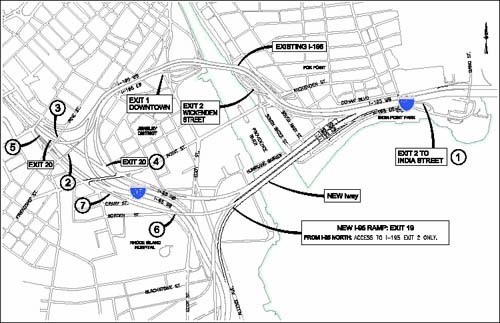
The R.I. Department of Transportation this week will close the temporary Gano Street exit ramp on the Interstate 195 East relocation project, dubbed the “Iway,” and reopen Exit 2, to India Street, according to DOT acting Chief Engineer Kazem Farhoumand.
That’s the first of four major changes to traffic patterns that will take effect this year due to the ongoing highway project.
Later this spring, the Friendship Street onramp to I-195 East will close and the Pine Street overpass will be demolished. Then, during early summer, Exit 20 – from I-95 North to the old section of I-195 East – will close.
The DOT discussed the changes at a work session held by The Providence Foundation at the Greater Providence Chamber of Commerce’s Exchange Terrace office last week. Some of the estimated 20 attendees raised concerns, including gripes about an Allens Avenue detour, while others offered suggestions.
The prospective closure of Exit 20 raised concerns about commuting to the Jewelry and Courthouse districts.
While the DOT suggested that traffic will use I-95 North’s Thurbers Avenue exit – Exit 18 – and drive north on Allens Avenue to Eddy Street, those at the work session weren’t convinced.
“I’m curious how you think you can put more traffic on Allens Avenue northbound,” said Richard Jaffe of the Jewelry District Association, adding that the road is already congested. “It doesn’t work now. How are you going to put more traffic on it and make it work? Paving it is not going to help.”
Farhoumand said many detour problems work themselves out over a few days or weeks as commuters decide which new route works best. And the intersection of Eddy and Point streets will be paved and traffic lights will be reworked to accommodate the new traffic, he said. But he warned that “if everybody keeps doing what they’re doing, we are going to have some problems.”
Aram G. Garabedian, president of Providence’s Bliss Properties, added that many commuters will likely ignore the detour, causing traffic jams north of Exit 18 on I-95.
Farhoumand said there are efforts under way to increase carpooling and use of Rhode Island Public Transit Authority buses. Also, some businesses might want to stagger their employees’ start and end times to reduce traffic, he suggested.
Charles Meyers, president of Metropark Ltd., which runs more than 10 parking lots around downtown, was skeptical that any commuter or business would make such changes. “As far as carpools – forget it. I can count on one hand the amount of customers I have that come with more than one person in a car,” he said.
Martha Sheridan, president and CEO of the Providence Warwick Convention & Visitors Bureau, said that the issue with detours doesn’t only apply to commuters and those working in the city. She said it will also be problematic for visitors, including the large crowds that flock to Brown University and R.I. School of Design graduations in May.
“This is a constituency that is not going to know anything about Providence until the week that they’re coming,” she said, adding that she wondered whether MapQuest or Google Maps would be informed of the changes.
While the DOT is holding back details on changes that will affect commuters during 2009, there was a consensus last week among attendees that the changes this year and the next will be the most significant so far for the $600 million Iway project, which is set to be completed in 2012.
“I think the upcoming phase of the Iway project will probably have more detours and closings than the rest of the project to date,” said Daniel Baudouin, executive director of The Providence Foundation.
Brown University Transportation Manager Carleia Lighty said her department will be relying on DOT for updates so she can plan bus and delivery routes.
Farhoumand said the color-coded detour-route maps will be posted on the DOT Web site and that businesses that want simplified maps for their areas can contact the DOT. •