The healing power of art is not a new concept. Since art first became incorporated into hospice care in the 1960s, several hospitals have hired artists trained as art therapists to provide a creative outlet for patients.
An interdisciplinary “Art as a Source of Healing” course taught at the Rhode Island School of Design is adding more artists-turned-art-therapists to the work force by inspiring art students to pursue further study in that field. It even has turned some pre-med Brown University students into psychology majors.
But more than that, the elective course represents a powerful tool for personal growth, said Melinda Bridgman, the RISD fine arts critic who teaches the course. Both the students and the Bradley Hospital patients with whom they have worked through the course over the past seven years have experienced more enriching lives as a result, she added.
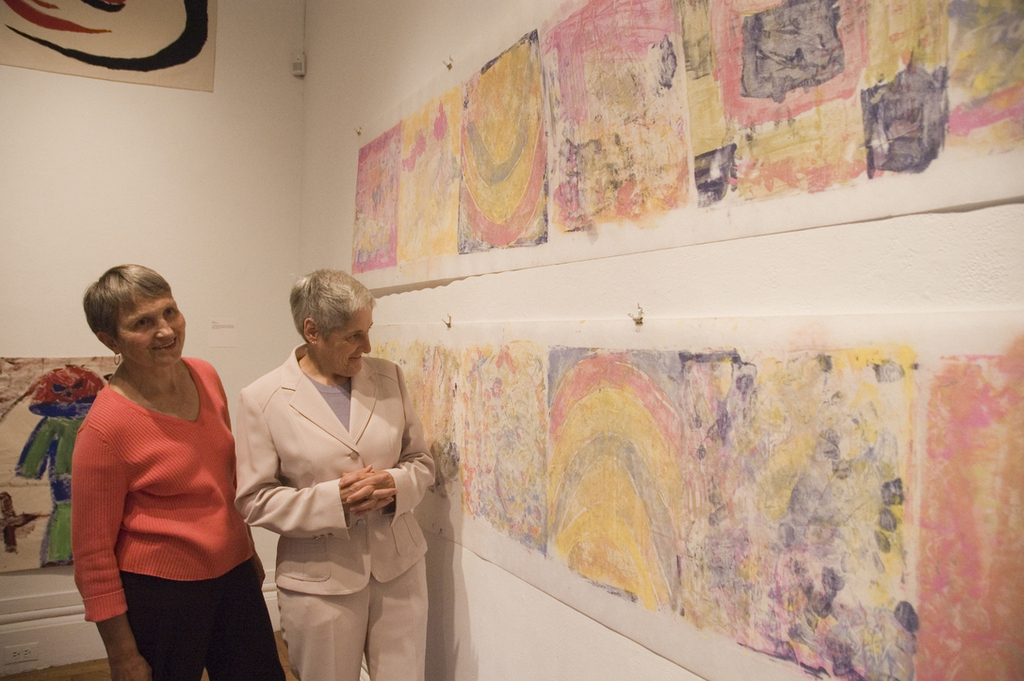
Now an exhibit in RISD’s Woods-Gerry Gallery is giving the public an opportunity to share in the personal growth of the students and patients.
Titled “Art as a Source of Healing: A Retrospective” and on display through Sept. 30, the exhibit includes students’ collaborative works with patients and students’ individual works in response to the experience of working with emotionally and behaviorally challenged children and young adults at Bradley, the state’s only pediatric psychiatric hospital.
Since its inception, the course has grown in intensity, Bridgman said. Students and patients are working on more challenging projects and sharing more intimate relationships that are inspiring RISD and Brown students on deeper levels.
One RISD student decided it was time to deal with her own experiences with sexual abuse after spending time with an 8-year-old girl dealing with the same problem.
“How powerful is that?” said Margaret Paccione-Dyszlewski, director of residential programs for children and adolescents at Bradley Hospital, which co-sponsors the course.
Improvements have been seen in patients as well.
Bridgman recalls an autistic girl who has participated in at least three semesters of the course, which is taught in the fall and spring. In the beginning the girl was reclusive, Bridgman said. The girl would go sit in a corner when students entered the room.
Bridgman said the same girl now asks her when the next group of students is coming to the hospital, and she has become more friendly and sociable with the students.
For the high-functioning, developmentally delayed young adults aged 16 to 22 who have emotional and/or behavioral problems, the benefits of the course have to do with socialization, Paccione-Dyszlewski said.
“They love coming to RISD to work on projects,” she said. “As their relationships [with the students] grow, they take more risks … they can go to social places.”
For the younger patients aged 4 to 12 who have emotional and/or behavioral problems that prevent them from living safely at home, the benefits lie more in building their resiliency, or inner strength, which translates into higher self esteem and improved self-image, Paccione-Dyszlewski said.
“Students are also building resiliency,” she said. “The students and patients feed off each other.”
Bridgman added: “It gives [students] an opportunity to see other ways they can give to humanity.”
During the class, students have to figure out how to take all their training and break it down into a project that is applicable for the patients, she said. And they learn they first have to build relationships with the patients or it just doesn’t work.
Bridgman recalls some students who have taken that relationship training into their professional work post-graduation. A RISD graduate who does portrait painting in New York City uses the skill to build relationships with the subjects of her portraits, Bridgman said.
In addition, some students have graduated to take jobs at Bradley Hospital, Paccione-Dyszlewski said. And several students continue their relationships with patients by volunteering at the hospital.
The course, she said, “really has an impact.” •