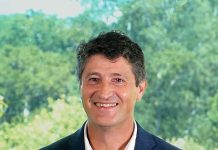
Donald J. Farish, inaugurated Oct. 13 as the 10th president of Roger Williams University, is in the process of forging a shared vision for the 55-year-old, private school along the waterfront in Bristol. He’d like to see an MBA program established, for instance, and increased use of the downtown Providence continuing education program.
He began his new job in June, coming from Rowan University in Glassboro, N.J., where he served as president for 13 years.
An educator, attorney and a scientist, he received his doctorate in biology from Harvard University and his law degree from the University of Missouri. His first administrative job was assistant/associate dean at the University of Rhode Island, where he served from 1979 to 1983. He later worked in California for 15 years before taking on the Rowan presidency.
He believes a university, whether public or private, has a responsibility to society and the community.
All colleges and universities in Rhode Island should work together on closing the skills gap in the state, he said. And in Bristol, he is working with town officials on several projects, including conversion of the former Wally School into an arts center and preservation of an historic building at Colt State Park.
PBN: What do you see as your top priority as president of Roger Williams University?
FARISH: Developing a shared vision for our future. There are wonderful individual programs [at RWU], but I don’t have the sense that we share any collective vision of where we’re trying to go as an institution – and that’s a leadership responsibility.
So, what I’m doing is just having lots of different kinds of conversations with the faculty and staff and, of course, the administrators. … I’m constantly trying to ascertain what it is that people think and then convert what I’m hearing into some type of more-general concept for the future of the university that we can hopefully all agree on and have a sense of direction for what we’re doing.
Rhode Island's Market Has Changed. Developers, Builders, Investors and Sellers Must Change With It.
By Emilio DiSpirito IV License Partner | Engel & Völkers Oceanside Leader | The DiSpirito…
Learn More
PBN: What changes are you planning to bring to the university? PBN: What can you do to brand Roger Williams University to make it stand out? PBN: Especially at the School of Business, are there any new or innovative programs you’re considering? PBN: Any changes planned at the law school? PBN: One of the greatest challenges facing Rhode Island is its high rate of unemployment. What can the university do to better train our work force?
FARISH: The specific changes from a programmatic standpoint will emerge from the discussions we’re having right now on a sense of strategic direction for the institution. One thing I can say that I do feel we need to do is, we need to develop among faculty, staff and students a campus that is more clearly reflective of the diversity of our society. We are still not reflective even of the diversity in Rhode Island.
FARISH: We need to say: “Look, we are at heart a liberal arts college, but we have a good many professional programs that one doesn’t always see at a liberal arts college.”
We have real strength in areas such as engineering, architecture, the law school, of course … We have a business program, we have marine sciences. What we’re saying to students is: “If you want to major in one of these applied fields, whether it’s business or engineering or architecture, you can do so at what is otherwise a small, liberal arts college and not feel that you have to go to a large, impersonal university in order to get that kind of specialized education.”
We’re doing very well as far as enrollment is concerned right now [at 4,715 for both undergraduate and graduate students, not including 650 undergraduate continuing education students]. … We actually exceeded our enrollment target this year. … So, I think the word is getting out about Roger Williams.
FARISH: We are. In fact, I just met [recently] with the dean of the School of Business, Jerry Dauterive, and said, “I really would like you to take a run at developing a program on entrepreneurship.”
We have someone that I’ve met who may be a prospective donor for such a program, to help get it off the ground. That’s something I helped oversee [at Rowan] that was very successful and it would be here as well.
I’ve asked the dean also to take a long, hard look at an MBA program because the idea of combining a law school degree with an MBA is a very attractive educational package and I think we could pull that off quite nicely. … It is very likely we could have an MBA program probably two years from now. … We are doing a needs assessment.
FARISH: Yes. [What I’ve talked to Dean David Logan about] is how to address some of the ideas that I see as possibilities. The law school here has, in my view, for too long been programmatically isolated from the rest of the university. It’s almost like a stand-alone, independent program and to some degree it was designed exactly in that way. … But from the standpoint of joint programs with other aspects of the university, we haven’t really developed that as much as I think we could and should.
FARISH: I absolutely do see a role … This is central to why I am as passionate as I am about the field of higher education. I was the first in my family to go to college and it was a complete game-change as far as my life was concerned. …
A recent report by the Brookings Institution studied 100 American urban areas, asking about the skills gap. … The cities were ranked, and Boston was No. 2, meaning that the skills gap is very slight and that’s one of the reasons Boston has low unemployment, relatively speaking. Providence ranks No. 41. Here we are 40 miles away from Boston, but we have a very substantial skills gap.
All of the universities and colleges, in my view, public or private, are part of the social fabric of our country and they are all working, or should be, in the public interest. We all have a responsibility to do what we can to help close the skills gap.
At Roger Williams, we have a [continuing education] program in downtown Providence, which I want to breathe a lot of new life into. It’s been there, but not doing a whole lot in recent years, and I want to ramp that up substantially. … And we are increasingly doing this work online, so there are opportunities for people who are not necessarily living and working in downtown Providence. … We’ve been approached by a couple of corporations – whom I don’t want to identify right now because we haven’t signed contracts yet – to provide skill sets to their existing workers. …
If we [the colleges and universities in the state] put our collective energies into taking on the problem of the skills gap in Rhode Island, we could do a great deal of good for the state. … We could do it in a way that is collegial and focused especially on this issue: getting the people of Rhode Island back to work. •