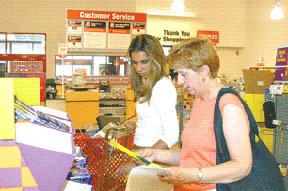
supplies at a Staples in Smithfield.
The local retail industry is expecting back-to-school business to be more brisk than last year, with a rebounding economy spurring parents and teens to spend more dollars at area stores.
Families with school-aged children will spend an average of $450.76 on back-to-school items, up from $441.60 in 2002, according to the findings of a new survey by the National Retail Federation. Nationwide, spending for the back-to-school season is expected to pump $14.1 billion into the economy, with kids adding another $750 million to the total, according to the study.
The average consumer expects to spend $206.24 on clothing, $84.44 on shoes, $74.04 on school supplies and $86.03 on electronics and computer-related equipment, according to the National Retail Federation’s 2003 Back-to-School Consumer Intentions and Actions Survey.
For Leaders Who Don't Have Time to Get Sick
Top performers guard their calendars, delegate relentlessly and optimize every hour of the day. Health,…
Learn More
Ninety-five percent of families with school-aged children intend to purchase clothes, shoes and school supplies this fall, and almost 46 percent of consumers said they plan to buy electronics or computer-related equipment.
“People are spending more this year because, for the first time in a while, many different economic indicators are falling into place,” said Ellen Tolley, a spokeswoman for the NRF. “We’re seeing record low interest rates, higher levels of mortgage refinancing, which leads to more discretionary income. Certainly the tax credit checks and the tax cut will benefit retailers, as well as an improvement in the stock market.”
From backpacks to blue jeans and coats to computers, retailers are set to benefit from sales of a wide variety of back-to-school merchandise. The NRF is projecting a 4.5 percent growth in sales at general merchandise stores, apparel stores, furniture and home furnishings stores, electronics and appliance stores, and sporting goods, hobby, book and music stores in the second half of 2003, up from 2.2 percent in the first half.
Just more than 78 percent of consumers said they would do their back-to-school shopping at discount stores such as Wal-Mart and Target, and local discount stores are already experiencing an increase in business.
“Typically, this week is a very busy week for people to come in. Traffic has definitely picked up,” Michelle Stevens, an assistant manager at a Target store on Bald Hill Road in Warwick, said last week. “I know we are anticipating a better season.”
Almost half of all consumers – 49.5 percent – also plan to purchase products at department stores, and 31.9 percent of consumers said they would shop at office supply stores such as Office Depot and Staples.
One in five consumers polled said they plan to purchase goods at specialty stores such as The Gap, Foot Locker and Radio Shack. A little more than 16 percent of consumers said they would shop at drug stores for back-to-school items.
Kids and teenagers will also be heading to the stores before heading back to school. Nearly half of parents polled – 43.6 percent – said their teenagers would be spending their own money on back-to-school items.
Teenagers who will spend their own money plan to spend an average of $62.71, according to parents. Also, 26 percent of parents said that their 6- to 12-year-olds would spend their own money. The average amount of money spent by 6- to 12-year-olds, who shop with their own money, is expected to be $32.63.
Malls are still the favorite place to shop this year for 74 percent of parents and 83 percent of teens. Nearly three-quarters of parents and teens said they like the merchandise selection malls offer.
Slightly more than half of parents said they prefer malls because shopping in them saves time, and a mall’s convenient location is important to 52 percent of parents. Teens prefer malls because they offer the chance to socialize with friends.
Parents and teens, however don’t see eye to eye on their favorite stores for back-to-school clothes. While 46 percent of parents will shop at mass merchandisers like Target or Wal-Mart, only 20 percent of teens said they would do their school shopping at the discount stores. Thirty-seven percent of teens said they prefer specialty stores such as The Gap or Urban Outfitters.
But teenagers’ preference for more expensive clothing does not indicate that they are just throwing their money around, said Tolley of the National Retail Foundation.
“Surprisingly, teenagers are extra frugal when it comes to their money. Granted, they will spend on what’s important to them, but they will definitely do their research before they spend. And we do see teenagers shopping at discount stores and saving like their parents,” Tolley said.
Many stores have tried to boost back-to-school business by spending more on advertising and holding sales and promotions earlier in the summer this year, said Tolley. That tactic is apparently paying off for local Staples stores, which have forged partnerships with area schools in an attempt to lure business.
“We carry school lists, and that’s been working,” said C.J. Daye, a sales manager at Staples on North Main Street in Providence.
“A teacher will come in and give a list of what they want their students to have in the classroom, and we’ll put all of the items in a box, or on a list that tells people where it is, how much it is and what teacher wants it.”
For the complete current issue, visit our subscription Web site, or call (401) 273-2201, ext. 227 or 234.