torpedoes or auto airbags.
Company: Systems Engineering
Associates Corp.
Selling Luxury Real Estate Requires More Than Exposure
By Emilio DiSpirito IV License Partner | Private Office Advisor Engel & Völkers Oceanside www.DiSpiritoteam.com…
Learn More
Location: Middletown
Web address: www.seacorp.com
Employees: 165
Year founded: 1981
Annual revenues: $15.5 million
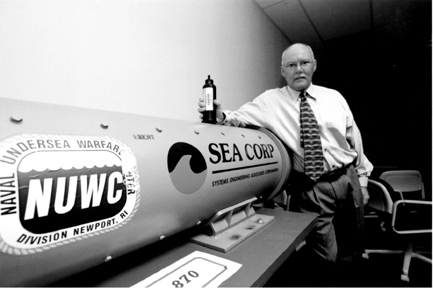
In July, U.S. Patent No. 6,418,870 was issued to Middletown-based SEA Corp., a provider of software and engineering services to the U.S. Navy.
The patent protects a new torpedo-launching system that SEA Corp. developed using the same cartridges that cause automotive airbags to inflate. The launcher deploys multiple inflaters – these taken from minivans – to propel torpedoes weighing as much as 750 lbs. from surface ships, launching them at the precise velocity so they dive into the water at a predetermined angle.
It’s heady stuff for a relatively small, private firm that has made its living by quietly winning Naval service contracts over the last two decades, achieving steady growth despite a federal defense budget that had been shrinking. But for SEA Corp., the patent highlights a new strategic focus on product innovation.
“We will always be a services company,” said Brian W. Gilligan, SEA Corp.’s president and co-founder. “But more and more we’ve been involved in developing innovative products.”
To some extent, SEA Corp. (Systems Engineering Associates Corp.) has been able to pursue sexy projects like the torpedo launcher because of its workmanlike success winning services contracts from the Naval Undersea Warfare Center in Newport, the Navy’s primary undersea laboratory. The firm now has a backlog of $158 million in contracts, which is the largest in the company’s history, Gilligan said.
SEA Corp. engineers and computer analysts typically test and evaluate combat systems either at the Newport Naval Station or out in the field, aboard combat submarines. They make sure the electronic and mechanical components of the combat systems – acoustic, visual and electromagnetic sensors, communications, intelligence and navigation equipment and weapons subsystems – are working properly.
For example, under a $40 million NUWC contract awarded last year – SEA Corp.’s largest ever – the firm is providing engineering services for Seawolf and other attack submarines.
More than 95 percent of its work comes from contracts with the NUWC, or its parent, Washington, D.C.-based Naval Sea Systems Command. Much of SEA Corp.’s success rests on winning recurring work, and the company claims to have won every follow-on contract it has bid on.
“The service industry is slow growth,” said David V. Miller, SEA Corp.’s business development manager. “The business is almost exclusively government-oriented, and those existing contracts are absolute must-wins.”
“It sort of feeds off itself,” Gilligan added. “We have the talent to write good technical proposals and we have the spending discipline to submit competitive proposals and win contracts. People see that we’re winning contracts, and we’re able to attract talented test engineers and computer scientists”
Gilligan co-founded the company in 1981, after spending several years as an engineer working primarily for NUWC. In the early years, SEA Corp. subcontracted much of its work out to large defense contractors such as Raytheon and Electric Boat.
But in 1989 the firm finally landed its first big contract: a five-year, several-million-dollar contract from NUWC to test and evaluate sonar systems. Since then, SEA Corp. has won 10 “prime” Navy contracts, providing, for example, engineering support for the Navy’s acoustic trainer programs and its Tomahawk and Harpoon missile programs.
Its growth has been strong and steady, jumping from 90 employees in 1996 to about 165 now. Revenues shot up from $10.5 million in 1999 to $15.5 million last year.
SEA Corp.’s foray into product development largely has been supported by Small Business Innovation Research (SBIR) grants, which the federal government awards small businesses for research projects that have the potential for commercialization. The company has received several million dollars in SBIR grants, and the torpedo-launcher project – which was awarded a rare Phase III SBIR grant – was funded mostly through SBIR money.
The company has outgrown its 24,000 square-foot building in the Aquidneck Corporate Park, which is comprised mainly of offices and a few test areas. By the end of the year, however, the company plans to expand into a 37,000 square-foot building across the street. While the building will provide needed office space, it also will enable SEA Corp. to expand its R&D functions and tighten its focus on product innovation.