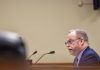
U.S. Securities and Exchange Commission Chairman Christopher Cox was asked on March 11 if he was concerned about the financial condition of Bear Stearns Cos.
“We have a good deal of comfort about the capital cushions at these firms at the moment,” Cox told reporters.
Three days later, the Federal Reserve said it was pumping emergency funds into the 85-year-old securities firm through JPMorgan Chase & Co., the third-biggest U.S. bank by assets. On March 16, JPMorgan announced it was buying Bear Stearns for $2 a share, or $240 million in stock, 90 percent less than the company’s market value two weeks ago.
Bear Stearns’s forced sale days after the SEC chief’s reassurances is raising questions about the vigilance of the top U.S. securities regulator, which is charged with making sure Wall Street firms have enough cash to survive a crisis.
“It’s really speaking to the lack of good supervision by the SEC,” said David Hendler, an analyst at CreditSights Inc. in New York. “They’re not really a real regulator staying on top of things.”
SEC spokesman John Nester declined to comment last week. Cox, who was unavailable for comment, became chairman in August 2005 after being nominated by President George W. Bush.
The SEC, as part of its supervision of Bear Stearns, the fifth-largest U.S. securities firm, and its rivals, tries to ensure that the industry has adequate funds to meet expected obligations for at least one year during periods of “stress,” according to the agency’s Web site.
Cox said on March 11 the SEC was monitoring firms’ capital levels on a “constant” basis and sometimes daily in response to the subprime-loan meltdown that triggered the crisis.
The agency’s oversight abilities were overwhelmed by the speed of events in the Bear Stearns collapse, said Christopher Whalen, managing director of financial consulting firm Institutional Risk Analytics in Hawthorne, California.
“None of the SEC’s stress testing began to anticipate’’ what happened, Whalen said. “This is a systemic breakdown where people are running away from banks,” he said.
Due to “rumors that were untrue,” banks wouldn’t lend to Bear Stearns even if it put up “relatively liquid” assets as collateral, Chief Financial Officer Samuel Molinaro said on a March 14 conference call with analysts and investors.
In a statement on March 14, after the Fed announced it would provide funding to Bear Stearns, the SEC reiterated that the firm had “a substantial capital cushion” on March 11, citing information the company provided to the agency.
“Beginning on that day, however, and increasingly throughout the week, lenders and customers of Bear Stearns began to remove funds from the firm,” the SEC said. “As a result, Bear Stearns’ excess liquidity rapidly eroded.”
The SEC was “working closely” with the Fed and the Treasury Department to ensure “orderly and liquid markets,” the statement said.
Bear Stearns had more than $17 billion in cash and salable assets on March 11, according to the SEC.
“Criticizing SEC examiners is unfair,” said Robert Neff, a former Bear Stearns risk manager who left the firm in March 2006. “They’ve become every bit as strong and vigilant as the Fed. The SEC just doesn’t have the ultimate power of the checkbook.”
Neff now works at Sailfish Capital Partners LLC, a hedge fund adviser based in Stamford, Connecticut.
A decision by the Fed to lend money to the biggest dealers in government bonds “takes the liquidity issue for the entire industry off the table,’’ Lehman Chief Executive Officer Richard Fuld said in a statement last week.
The SEC and the Fed “are both equally guilty on regulatory blame for being asleep at the switch,” said Anthony Sabino, a business-law professor at St. John’s University in New York and head of Sabino & Sabino, a securities litigation firm.
“The smart move would have been two years ago to tell these firms to shape up, you’re not telling the market enough, you’re gambling too much,” Sabino said, citing the firms’ investment in securities tied to subprime mortgages.
The SEC may have been better off to say nothing about Bear Stearns, said U.S. Sen. Jack Reed, a Rhode Island Democrat.
“The next time the SEC steps up to the plate to vouch for a company, will the market then say: ‘Oh my gosh, we have to head for the exit,’” said Reed, chairman of the Senate Subcommittee on Securities, Insurance and Investment. “Or will they say: ‘This is something we can take to the bank.’”
In determining whether securities firms have enough capital and access to cash, the SEC conducts on-site examinations of risk-management policies and procedures, according to its Web site. The regulator also reviews “risk reports substantially similar” to ones provided to the firm’s management every month.
Agency staff members meet at least once a month with senior risk managers at securities firms to scrutinize “outsized risk exposures” and once every three months to review how easily assets on the balance sheet can be converted into cash, the SEC said.
The SEC’s oversight of securities firms is “strong,” and Bear Stearns was done in by a run on the bank, not a lack of capital, SEC Commissioner Paul Atkins said.
“Once upon a time, a year ago, we had over-exuberance in the marketplace,” Atkins said in a March 15 interview. “We now have a period of over-pessimism.” •



No posts to display
Sign in
Welcome! Log into your account
Forgot your password? Get help
Privacy Policy
Password recovery
Recover your password
A password will be e-mailed to you.
- Featured Event -