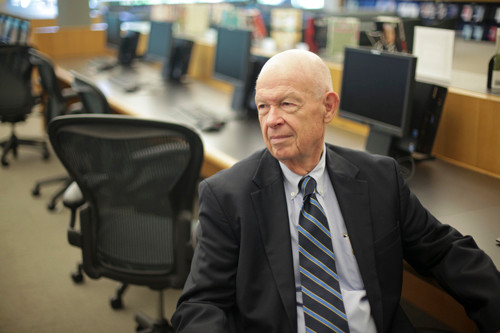
Bryant University has gone to the “cloud” and is looking to take schools, local government agencies and others along with it.
Just four years ago, Bryant announced its new, green data center, consolidating four server sites into one and reducing its energy usage for storage by 35 percent, as much as $20,000 annually. And now the school is taking the next step.
“We’re building on the virtualization that took place in the data center four years ago,” said Rich Siedzik, director of computer and telecommunications services. “We started out with servers, now we’re getting into desktops, networks and storage so the entire infrastructure inside the data server is becoming virtual.”
The first step, reducing the number of servers, was beneficial to the university’s bottom line, cutting the operational budget for hardware and software maintenance by 21 percent.
The next step could provide a new source of revenue for the institution.
Bryant is looking to build a cloud-computing product that can be accessed by all of Rhode Island’s school districts.
(Cloud computing refers to individuals and organizations linking to other computers and servers – usually via the Internet – to share information and computing capacity.)
“Cloud computing would allow them to each run their own [virtual applications] with the idea of combining them at a higher lever,” said Art Gloster, vice president for information services.
Already Bryant is in discussions with the Smithfield school district. “It would be a joint effort,” said Gloster. “They would be the guinea pig, if you will. Bryant would gain the experience and Smithfield would get the IT services [virtualized servers] that it needs,” he added.
“When you really look at this, you’re sharing applications to reduce the costs [related to] infrastructure and labor,” said Siedzik. “Why should we do 39 different payrolls for 39 different school districts? There are a lot of efficiencies that can be gained.”
Bryant’s original plan was to begin offering its cloud-computing services to K-12 schools this summer, but that plan has been delayed.
“We want to be sure that we do it right,” noted Siedzik. “We think it’s a good opportunity and would be helpful to the educational process, and would reduce the costs of various subdivisions of the state.”
“On a national level, very few institutions – none that we’re aware of – have really done this in a larger environment, as far as servicing the community is concerned,” said Siedzik.
Also considering itself a leader in cloud computing is the IT department at Brown University, which hosts well more than 200 servers, 85 percent of which are on the institution’s internal cloud.
But Michael Pickett, chief information officer at Brown, doesn’t take all of the credit for being “pretty far ahead” of his peers in terms of cloud computing.
He simply puts it down to timing.
“We have been using old mainframe systems for 20-something years. They’re finally reaching the end of life, and the vendors are no longer providing the same kind of support. It was time to move on. It just so happened that there was a strong need to do something about those older systems when new cloud applications were becoming available out on the Internet,” said Pickett.
“So rather than installing what could be described as ’90s technology, we were able to leap a generation and go straight to the cloud,” he added. The push to move to the cloud, beginning about five years ago, actually came from a need to pinch pennies and concentrate funds on attracting top faculty.
Brown has both an internal and external cloud, and was one of the early adopters of OSHEAN’s private cloud, Cumulus. It uses the latter to test out certain applications without paying “really, really high rates for things that have, say, 1,000 users.”
“Essentially, a lot of cloud computing is weighing the risks – is the risk of having down time worse than having a breach of data, in terms of statistical odds?” Pickett said, noting that at first, many were hesitant about using Google for its email and calendar services – a tool that is now commonly used at universities nationwide.
However, when “free” compares with the $700,000 to $1 million annual price tag that would come with replacing an old version of Microsoft Exchange at Brown, the “pros” may outweigh the “cons.”
And although “cloud computing” seems to be on the lips of every CIO in the world, in the end, it comes down to a simple business decision, said Pickett.
“I would never tell people to dump their PeopleSoft or Oracle … unless there was some incredibly functional cloud application,” he said. “At some point, it’s going to be cheaper to buy a commodity, a utility service off the Internet – even for some of my academic services [such as course management]. It’ll be cheaper than taking up space in my data center … and paying programmers.”
Cloud-based applications may match the costliness of traditional ones but they offer a different kind of functionality and more advanced features, Pickett said, explaining that traditional vendors have to create and test their product on different types of hardware and operating systems, which requires a “tremendous effort.”
“With the cloud, there is one version. It’s what you get,” he said. Development cycles for cloud applications, therefore, are much more aggressive, because companies can put more resources behind new features.
Institutions are also using the “commodity cloud” as a way to handle one-off peak data loads caused by, for example, growth or twice-annual events, Pickett said.
“[At Brown], we’re going to run out of space. We have to keep looking at, when we run out, does it make sense to find expansion out on the cloud … and then ask that question: Do I really need to bring it back into Brown?” he asked.
One service Pickett isn’t ready to let fly free in the cloud? Disaster recovery, which Brown is willing to foot the bill for at least into the foreseeable future. However, that future may be as limited as five years, Pickett said. •