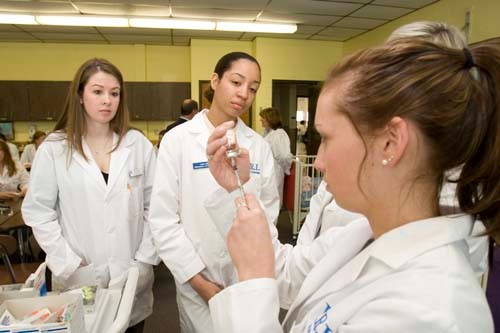
The request could arrive at a real estate developer near you: State seeks private partner to build a nursing-education center in return for 25-year lease.
It is one option floated to pay for a proposed University of Rhode Island and Rhode Island College shared nursing facility in Providence’s Jewelry District. Lawmakers have yet to approve the project or a funding option, but the public-private partnership option has caught the attention of some local developers.
“This would be a great project,” said Joseph Paolino Jr., whose family owns Paolino Properties.
Paolino and education officials say such a center would catapult development in the Jewelry District, where Brown University is building a new medical school. City and state officials envision the one-time manufacturing district as a hub for medical research.
Developers like Paolino see it as one of the few areas ripe for projects in a city where few commercial tenants are clamoring for office space. The nursing center, Paolino said, could prove especially attractive because the state would back the lease.
“The state will never go out of business,” Paolino said. “Once the state goes out of business the world comes to an end.”
There are other benefits too, said Arnold “Buff” Chace Jr., owner of Cornish Associates, a Providence-based developer. A state commitment would likely lower borrowing costs for a developer. And a developer could turn the depreciation of the building into tax savings, unlike the state.
A developer, Chace and Paolino say, also could likely construct the facility faster and more efficiently than state officials contending with layers of bureaucracy. And despite the state’s precarious financial situation, it maintains credit ratings in the upper crust, Chace noted.
“It seems like a good marriage of the strengths of two different organizations,” Chace said.
Such a marriage would likely come with a long-term commitment during an era of landlords coping with commercial tenants downsizing, merging and moving.
Monetary benefits for the state, though, are far from a sure thing. The state constructing a facility without private support on state land would cost $101.3 million over 25 years, including debt service, according to a report commissioned by the R.I. Board of Governors for Higher Education. The same building constructed by a private developer on state land would cost $125.9 million, including the leasing costs.
Privately built on private land, the project would cost $137.7 million – or $284,701 more than constructing separate facilities at each school. Under the private arrangements, the report’s authors – Robinson Green Beretta Architects of Providence and HO+K Architects of New York City – factored in the costs of the state buying out the building after 25 years. The report did not make a recommendation of which financing option would be best but did recommend a shared facility, which the two schools also support.
The proposal, however, has been enough to give some people pause. House Finance Committee Chairman Helio Melo, D-East Providence, said in a statement that he did not expect a quick decision from his colleagues on whether the project would receive General Assembly support.
Melo said lawmakers were tied up putting together the state budget. They also need to resolve how the state will dispose land under the old Interstate 195; some parcels are eyed as the home of a shared nursing center.
And putting together a public-private partnership may not be easy, said Alan Doyle, a principal at Larew, Doyle & Associates, which helps arrange financing for commercial real estate projects.
With a $60 million price tag just for construction and design, a shared facility would cost about double per square foot compared with a traditional building of similar size, Doyle said. The specialized nature of the facility – with its simulated labs and ORs – would make it difficult for a landlord to find a tenant if the universities ever left.
And then there’s perception. Doyle said he queried one client – a major insurance company – about its interest in financing a shared nursing facility. The reply was curt: Maybe in Boston or another high-profile market, but not in tiny Rhode Island.
The state is also struggling to get its fiscal house in order. In June Moody’s lowered its outlook for Rhode Island bonds from stable to negative, citing the state’s ballooning pension costs.
“It’s hard … for any lender to look at the state of Rhode Island and say this is a good deal,” Doyle said.
Steve Maurano, a spokesman for the R.I. Board of Governors for Higher Education, said education officials had floated the private-public concept with local developers before the release of the report and received positive feedback.
Higher Education Commissioner Ray Di Pasquale is optimistic that the concept will catch on as the state refines details and lawmakers debate the best financing approach.
“We’re hopeful that once this gets out it will generate … some real excitement,” he said.
If it does, it could arrive in a variety of forms. Paolino and Chace – the developers – said they would likely partner with another firm if they were to tackle the nursing center. Or Chace said an ad hoc group could emerge to finance the building under a similar scenario that built the GTECH building in Providence.
“We look for opportunities,” Chace said. “We try and advocate for the institutions and government to create incentives to make private capital invest in these projects.” •