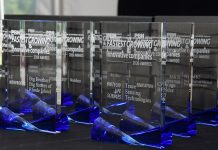
Atlantic Affiliates, a hybrid consulting firm – and example of pure capitalism
Five business people sat down for lunch late last summer to discuss the idea of melding their individual freelance businesses. Working as a team, the five of them could provide clients with critical solutions to a much greater range of needs than any one of them could offer alone – marketing, Web site and computer networking services, TV and video producing, graphic design and illustration. The idea was exciting.
They were all in agreement, then. They would not go into business together.
Your Business Has Gone Global. Has Your Insurance?
A decade ago, “doing business internationally” was mostly a large-company concern. Today, a manufacturer in…
Learn More
Or at least they wouldn’t launch a traditional business partnership. For starters, each one valued their freelance business too much. The notion of renting office space, hiring a staff and punching a clock made them all shiver. Rather, the idea was to enhance their individual practices by scoring more clients and offering them a wider range of services.
And so Atlantic Affiliates was born. The organization is a kind of hybrid consulting firm – a loose affiliation of self-employed specialists working together to solve their clients’ needs. The arrangement was agreed upon with handshakes – no lawyers, no contracts.
The memebers of the group don’t pool revenue. Each one bills clients at their own rate. Anyone can leave the affiliation at any time, for any length of time, for any reason.
All of the Atlantic Affiliate members say that the arrangement allows them to reserve their independence as soloists, but that now they can offer their clients the broad services of a group consulting firm. The whole is greater than the sum of its parts.
“Atlantic Affiliates as a concept makes me look better as an individual. Having other people with you who provide creative services gives you more to offer,” said Leslie Lindeman, a Tiverton freelance marketing consultant and member of Atlantic Affiliates. “I had no desire to run out and hire 10 staff, I enjoy being a sole proprietor. That having been said, you need those other pieces.”
The affiliates each maintain their own home offices, spread across Southern Rhode Island and Somerville, Massachusetts. They work together on projects when the opportunity exists, using e-mail and instant messenger to contact each other. Each member can be hired independently, or several can be contracted for a project. They sit down formally every two weeks for an hour or so.
Each brings distinct business experience and skills to the table. Lindeman offers marketing strategy and special event planning. Newport resident Graeme Smith is a Web designer and hosting-services specialist. Little Compton resident David Wilson specializes in computer databases and information security. Steve Roy of Bristol produces television commercials, instructional and Web videos. And Kim Schmidt of Somerville is a graphic designer.
“To the outside world it makes a difference to see an organization. Sometimes it’s hard to land that big client because you’re only one person. We’re like a virtual company. We have all the components of a major group without the infrastructure and the overhead,” said Lindeman. “As a client of Steve’s, your not paying for my photocopies.”
There is no hierarchy to their organization – each person sets his or her own hours and workload. Business is brought into the group through any one of the affiliates, who each have established contacts in their own fields. Typically, one team member will bring in other members on a project, and then act as the Atlantic Affiliate project manager for that particular client.
The partners said the arrangement results in lower costs for clients, since they are only billed for the contracted work, not any of the other expenses associated with contracting an entire consulting firm.
As an example, this summer Wilson was hired by EMC Technologies to upgrade the Fall River high-tech company’s computer network. EMC then asked Wilson to develop a Web site and get it on the Web. With EMC’s blessing, Wilson brought in Schmidt to design the overall look and graphic elements for the Web site. Lindeman was then hired to develop and direct the photographic and written content. The project brought in three of the five affiliates.
“Now EMC has an upgraded network, a new Web site and press package, and it didn’t cost them anything extra. It was all on a project by project basis,” said Wilson.
Roy said the professional affiliation also allows each of the members to think in big in their own businesses, and offer broader services to clients.
“I run into people all the time who have a lot of needs that I can’t fill all by myself – they’ve got no logo, or worse, they’ve got five logos. In the past we’d thumb through the yellow pages together. Now I can say, ‘well, I’ve got people who I trust.’ It just expands my ability with a client, when they come to me for strategic thinking. It makes me look great,” said Roy.
The five members all say their affiliation has brought in more business collectively than they would have generated separately. Smith said his client list has grown by a third in the past year.
The group said they work well together, and there is a visible camaraderie when they gather together in a room. Roy and Lindeman have been friends for a long time – Roy’s wife is one of Lindeman’s oldest friends. And yet, the group said their professional affiliation does not spill over into their personal lives.
“We don’t barbie together. We don’t go out for beers together,” said Smith, who emigrated from Glasgow, Scotland five years ago. “If we meet socially, it’s because we arrive there by different routes.”
Roy agreed, saying, “We don’t need this for a social structure, we all have fully developed lives. This is as pure as capitalism ever gets.”