PROVIDENCE – An additional 180 acres of Greenwich Bay has been conditionally approved for shellfish harvesting starting due to improvements in water quality, the Rhode Island Department of Environmental Management announced on Thursday.
The newly opened area now ends at Cedar Tree Point, about 4,000 feet eastward of its previous closure line at Capron Farm Drive.
Selling Luxury Real Estate Requires More Than Exposure
By Emilio DiSpirito IV License Partner | Private Office Advisor Engel & Völkers Oceanside www.DiSpiritoteam.com…
Learn More
Starting at the sunrise Friday, shellfishing in the area will be allowed, but only under certain conditions. For example, shellfish harvesting will prohibited in the area if more than half inch of rain falls in 24-hour period, as rainfall can increase bacteria levels in water. Daily harvest limits have also been set to preserve the shellfish population.
This move represents a 10% increase in the area of the Greenwich Bay that was conditionally approved for shellfishing.
“This is exciting news for Warwick diggers and residents, the habitat of Greenwich Bay, and Rhode Island’s local food economy,” said Gov. Daniel J. McKee in a press release. “This is a water quality success story.”
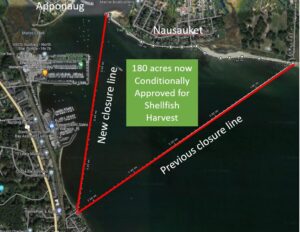
The 180-acre area, located in the Nausaket area of Greenwich Bay in Warwick, has been closed to shellfish harvesting since 2002 due to poor water quality. But a recent review of shellfish tissue samples collected in the area by the Office of Water Resources now meet the national standards for safe harvesting.
“The improvements in the cove are the result of a combination of better storm water management, extensive hook-ups to city sewer systems, and elimination of cesspools,” said Terry Gray, the director of the Department of Environmental Management in the release. “All these actions were driven by state programs and implemented in partnership with the city of Warwick. This opening is an example of vision, long-term infrastructure investments, and state-local-federal cooperation leading to cleaner water.”
“The city of Warwick is committed to both protecting our natural resources and promoting economic growth,” added Warwick Mayor Frank J. Picozzi. “From improved stormwater controls linked with the Apponaug circulator project to the elimination of cesspools in the Apponaug area due to the 2007 Rhode Island Cesspool Act, our city has been committed to this cause for decades. In the early 1980s, practically no homes in Apponaug were connected to municipal sewer service, but today nearly 90% of homes are.”
Claudia Chiappa is a PBN staff writer. You may contact her at Chiappa@PBN.com.