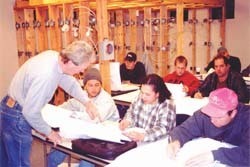
 www.buildri.org. / " title="APPRENTICE electrical workers learn skills from master electricians during a BuildRI training program conducted at the International Brotherhood of Electricians, Local 99, training hall in Cranston. To learn more about BuildRI, a coalition of local construction-related contractors and labor unions, visit www.buildri.org. /"/>
Fewer young people target building trades
Across Rhode Island, the construction industry is busy with major projects – mill rehabs, condominiums, hotels, offices. But unless more young people start pursuing the building trades, some say, the future of the state’s construction industry could be in jeopardy.
A modernized health plan: Supporting cost management and the employee experience.
The Surest health plan came from a group of innovators wondering: What if health care…
Learn More
“Obviously, we’re worried,” said Roger Warren, executive director of the Rhode Island Builders Association. “That’s why we’re spending time and money addressing it.”
During the last five years, Warren said, the association has been working with vocational and traditional high schools, “trying to foster their programs” in construction trades such as carpentry, electricity, plumbing and building.
“We’re trying to show that college is not the only career path,” he said. “We’ve recognized if we don’t [recruit] now, it might not happen.”
It’s a worrisome subject for the construction unions as well, said Greg Mancini, executive director of BuildRI, an alliance of trade unions and 17 contractors in the state.
National studies suggest at least 18 percent of New England’s work force is 50 or older, he noted. And as the baby boomers continue to age, that percentage will increase.
The anticipated aging of the work force, combined with the shrinking number of students entering the building trades and the expansion of construction projects in the state, is expected to create an industry-crippling shortage of construction workers, Mancini said.
In response to that threat, BuildRI is forming partnerships with other agencies and local government to develop the next generation of skilled workers for the trades, he said.
“The idea is to recruit applicants,” Mancini said. “To recruit and train them and place them in a job.”
But all of that will take time to initiate, as the project is in a very preliminary stage.
In the meantime, Mancini said, “it is an important part of our message to go to the owners [of construction firms] and say to them, it’s in their long-term interest to understand the value and the cost of training.”
(Though union labor is typically more expensive than non-union labor, training is one of its selling points: the trade unions run their own programs, both to recruit and train new members and to keep existing members’ skills and knowledge up to date.)
No one knows exactly how big the shortage of construction workers is, Warren said. But the builders’ association knows “what our members tell us” – namely, that its members are having trouble scheduling subcontractors for jobs because the subcontractors are overworked.
When there is a shortage of subcontractors for new jobs, the whole industry suffers, because that causes housing and commercial construction costs to rise, he said.
And though the builders’ association already spends much time and money promoting the construction industry to high school and college-age people, more could be done.
The biggest hurdle, Warren said, is convincing parents and guidance counselors that the construction industry is a viable alternative for students who lack the aptitude for – or interest in – college.
“A lot of construction jobs pay more than what we consider the ‘white collar’ trades,” he noted.
Last year, the average construction salary was $44,792, according to the R.I. Department of Labor and Training. That average has increased by $1,323, or 3 percent, since 2003.
The University of Rhode Island’s Transportation Center also is helping raise awareness of construction jobs.
The center helped organize Rhode Island’s first ever “Construction Career Days” in 2001.This year, about 1,300 high school juniors, seniors and chaperones attended the event, said Jeff Cathcart, director of technology transfer outreach at the center.
“It is a hands-on introduction to the construction industry,” Cathcart said. “They build a tool box and a flower box. They use jack hammers and cutting torches. And they design bridges on computers.”
The two-day event is sponsored by the R.I. Department of Transportation, the U.S. Federal Highway Administration, together with other groups such as the builders’ association and Construction Industries of Rhode Island.