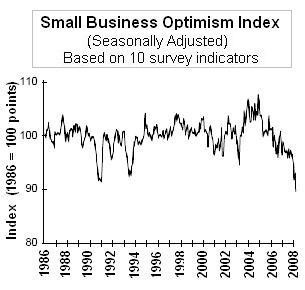
WASHINGTON – Confidence among U.S. small business owners nationwide fell last month to a 28-year low, after rising slightly in February, according to the Small Business Economic Trends report released today by the National Federation of Independent Business.
The group’s Index of Small Business Optimism fell 3.3 points in March to a seasonally adjusted 89.6 points (1986 = 100). The reading – the lowest since the second quarter of 1980, when the index fell to 80.1, and the lowest monthly reading since the more-frequent surveys began in 1986 – followed scores of 92.9 in February, 91.8 in January and 94.6 in December.
“Recession fears are spreading and the economy is showing definite signs of slowing, even on Main Street,” the NFIB said. “For the small business sector, the decline started in September, more precisely Sept. 19,” when “the official warning of recession possibilities coupled with the Federal Reserve’s actions produced a pull-back in small business (and likely consumer) spending.”
Five percent of respondents said now is a good time to expand, and 19 percent reported current job openings. Only 3 percent of said they plan to expand their staff, however, down from 11 percent in February.
Twenty-five percent were planning capital outlays, down from 26 percent the month before.
The net share expecting their own sales to improve fell 3 percentage points to negative 3 percent, while those expecting the economy to improve fell 14 percentage points to negative 23 percent.
“The weak economy does not seem to be helping on the inflation front,” the NFIB noted. “The number of owners citing inflation as their No. 1 business problem is at its highest level since 1982.”
The report was based on a survey of 1,845 NFIB members nationwide. The group says its typical member business has a five-person staff and gross sales of about $350,000 per year.
“The good news is that the recession fear has infected expectations more than spending plans (which directly impact Gross Domestic Product and employment). This leaves open the possibility that the downturn can be modest,” the NFIB said.
Moreover, “The Federal Reserve seems to have zeroed in on the problems Wall Street is having. Perhaps it will focus its efforts there and stop treating the whole economy for a disease that has infected only a few firms on Wall Street, large as they may be.”
The National Federation of Independent Business is a lobbying group with offices in Washington, D.C., and all 50 state capitals. Its quarterly small business economic studies date back to 1974. For additional information, visit www.nfib.com.