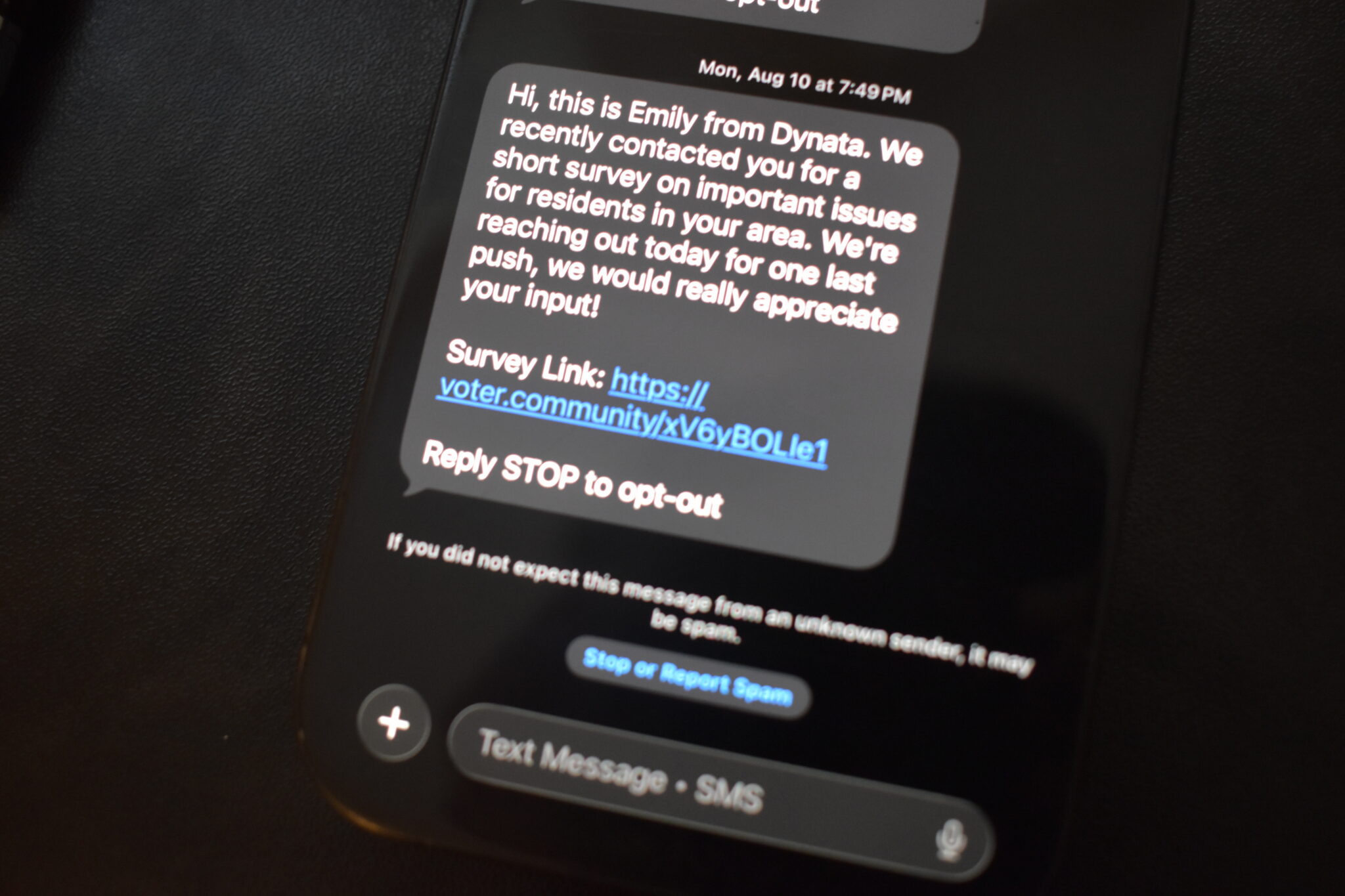
The missed call log in Dr. Eric Bai’s iPhone has a sea of phone numbers with unfamiliar area codes. Some of them are likely from pollsters wanting to ask him about the upcoming Rhode Island primary elections.
A few times, he’s answered only to end up staying on the line to complete a survey.
Cybersecurity Awareness Month: What to Do When Your Identity Is Stolen
In recognition of Cybersecurity Awareness Month, it is important to remember that identity theft affects…
Learn More
“I felt bad,” Bai, 32, of Providence, explained.
But he’s busy, juggling part-time jobs as an internal medicine doctor at Thundermist Health Center in West Warwick and a product designer for health technology company ITO Health.
Mostly, he lets the calls go to voicemail.
Response rates in public opinion polls plunged after cellphones replaced landlines. Researchers turned to new recruitment methods, survey platforms and statistical sampling techniques as alternative solutions.
Gov. Daniel J. McKee’s campaign insists the new methods are inaccurate.
Hours after an Aug. 27 University of New Hampshire survey came out, showing McKee 38 points behind his Democratic primary challenger, Helena Buonanno Foulkes, the governor’s campaign team slammed the results as “bogus,” calling the research institution “an unreliable pollster.”
Previous polls, including by UNH and WPRI-TV CBS 12 in partnership with Emerson College Polling, showed McKee trailing Foulkes by a smaller margin of 15 to 20 points.
Andrew Smith, director of the UNH Survey Center, shrugged off the criticism.
“It’s the oldest play in the book: The first thing you do if you don’t like a poll is attack the methodology,” Smith said.
He would know. After four decades in academic survey research, Smith, 65, is no stranger to candidates criticizing his work. Human nature has stayed consistent in an ever-changing world of public polling.
But even Smith acknowledges that skewed participation in public polling persists.
“We’re still trying to figure out ways to diminish that,” he said.
The 2016 and 2020 presidential elections put the problem with polling front and center. Blue-collar Republicans didn’t participate in public surveys, leading to polls that overstated voters’ support for the Democratic candidate in each cycle.
More recently, in August, progressive candidates in the Democratic primaries for a U.S. Senate seat in Michigan and governor of Wisconsin fared worse than polls indicated, suggesting moderate Democratic voters may also be the latest casualty of the “non-response bias” problem in polling.
“There’s no doubt that right now in Democratic primaries, the well-educated progressive voter is much more likely to answer these polls than the more mainstream, less well-educated, working class voter,” said Adam Myers, an associate professor of political science at Providence College. “No one in the polling world has figured out the right formula.”
McKee’s campaign is counting on it.
“If this same issue exists in Rhode Island primary polling, it would indicate that polls overestimate support for Helena Foulkes and underestimate support for Dan McKee, assuming that pollsters overindex on the discontented subset of Democrats who oppose incumbent politicians,” Sophie Mestas, a McKee campaign spokesperson, said in an emailed response.
Foulkes’ campaign did not respond to requests for comment.
Divergence between polls and election results is why Matt Foster tries to answer as many of the text invitations for local surveys as he can.
The 45-year-old Providence resident and bank risk manager and registered independent says he’s taken at least a half-dozen online surveys gauging his opinion on candidates, elected officeholders, and state issues within the last few months.
“I’ve never done it before, so I figured this election cycle, I would see what it was like,” Foster explained. “I was just curious.”
Some are more arduous than others. If it takes more than five minutes to complete, Foster sometimes stops midway, he said.
But he likes the idea that his participation as a self-described moderate – a group underrepresented in other Democratic primary surveys – might help researchers tweak their recruitment methods and statistical calculations.
Salve Regina University’s The Pell Center Aug. 18 poll put Foulkes 20 points ahead of McKee among the 394 likely primary voters surveyed from Aug. 3 to 11.
The WPRI-Emerson poll released one week later showed McKee narrowing the gap to 15 points behind Foulkes among 522 likely primary voters who took the Aug. 21-22 survey. Two days later, UNH’s poll put Foulkes 38 points ahead among the 451 likely Democratic primary voters in the Aug. 20-23 survey.
A fourth survey by the University of Rhode Island’s Rhode Island Survey Initiative published Tuesday asked about the gubernatorial candidates in a general election matchup. But the poll, conducted July 29 to Aug. 13, did not ask the 500 respondents about the primary race between Foulkes and McKee because survey researchers didn’t know if the results would be ready to publish before the Sept. 9 primary.
“I didn’t want to waste a question on something that would be old anyway,” said Julie Keller, an associate professor of sociology at URI and lead researcher of the survey initiative.
During the three-week span of surveys, there were three live debates between McKee and Foulkes, a highly-anticipated Supreme Court nomination, and a Washington Bridge update.
“Polling is truly a snapshot in time,” said Katie Sonder, associate director of The Pell Center.
As Spencer Kimball, director of Emerson College Polling, sees it, the problem isn’t with the poll but how people interpret it.
“What the public expects out of a poll is to pick the winner,” Kimball said. “Polls need to be read as a range of scores at a specific point in time.”
Methodology matters. Are respondents chosen entirely at random, or are they recruited because they represent target demographics, including a history of voting? Are they contacted by phone or by text? Can they complete the survey online? And how is the raw data from their responses statistically weighted to better reflect the broader electorate?
Particularly in primary elections, traditionally plagued by low turnout, researchers don’t actually know who the group they’re trying to represent is.
They can look at past primary turnout as a guide, but that’s not always accurate. A young, enthusiastic candidate like New York Mayor Zohran Mandani can bring out groups of voters who haven’t participated in the past. The 2025 city mayoral election drew the most voters of any city race since 1969, with a surge in ballots cast by voters under age 40.
Could that happen in Rhode Island?
“You can’t say for sure,” Smith said. “We have a great tendency in general to overestimate our desire and intentions in voting.”
Perhaps democracy would be better served without any public election polling at all?
“The obsession with electoral polls and campaigning is bad because so much of coverage of campaigns is about the horse race,” Myers said. “It would be a lot better if the focus of campaigns, and media coverage of campaigns, was about the issues.”
Bai said he had not paid any attention to the results of recent polls in preparation for voting in Democratic primaries.
“I think I should vote based on what I think, not what other people are voting for,” he said.
He continued, “When I think about the value of polling, I wonder who it’s really for? It’s not for me as a voter.”
But it’s important to researchers like Smith, offering a rare opportunity to test survey methodology against concrete Election Day results.
Polls can also help inform campaigns on which demographic groups they need to target, while alerting voters to the fact that there’s an election happening at all, Kimball said.
Roughly 1 in 5 Democratic voters were still undecided in the gubernatorial primary race in all three surveys; in the primaries for lieutenant governor and attorney general, nearly half of likely primary voters hadn’t made up their minds yet.
McKee campaign spokesperson Mestas emphasized the importance of public outreach in the campaign: TV ads, door-knocking, and phone banking among them.
“While public polling is often used by pundits to pontificate on the state of the race, it is not a helpful tool to inform campaign strategy – in part because of methodological issues that have been rife in polls of the Democratic primary electorate this cycle [sic] but largely because polls are only one part of a much bigger picture,” she wrote in an email.
At least some of McKee’s messaging against Foulkes appears to have broken through to Bai, who referred to Foulkes as “that CVS lady.” But, he also didn’t know that McKee was running again, admitting he had only a “vague sense” of the candidates.
“That’s on my to-do list for this upcoming weekend,” Bai said.
Nancy Lavin is a senior staff writer for the Rhode Island Current.