The project seemed like a godsend for Fall River: Meditech, a software company with 2,300 employees at five Massachusetts sites, announced last summer that it would erect a 125,000-square-foot office building near the intersection of Interstate 195 and Route 24 and create up to 600 jobs.
It was exactly the kind of project officials had sought for the former Kerr Mill site off South Watuppa Pond. The land had sat idle for more than a decade after the mill burned down in 1987, but since then, MassDevelopment had been trying to turn it into a technology hub.
ISO 9001:2026: A Practical Opportunity to Build for What’s Next
For Rhode Island manufacturers, ISO 9001 has been much more than a certificate on the…
Learn More
Working with the University of Massachusetts Dartmouth, the agency built an Advanced Technology & Manufacturing Center on part of the site in 2001, attracting 11 startups, a small technology firm and a pilot manufacturing facility for Avant Immunotherapeutics.
But Meditech could really transform the site. Fall River Mayor Edward M. Lambert Jr. was thrilled, calling the news “a breakthrough announcement.” Yet there was an obstacle: the United Textile Machinery Corp., operating right where Meditech wanted to build.
Now, in a textbook case of economic development vs. private property rights, Fall River is threatening to use its power of eminent domain to evict United Textile – even as behind the scenes, city officials continue to negotiate with owner Samuel Shapiro to buy his land.
Kenneth Fiola Jr., executive vice president of the Fall River Office of Economic Development and the city’s point person in the deal, refused to comment for this story, and instead faxed PBN a copy of a Fall River Herald News article that quoted him saying negotiations had “hit a wall,” and the city Redevelopment Authority had voted to use eminent domain by Jan. 5.
The article also quoted Fiola saying that Shapiro would be given a $1.6 million check and have 120 days to vacate the premises, or else be removed by law enforcement officials.
But A. Neil Pappalardo, chairman and CEO of Meditech (Medical Information Technology Inc.), said on Tuesday that in fact Shapiro’s property is not going to be forcefully seized this week, but rather, both parties are “extremely close” to a deal.
“We’re currently negotiating the price to be paid for his parcel,” Pappalardo said. “We have reason to believe we’re very close to coming to a final agreement on that – and of course, there is in the background the approval to take it by eminent domain if the individual doesn’t want to come to the table and agree to a fair and reasonable price.”
Pappalardo said the threat of seizure was meant to ensure that Shapiro knew “that it’s inevitable that the parcel will be acquired.” But Meditech doesn’t want to just force him out, he said, or else it would’ve stopped negotiating months ago.
“I’d much prefer to have it done the nice way,” Pappalardo said. “And I think it’s common knowledge that if you resort to eminent domain, the most the individual would get is the appraised value of the property. If you’re willing to come to the table, especially if there’s a company like Meditech that’s interested in it, there’s a lot more to be gained financially.”
Shapiro did not return a call from PBN, and only limited information about his company could be obtained. United Textile’s Web site describes the company as “the largest and most diversified textile dealer in the United States,” selling machinery and equipment.
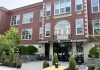
A map provided by Pappalardo shows Shapiro’s property, at 81 Martine St., includes two brick factory buildings – one large and one small – as well as a wood-frame building and some corrugated metal buildings. The parcel is surrounded by MassDevelopment-owned land.
The quasi-public agency already has a deal in place with Meditech for 12.35 acres, all the undeveloped space. But Pappalardo said that after accounting for wetlands and restricted-use contaminated land, the company wouldn’t have enough to build its offices, thus the need for Shapiro’s parcel.
Yet unlike the MassDevelopment land, which has been thoroughly investigated for contamination and remediated to the extent possible, Pappalardo acknowledged that the United Textile site has not yet been examined.
Any environmental issues there, Pappalardo said, would affect the potential purchase price.
Founded by Pappalardo, Meditech is a major health care information software vendor, with $280 million in sales in 2004. Along with its headquarters in Westwood, Mass., it has facilities in Framingham, Lowder Brook, Canton and Norwood.
The Fall River site would be Meditech’s first outside the Metro West/Route 128 cluster, and it was chosen, Pappalardo said, because housing prices are much lower there.
“We are a company that for 36 years has exclusively promoted from within, and hence we tend to hire relatively young people,” he said. Young people don’t stay in the Boston area for long anymore, he said, because “they can’t afford the price of housing – that simple.”
The job applicant pool has shrunk so much in the last five years, Pappalardo added, that Meditech’s future growth is “severely constrained by the unavailability of people.” So the company looked at other Bay State cities, and found itself embraced by Fall River.
Meditech’s plan is to build a four-story building, plus a parking garage – because there’s not enough land for a big enough parking lot, Pappalardo said. The offices would house a mix of software developers and sales, customer service and technical support staff. He wouldn’t say exactly how much the company plans to invest, but he did note that Meditech likes to build “fairly nice” buildings, so he expects this project to cost about $250 per square foot.
In the meantime, Meditech has leased temporary space in the Advanced Technology & Manufacturing Center. Only a handful of people are there now, but up to 60 are to move in.
Asked how Meditech’s plans fit with MassDevelopment’s vision for the site, dubbed the Southcoast Research & Technology Park, spokeswoman Janet Hookailo said it’s “absolutely” what the agency was aiming for, and Meditech is “a very solid Massachusetts employer.”
But across the country, eminent domain remains a touchy subject. After last year’s U.S. Supreme Court ruling upholding the city of New London, Conn.’s right to take private land to give it to another private party for the sake of economic development, Rhode Island Gov. Donald L. Carcieri urged the R.I. Economic Development Corporation to create a policy that would make it clear that the state wouldn’t force people out of their homes like that.
Last month, the EDC agreed to pay $1.65 million to a Smithfield couple whose home and business it had seized by eminent domain in 2002 to give to Fidelity Investments; the agency had decided not to evict them right away, but rather try to settle the dispute.
Yet the Fall River case “sums up the reason why you need to be able to use eminent domain,” said EDC Executive Director Michael McMahon.
“Companies that are growing need space,” he said, and New England is constrained by wetlands, brownfields and a desire not to build on open space. “So if we want to accommodate the forces of growth and smart reuse,” he added, “you’re going to have to ultimately be prepared to use eminent domain.”
McMahon said the key is to have an open process and provide “fair compensation,” which includes the fair market price as well as relocation expenses.
“If you put those elements together, it’s not something you look forward to using, but in certain circumstances. … It’s difficult enough to get companies to grow in New England, and lack of good sites is one of our most pressing needs.”