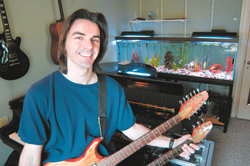
Tony Ricci in his Woonsocket recording studio, which is equipped with such "toys" as several guitars, a grand piano, an old Wurlitzer keyboard - and of course his fish tank.
After cutting sizable overhead, music producer returns to his true passion
Owner: Tony Ricci
Type of Business: Music recording and production
Location: Park Square, Woonsocket
Employees: Two
Year Founded: 1990
Annual Sales: WND
Building a Strong Data Foundation in the Age of AI
Artificial intelligence (AI) has become a key priority in the boardroom and across management —…
Learn More
If you’re a Rhode Island music fan, chances are you own at least one Triad recording. Maybe it’s Becky Chace’s bluesy debut, “Play Me.” Or loud, gritty rock, like the Mill City Rockers’ “Mission.” World music and jazz by Planet Groove. Or power-pop from the Marlowes.
For years, Tony Ricci’s Triad Recording Studio has been one of the largest and best-known studios in the area, with as many as four engineers making hundreds of demos and full-length records in every genre, from classical to heavy metal.
But this spring, Ricci downsized. He vacated the large loft at Warwick’s Pontiac Mills that he’d occupied since 1990, sold off much of his gear, cut down his staff to himself and an apprentice, and moved his operation to the back of his house in Woonsocket.
It was, in part, a business decision: His overhead was “very high.” But mostly, he said, it was about going back to his true love. He hadn’t started Triad to do paperwork, supervise a team of engineers, or oversee a huge loft full of equipment, but that’s what he was doing. He’d also taken a marketing job at Bose, in Framingham, so he was working some 60 hours a week, but rarely doing what he loved most.
Now, he said, “I’ve started making records again.”
Recording is actually one of those rare industries in which being big and being successful don’t necessarily correlate. Some of the best-known producers have small, even one-man operations. Anyone can buy fancy gear, or hire a big staff; what musicians really prize is expertise and creative guidance, the magic touch that will take them to the next level.
That’s where Ricci is now putting his energy.
No longer tied to his big loft, he records in a variety of sites: in his own studio, in larger studios he sublets as needed, and in entirely different spaces, such as St. Paul Church in Cranston, where he recently recorded Passio, a Renaissance vocal group.
“It’s this cavernous space with an acoustic I could’ve never gotten if I’d done it in a studio,” Ricci said.
Artists come in at all hours, and record, listen, revise, even write new songs while Ricci is taping and mixing them. The room where they work is tiny and cozy with a big fish tank on one end and a love seat on the other, and much of the space taken up by “toys” he’s set up for them – a grand piano, several guitars, an old Wurlitzer keyboard.
The process can take days or even months, depending on the scope of the record, and the complexity of the songs. Some artists come in knowing exactly what they want; others seek extensive guidance from Ricci. With most, it’s “a real collaborative partnership,” he said, with Ricci taking the material and suggesting ways to streamline it, make it more radio-friendly, or make it more interesting by adding instruments and sound effects.
But Ricci said he also tries hard to be true to the artists’ own vision.
“My job is not to have a sound; my job is to find out what makes that band unique,” he said. “My biggest hope is that one of the bands who work with me will take hold and take off with their own sound.”
Most of Ricci’s part of each project is done in a control room next to the studio, which is filled with mountains of digital and analog equipment. He still records on 2-inch tape, he said, because the sound quality is warmer and richer. But he’s no old-timer: all the tracks are converted to digital, then mixed with the latest gadgets. One of his most treasured possessions is his 24-track Mackie board, a digital dream toy that memorizes every adjustment he makes throughout a song and reproduces it automatically at the touch of a button.
“I’ve been waiting for this my whole life,” Ricci said. “A board that did this in the mid-80s cost literally $1 million and didn’t do everything this one does.”
The digital age also has drawbacks, though. Home studio equipment is now widely available, he noted, and just cheap enough that many musicians buy it instead of hiring pros. “Technology has just ravaged studios,” Ricci said. “Most bands do it because they want to save money, and they end up spending more.”
The impact on Triad, however, has been primarily in the demo business, Ricci said. For full-length records, bands still want pro-level gear and a professional engineer, so he’s plenty busy. He’s also as happy as he’s been in a long time.
“This is really what it’s all about: being able to be part of the creative process,” he said. “You get done at 4 o’clock in the morning and you’re not tired. You feel great.”