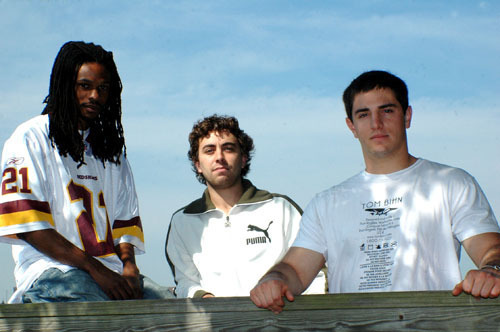
Since news broke that then-New York Gov. Eliot Spitzer was linked to a prostitution ring, at least one company, AimeStreet.com, has profited from the public’s curiosity about “Kristen.” She’s the call girl-musician whose tryst with Spitzer led to his resignation three weeks ago.
The innovative, music-sharing Web site that was started by three Brown University students during their senior year back in 2006 has been mentioned in numerous published articles about the scandal for its role in hosting the music of Ashley Alexandra Dupre, a.k.a. Kristen.
The Web site, comparable to Apple’s iTunes program, allows artists to upload their own music, making their songs available for download. Initially, every song is available free of charge but as the popularity of a song increases, the price also increases until it reaches the maximum price of 98 cents per song.
Dupre, who had one single, “What We Want” uploaded on the site before the scandal broke, quickly uploaded her second single “Move Ya Body,” only hours after the story became public. The song rose to the maximum price within five hours – the fastest climb in the site’s history.
“First and foremost, it’s brought a lot of attention to our business, our Web site, and how we’re trying to change the industry,” said Josh Boltuch, one of AimeStreet’s founders.
Although he wouldn’t disclose any numbers about membership increases, Elias Roman, a co-founder of AimeStreet said “we certainly have seen a significant increase in traffic [and] attention around Ashley’s music.” Her personal-artist page alone has received over 500,000 visits.
AimeStreet keeps 30 percent of every download, but wouldn’t disclose how many times Dupre’s two songs have been downloaded.
The songs, selling at the maximum price, would fetch Dupre 69 cents per download, potentially earning her more than $329,000. If even half of the more than 470,000 people who had listened to her music as of last Tuesday had downloaded it at 98 cents, she would have earned more than $164,000.
By comparison, other artists featured on the site such as These United States, which is listed on the site as one of the most popular bands, has reached the maximum price for the majority of its songs, with 21,000 listens to date. More well-known artists such as Ray Charles, had 1,202 listens last week.
The only other musician that seems to compare is the Barenaked Ladies, who have over 500,000 listens. However, they have 155 songs uploaded, compared with Dupre’s two songs. “The people decide what’s popular, what they want to hear. This clearly shows how all artists, when starting on the same playing field, can really make a name for themselves,” said Boltuch.
Boltuch, who said he has given more than a dozen interviews since the story broke, seems happy about all the publicity. But he’s eager to focus on conveying the image of AimeStreet as what he called “the place to go to discover new music.”
“The next step is continuing to listen to our customers,” he said. “That’s how we built AimeStreet. We have a great relationship with our customers, and [we] respond to people who write us … within 24 hours because they’re the ones driving the music industry, driving all of this,” said Boltuch.
The company was started by Boltuch, Roman and Elliot Breece in an apartment they shared in Providence while attending Brown. The three have finally settled in New York, after an incident in which their landlord called them the night before they were supposed to move and told them she had had a nightmare and decided not to rent to them. After scrambling, they landed in Hicksville, N.Y. and got an office in Queens where they employ 16 people; nine of whom graduated from Brown.
According to Boltuch, the Web site began gaining publicity late in the summer of 2006, which caught the eye of Amazon.com founder Jeff Bezos. The three entrepreneurs were flown out to Seattle to meet with Bezos, where they talked about AimeStreet, their vision, and what they thought of the industry. In August of last year, they announced a significant round of venture funding led by Amazon.
“That’s really when we were able to hire people. Pay ourselves … a little bit of money, anyway,” said Boltuch with a laugh. And the business started to take off from there, enabling them to make deals with record labels and distributors as they became more firmly established.
“Obviously the vote of confidence from Amazon was helpful,” he added. •