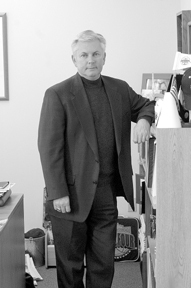
utive director for the state's sports
council.
Council finds new ways to attract events and revenue for the state
John T. Mousseau
Building a Strong Data Foundation in the Age of AI
Artificial intelligence (AI) has become a key priority in the boardroom and across management —…
Learn More
Position: Executive Director, Rhode Island Sports Council
Background: Mousseau is the first and only executive director of the
sports council, which he joined in November 1993. Prior to his current position,
he ran his own sports marketing company, Golf Event Management Group in North
Smithfield, for four years; and before that, he was the executive assistant
to the Rhode Island state treasurer for four years.
Education: Attended Rhode Island College, background in health and
physical education
Residence: North Smithfield
Age: 50
The Rhode Island Sports Council is a public/private partnership between
the state Economic Development Corporation and the Greater Providence Chamber
of Commerce. The two-person council looks to lure various sporting events to
the state as a tourism vehicle and economic generator.
A major coup for the council was attracting ESPN’s alternative X-Games event
in 1995 and 1996. The council also helped to land NBC Sports’ Gravity Games
in 1999, 2000 and 2001.
In its 11 years, the sports council has brought in approximately $300 million
to the state, according to event studies and estimates, Mousseau said.
Q. How did you end up working for the sports council? A. I’ve always had an interest in sports. As I got older and got more
into the different positions, I really gravitated that sports background to
events and event management, it was always something I had an interest in. …
The state economic development corporation saw the value in sports marketing.
They saw what other states and cities were doing around the country in attracting
major sporting events. They saw the value of bringing in all these families,
these competitors to a locale to spend their money, which would have a benefit
on the overall state, not only the host community. So they thought
it would be wise to have a full-time director to go and solicit these events
and extol the benefits of a locale.
Q. What exactly does the sports council do?
A. The main mission of the sports council is to attract major, amateur Q. What’s your funding source? A. With the public/private partnership, the state Legislature will Q. How much is raised at this fund-raiser? A. It’s probably somewhere in the vicinity of $60,000 to $70,000. Q. What are some of the key events the sports council has helped bring A. I think the X-Games was certainly a mark for us because it established Q. How did you initially attract the X-Games? A. What happened was a personal friendship with one of the gentleman Q. How do you market Rhode Island for a sporting event? A. A lot of that is personal contacts, and with a market like this Q. What are the state’s shortcomings when trying to attract a sporting A. When you look at what we have here, the quality of hotel rooms Q. What would you like see done to the Dunkin’ Donuts Center? A. I think a facelift is probably the right thing to do, but you can’t Q. What do sports event planners look for? A. I think the key is they want your cooperation. And that’s one of
and professional sporting events to the state for tourism and economic development
benefit. So when we look at the events we would like to bring here, it could
be a youth soccer tournament that has thousands of young people competing over
a number of days; what that relates to is hotel rooms, rental cars, restaurants,
mall shopping, etc. Or it could be a professional sporting event, or a made-for-television
event such as the X-Games, the Gravity Games where you have all of those elements
but you’re also exposing the entire state to a national and international media
audience. … We estimate the value of (all the) events that have been here, not
including media exposure, but hotel room nights, restaurants, car rentals, and
all of that, we’re probably in excess of $300 million in economic benefits to
the state over that period of time (11 years). We feel pretty comfortable with
those numbers and pretty proud of that, considering the amount of staff we have
and the size of the state and venues that we have here. Your competitions that
you can host are only as good as the venues can provide.
appropriate funds to the EDC which then grants the sports council the funding
(in the range of $125,000 last year, mostly for salaries) and then the Chamber
provides us with the office space, the parking, the travel budgets. Then the
majority of our operational budget is raised privately. We do that through partnership
agreements and one fund-raising event a year, which is turned into an awards
ceremony and a golf tournament and that really funds our operation for the year
to get out there and tell people why they should locate their event in Rhode
Island.
It fluctuates and it’s one of those things: How much can you raise at the event
will determine how much we can go out there and actually market ourselves.
to the state?
alternative sports as a mainstream event and worthy of international media,
but (also) various NCAA championships, regional basketball with NCAA, Frozen
Fours, the American Hockey League All-Star game and this year with the Triple-A
All-Star game, and the tennis and sailing events that have been held here. We
like to say that we’ve had a small part in a lot of those events and some of
our roles vary depending on the event.
(Ron Semaio) from ESPN who actually created the X-Games and my previous (company)
in the sports marketing field. I was involved with the Boston Red Sox Fantasy
Camp. This gentleman happened to be one of the Fantasy Campers. And it was right
before I took this position and I said, ‘I’m going to be doing this for the
state of Rhode Island and you’re doing this for ESPN; there’s got to be something
we can work on together – and with the proximity of your headquarters in Connecticut
and us.’ He said he had a wacky idea and was talking about the Olympics of alternative
sports, and said if he got the green light for it, it was going to be huge.
And I said, ‘We’re interested, what do you need?’ … So it was a relationship
that we started talking. We said: ‘We can do this here; we can accommodate your
needs.’ They came up and met with state officials – and that’s another benefit
of this state, it’s so small. It’s not unusual to bring in the governor, the
mayors or your congressional delegation to sit with corporate leaders and say,
‘We’re going to support you.’
you really have to get in their face and tell them, ‘Here’s why you should come
here, here’s what we have to offer.’ And you have to sell them on the renaissance
of what’s happened here because people have an image of Rhode Island from maybe
20 years ago. They don’t know what’s happened with Providence Place and the
development around the capital city. You almost have to take them by the hand
and bring them out there. … In terms of selling point, I think the biggest asset
we have is the public/private cooperation that is necessary. If you’re dealing
in Rhode Island or you’re dealing in California, the red tape you have to negotiate
in California versus how quickly you can get through that here is going to make
a big difference when it comes time for these proposals.
event?
is there, the number of hotel rooms for some of these events is not, so it’s
something we need to stress the importance of getting more hotel rooms available.
You need to be competitive there, both in number of rooms and pricing of those
hotel rooms. The civic center – you need to get that up to the caliber of other
arenas around the country. It’s centrally located, it’s a great building, but
it’s really tired, it needs some help, it needs some remodeling and then we
can get some of these events.
go into it with a cheap plan. I think a significant remodeling of the facility
would work and it has to be everywhere from the seats to the scoreboard, the
locker rooms, concession areas, the entranceway to the building. The high range
could be $50 million to $70 million and your mid range could be $20 million
to $30 million. I think in that range you’re going to get significant improvements
in that building and have it capable of doing the things we need to do. You
also have the assets that are connected to that, the convention center, The
Westin hotel and the mall. … It goes back to the question of what can you host?
You have to know what your niche market is. I think the Convention Center Authority
and the state and city are on the right path now, it makes sense for that building
to come under the auspices of the Convention Center Authority and let them have
the marketing power of that building, the convention center, The Westin. You’re
selling an entire package and one team’s selling all that.
our strengths. They want to come to a location that’s going to embrace their
event, rather than just tolerate it. They want someone to work with them. And
they’re looking, ultimately, at: ‘How can you reduce the cost of us doing business
in your community.’