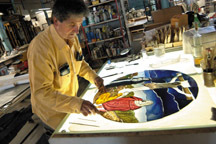
The old mill space is drab and dusty, but on racks, tables and in stacks on the floor, it holds countless exemplars of delicate, multicolored, sometimes exquisite beauty.
Light from a window streams softly through one of Christopher Foster’s latest creations: a window for a new church in Arlington, Va., a Nativity scene set in a blue background. On a small, lighted table, Foster is working on another window: a Crucifixion scene.
Building a Strong Data Foundation in the Age of AI
Artificial intelligence (AI) has become a key priority in the boardroom and across management —…
Learn More
A big restoration project keeps Foster’s two assistants busy: two double-paned stained-glass windows brought up from a church in Long Island. Then there’s an intricate window brought in by an antiques dealer, and a big skylight, broken apart, that Foster needs to repair.
Stained-glass work is not for most people, Foster freely admits: restoration, especially, is “just boring, meticulous, seemingly endless work.” One wrong move, and a day’s work is shattered. And just finding the perfect color for a tiny pane can be a project.
But the payoff is magic – whether it’s a spring morning’s light through a clear blue pane, or the ruby red of a glass butterfly, or the soft blush on a face painted with enamel. For 40 years, that magic has kept Foster going: first in New York City, then in Newport, then in Providence, and now here, in his biggest studio ever, bought and refurbished in 2003.
Foster’s old studio, on Tingley Street, was only 2,000 square feet. The Lincoln mill is more than 10,000 square feet. He set a room aside to teach classes – he has beginners’ lessons on Saturdays, and an intermediate class on Thursdays – and he’s been able to do more projects at once.
Business is steady, a mix of new commissions and restoration. Right now the volume of restorations is particularly high, Foster said: churches, historic houses, salvaged items. New work is more competitive – big studios tend to dominate – but stained-glass restorers are a rare breed.
Foster has done restorations for Kingscote, the 1841 Newport mansion, and for churches from Newport, to Wakefield, to Providence, Catholic and Protestant alike. Most of his clientele comes through referrals, he said – the Arlington project, for example, came after he did work for St. Ephraim Church in Central Falls. Antique dealers and architects recommend him.
He buys the glass from dealers across the nation: clear, opaque, smooth, textured, in single colors and variegated, with all kinds of unusual patterns. Most of it is rolled glass, which is what most Americans use, Foster said. But he also gets some sheets of blown glass, the European favorite, and six to eight times more expensive.
“It’s crisper,” he said. “It has a very clear, crisp, beautiful quality to it – very transparent.”
The glass comes in big sheets, and Foster and his assistants cut pieces as needed. For every color, they have dozens of choices. Even a single manufacturer’s color #11, say, may be available in a half-dozen variations: clear, clear and textured, opalescent, opaque, a lighter opaque.
“It’s endless – you can go crazy with it,” he said.
Some of Foster’s suppliers have been making glass for over a century; one, from Kokomo, Ind., started in 1888, for example. “And they haven’t changed how they do things, which is good for me,” he said, because he needs old-style glass for his restoration work.
In small amounts, Foster is also beginning to make his own glass. He’d always dreamed of having his own furnace, and here he finally was able to install one. He’s not blowing glass, but pressing it into dies: magnolias, a cherub.
As experienced as Foster is in assembling stained glass, this part is still relatively new, and the chemistry of glass-making is still a treat for him: the way copper oxide blended with the sand makes a turquoise-toned glass, but when you add tin as well, it’s red; or how sodium nitrate, which gives glass a finer texture, neutralizes the amber-brown coloring of coal.
Sometimes it’s frustrating – he really didn’t want the coal turned into carbon dioxide – but experimentation is part of the fun of the job, Foster said, and he’s had many a “happy accident.”
The challenges, even after 40 years, also give Foster a healthy respect for his historical predecessors. “What amazes me,” he said, “is how the Medievalists, without all our technology, managed to do it.”