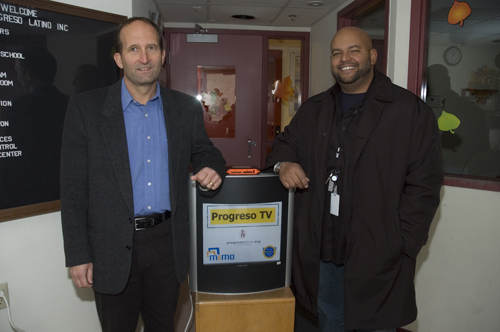
John Zib is an entrepreneur with a new vision for the way digital signage can be distributed to businesses and used by businesses.
He has partnered with the nonprofit Progreso Latino and the R.I. Small Business Development Center to provide digital signage to Latino business owners at a discounted price of less than $500 so that they can promote themselves – as long as they also advertise services provided by Progreso Latino and the SBDC.
The signs could display other community information as well, such as the details of a missing child, clinic locations, or dates, times and places for voting.
“It’s empowerment through technology,” said George Ortiz, chief operating officer for Progreso Latino, who met Zib at a networking event after moving to Rhode Island around the same time, about a year and a half ago. “We’re focused on mid-road to startup businesses. They don’t have a lot of money for marketing … it’s going to create much-needed advertising and … a sense of community.”
The benefit for Mëmo, Zib’s startup digital media company, is that it shows people can benefit from using the technology for community building. Until now digital signage has been used mostly in large deals with national brand advertisers for installations in airports, hotels and retail stores.
Zib would like to make the new digital media “available to anybody,” he said, by selling the digital signage to sign stores, which will then sell the product to the end user, which could be an individual company or a chain.
Bridging the $6 billion sign industry, which experienced about 5-percent growth from 2005 to 2006, and the $1 billion digital sign industry, which experienced about 25-percent growth in the same period, “is key to crossing the chasm,” Zib said.
But first the California native must test the business model in a regional market, separate from the partnership with Progreso Latino.
Zib is testing the Northeast regional market with seed money from local investors, but he said he is still looking for additional funding to close the seed round.
He has been actively speaking with angel investors in addition to representatives from the R.I. Economic Development Corporation, the SBDC, the Providence Geeks and the Brown Forum for Enterprise. He also has been attending networking events in Boston and Providence, he said.
Meanwhile, the company has aligned itself with Vista System, a sign company based in Sarasota, Fla. And it has gotten approved to distribute digital sign brands, such as Digital View and Nexus Media, to the sign trade.
Zib’s goal is to get 50,000 digital signs into the mass market in five years. He hopes to establish Mëmo headquarters in Rhode Island and hire between 10 and 15 people.
The real challenge is going to be refining the platform for the launch, he said, because “people don’t know what it is or how to use” digital signage.
Ortiz agreed. He said he thinks Rhode Island is behind other parts of the country such as California and Atlanta, where he’s seen many more digital signs during recent trips.
But that unawareness could be a bonus for Zib because it means he’s ahead of the curve.
“The thought is that a lot of these [digital signage networks] are going to be aggregated,” Zib said. “That’s how the cable TV networks were established. All of these small networks were created and then became aggregated. I think that will happen.” •