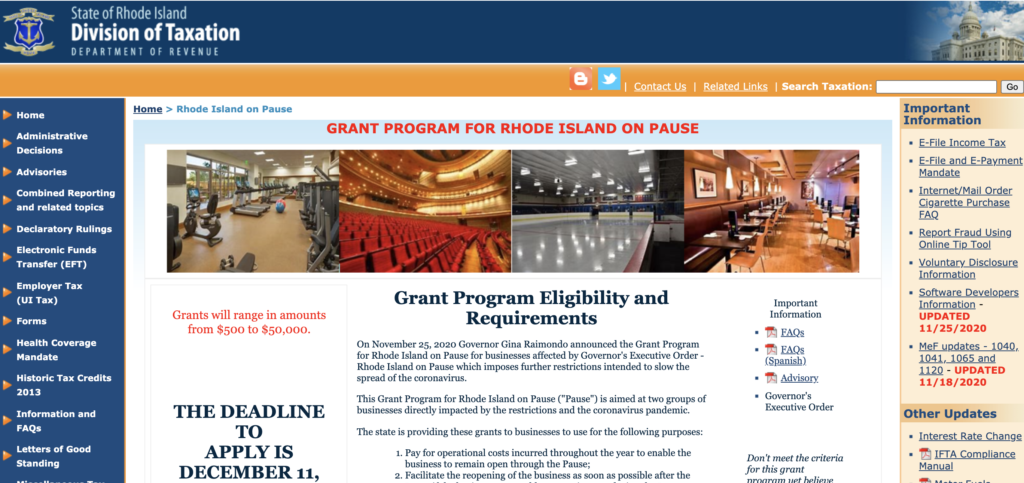
PROVIDENCE – More flexibility in how R.I businesses can apply for state grant funds during the two-week pause is expected to help grow demand, with 1,800 verified applications received since the program began, R.I. Department of Revenue Director Jim Thorsen said Thursday.
Thorsen outlined changes to the $50 million Grant Program for Rhode Island on Pause, which launched Nov. 27, during a House Oversight Committee meeting. The program offers businesses in eligible industries $500 to $50,000 in grants to help offset the losses during the two-week period of shutdowns and additional restrictions on business operations.
ISO 9001:2026: A Practical Opportunity to Build for What’s Next
For Rhode Island manufacturers, ISO 9001 has been much more than a certificate on the…
Learn More
Grant amounts for restaurants and bars are determined based on the difference in sales in May 2019 versus May 2020, as well as the meals and beverage and sales taxes paid in September 2020, according to information presented to the House Oversight Committee Thursday. For other eligible industries, grants reflect 4% of 2019 net taxable income, or 2019 gross receipts.
Calculating grants based on gross receipts rather than net income was added as an option Wednesday in response to concerns by impacted businesses, according to Thorsen. The alternate application documentation can be used by indoor recreation and entertainment businesses, gyms and fitness centers, indoor sports facilities and “event support professionals.” Those who have already applied can resubmit with the new financial documentation – 2019 federal tax returns and other financial documents detailing their gross receipts.
“Reapplying may take additional effort, but the result is likely to be an increased grant payment,” R.I. Tax Administrator Neena Savage said in a statement.
Asked why gross receipts were not originally included as an option off which to determine grant amounts, Brett Smiley, the R.I. director of administration, explained the state’s desire to balance serving businesses with being able to verify income. Allowing businesses to use gross receipts, based on tax return documents, is not as easy or simple to verify as the net income originally required. But after hearing from the business community that net income alone was insufficient, the state opted to expand its options, Smiley said.
The Department of Revenue will verify applications that use gross receipts from federal tax returns through a post-application audit, Thorsen said.
As of Dec. 3, more than 1,870 “signed” applications have been verified based on submitted tax documents, with another 450 submitted but awaiting verification, according to R.I. Department of Revenue spokesperson Paul Grimaldi,
Thorsen said in the committee hearing he expected application volume to increase “in the near future.”
Of the signed applications, just under 900 came from restaurants, followed by 379 from gyms and fitness centers and 270 from event services professionals.
Details on how much funding has been requested or approved was not available.
Other industries eligible for state grant funds such as restaurants, food trucks, caterers, bars, and movie theaters must use their net taxable income when submitting their applications.
The application, as well as updated FAQs on the program, may be found here.
Nancy Lavin is a PBN staff writer. You may reach her at Lavin@PBN.com.
This story has been updated throughout to clarify the reasons for expanding the program and current participation in the program.