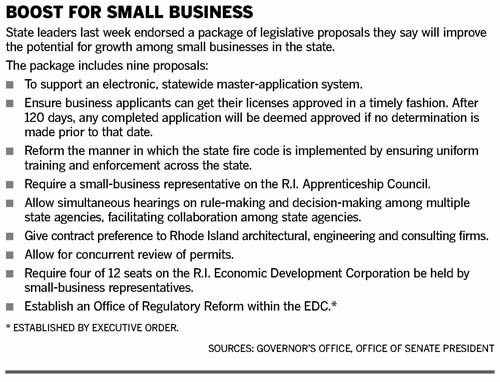
State leaders unveiled a package of legislative proposals last week aimed at removing regulatory barriers and fostering growth for small businesses in Rhode Island.
Eight of the nine proposals look to cut through existing regulatory red tape, including: speeding decisions on permits and licenses; creating an online, one-stop-shopping, master-application system for Rhode Island; ensuring uniform implementation of the state’s fire code and allowing concurrent review of permits, where applicable.
The ninth proposal, to create an Office of Regulatory Reform to be housed at the R.I. Economic Development Corporation, was established by an executive order signed by Gov. Donald L. Carcieri.
“It’s critical that we revamp our approach to economic development by focusing on three initiatives that are critical to the state’s economic recovery: improving access to capital; aligning our work force-development efforts with the emerging job market; and removing regulatory burdens that hamper business growth,” Carcieri said.
Among those joining Carcieri and House and Senate leaders in endorsing the legislative package were Keith W. Stokes, executive director of the EDC, and Laurie White, president of the Greater Providence Chamber of Commerce.
The gathering underscored ongoing cooperation and collaboration between the House, the Senate and the governor’s office, according to Sen. Erin Lynch, D-Warwick, who served as chair of the Senate’s Small Business Task Force. The task force held statewide hearings in 2009 and 2010, and many of the proposals unveiled last week were drawn directly from testimony by small-business owners.
Among its responsibilities, the new Office of Regulatory Reform will:
• Gather and report statistics, recommend legislative and regulatory changes, and develop and make uniform permitting processes that will be available online.
• Coordinate services and programs offered by the EDC more effectively and intervene in regulatory matters where necessary.
Cities and towns will be encouraged to designate a liaison to coordinate the creation of an economic plan and to work with the regulatory-reform office to develop new policies and procedures.
As the owner of a growing small business, which increased from three to seven employees in the last four months, Eric Offenberg, the founder of rTerra, a renewable energy firm in Middletown, was pleased to hear about the proposal to cut through Rhode Island’s jumble of regulations. “It’s a long time coming; we needed something to happen,” he said.
Offenberg, who had testified at one of the hearings held by the Senate Task Force, had recommended that a statewide ordinance be put in place for wind development in Rhode Island. That, he said, should be the next priority in regulatory reform. “I will tell you right now, we are spending most of our time doing solar in Massachusetts,” he said. “In Rhode Island, it’s difficult to do wind.”
Judy Clappin, owner of Donovan Travel, with offices in East Greenwich and Newport, had testified about the need to give preference to Rhode Island small businesses for state contracting. The new legislative package would do that – but only for architectural, engineering and consulting forms.
“Why should it just be architects and engineers, and not the travel industry or other industries?” she said. “The state awards contracts every day. There are a lot of good, tax-paying businesses that would not have a problem handling state contracts.” •