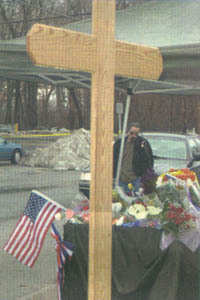
The site of The Station Nightclub in West Warwick became a makeshift memorial after the tragedy, with many visitors pausing to leave flowers and say a prayer.
It took just moments for sparks to turn a West Warwick nightclub into a death trap. But the scars left from the deadly fire three years ago, on Feb. 20, 2003, may never be erased.
The blaze started as heavy metal band Great White took the stage at The Station, a nightclub on Cowessett Avenue best known for booking tribute acts and rock groups of yesteryear.
As the audience drank and danced to the music, pyrotechnics set off by the band’s road manager, Daniel Biechele, during the first song sent off sparks that ignited soundproofing foam along the walls and ceiling. Soon the wood-frame structure was engulfed in flames.
Building a Strong Data Foundation in the Age of AI
Artificial intelligence (AI) has become a key priority in the boardroom and across management —…
Learn More
For about two minutes, the club’s patrons scrambled to its doors and jumped out of its windows. Roughly 300 escaped, some with serious injuries; 100 either perished inside, or died from their injuries at area hospitals.
It was the deadliest fire in Rhode Island history, and one of the worst nightclub fires ever in the United States.
Afterward, officials said the highly flammable foam, the lack of sprinklers, poorly marked exits, and overcrowding all had contributed to the high death toll. In response, legislators made sweeping changes to the state’s fire code.
Among the law’s new requirements was a mandate that food and beverage establishments with capacities greater than 300 have sprinklers by July 1, 2005, and those with capacities of 150 to 300 install sprinklers by next July 1.
Combined with tougher enforcement of the existing codes, the new requirements cost many businesses tens of thousands of dollars. Some just shut down, said Rhode Island Hospitality and Tourism Association board Chairman Brian Casey.
However, he said, most establishments within the state’s hospitality industry have chosen to comply. “I believe that some [of the changes are] overreaching, but for the most part, they needed to be done,” Casey said. “You want great service when you go to a restaurant, and this is part of great service – being safe.”
State Rep. Peter T. Ginaitt, D-Warwick, a now-retired Warwick firefighter who worked on triage of the injured on the night of The Station fire, said in a recent interview that from his perspective, one of the key provisions of the new law was the elimination of “grandfather” rights for establishments that weren’t in compliance with fire codes.
Before the changes were unanimously approved by the General Assembly in 2003, bars and restaurants didn’t necessarily have to update their buildings as fire codes changed.
“Some buildings had no protection at all because they were too old,” Ginaitt said. “Those were the buildings that you obviously wanted to see a greater amount of protection for.
For a lot of reasons, they were probably less safe than brand-new … buildings.”
The code changes were accompanied by upgrades to communications systems and other public safety efforts that Ginaitt said have made Rhode Island a safer place to live in and visit.
“You always prepare for the worst,” Ginaitt said. “However, you hope that you never have to experience it.”
The aftermath of the tragedy has also played itself out in the courts. First it was discovered that The Station had carried no workers’ compensation coverage for its employees, four of whom died in the fire. Club owners Jeffrey and Michael Derderian were fined $1 million; after a lengthy appeal process, the R.I. Workers’ Compensation Court deemed them personally liable for the penalty.
Separately, in December 2003, Biechele, the Great White road manager, and the Derderian brothers were each indicted on 200 counts of involuntary manslaughter (based on two different theories of culpability) for their respective roles in the fire.
This month, as part of a plea agreement with Attorney General Patrick C. Lynch, Biechele pleaded guilty to 100 counts, and the other 100 were dismissed. He is to be sentenced on May 8, and faces up to 10 years in prison. The Derderians, meanwhile, are still awaiting trial.
In addition, victims and their families have sued the Derderians in state and federal courts. The cases were eventually consolidated in U.S. District Court and are moving through the system. One key defendant, Essex Insurance Co., which was being sued for its alleged negligence in inspecting The Station, had the case against it dismissed recently.
Other major defendants remain, however, including town and state fire inspectors, companies that helped promote the show, Great White, and the presumed manufacturer of the foam.
Three years after the fire, Ginaitt said, its impact is still felt.
When he travels to public safety conferences, he said, the topic invariably comes up. And when he speaks to people who, like him, worked to save lives that Thursday night, the pain is still evident.
“If you talk to health care workers in hospitals, they still remember like it was a week ago,” Ginaitt said. “Firefighters are the same way. … A lot of people that I think were just good public safety people were immersed into something that was worse than they had ever imagined.”