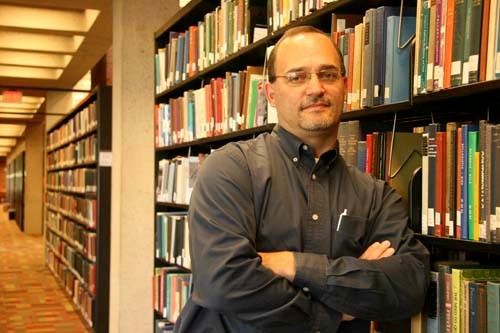
As Matt Berard entered his 40s, he realized he was ready for a change. So after being out of college for 24 years, he decided to go back.
He continued his work in retail management and enrolled in Providence College’s School of Continuing Education. “I had a couple people tell me going back to school is one of the best things you can do for yourself,” he said. He originally studied liberal arts classes but after listening to school counselors, “PC steered me in the right direction and career.”
He graduated in May with the help of financial aid and scholarships and started a new job employed at the R.I. Office of Rehabilitation Services, where he assist people with disabilities find and maintain work.
Returning to school after age 40 has become increasingly common, according to local colleges, as workers have struggled to stay employed or find satisfying jobs in a down economy.
And Berard’s success finding a new career is not uncommon, at least for social work, for those willing to make the necessary changes, according to the Brown School at Washington University in St. Louis.
The school surveyed older graduates from its Social Work school and found that most of the older students who either began college or were looking for a change found success.
“With this trend towards working longer, educational institutions have been trying to figure out their role in keeping up with the needs of our aging society,” said Nancy Morrow-Howell, the Ralph and Muriel Pumphrey professor of social work at the Brown School.
The Brown School decided to study the experiences of their students who came to get their master’s in social work after the age of 40. The survey focused on pathways to graduate school, their experience in the classroom as well as the field, and their post-master’s of social work careers.
“As part of our Next Move project, we surveyed our students [older than] 40 from the past 10 years to find out if their efforts were worth it and if there was anything the school could do to improve the experience,” she said.
Overall, the findings were positive.
“We found that people came, they did well, they went out and accomplished their plans, they got into the careers they wanted and they looked very favorably at their experience,” Morrow-Howell said.
Berard’s wife was instrumental in getting him motivated, he said.
“She basically kicked me in the butt and kicked me back to starting school,” he said. His kids also love it because some of them were in college at the same time he was. Berard was the recipient of Providence College’s School of Continuing Education Illuminations Award at the graduation banquet. The award is unique to the School of Continuing Education.
It was created to recognize the many accomplishments of continuing-education students, both inside and outside the classroom and the journey of the nontraditional student
Berard, 44, returned to school to complete his degree in 2009. Once he got started he was determined to finish, and generally took four courses each semester. In the meantime, he continued working full-time and spent time with is wife and six kids.
“When I first met Matt, he was a speaker at an orientation for new students in the fall of 2009 – which was also an orientation for me, as a new dean,” said Janet Castleman, dean of the school of continuing education at Providence College. “I remember being impressed by how motivated and motivating of others he was … Matt’s involvement in SCE went beyond the classroom.”
Berard found time to volunteer as a mentor for new students and to serve on the graduation-planning committee.
He believes his education not only helped his career, but helped make him a better person.
While enrolled in the School for Continuing Education, Berard found a new calling, to assist others seeking employment.
He became an employment specialist with the state of Rhode Island and is now enrolled in a master’s program in vocational counseling at Salve Regina University.
He maintains close contact with Providence College’s School of Continuing Education and continues to serve as a peer mentor.
“I work with professional programs, laid off people or those who have lost their jobs,” he said. “And they are highly motivated and extremely focused, with a good skill-set.”
Also, bringing real-world experience into higher education makes a big difference in their success, O’Leary said.
Morrow-Howell said she learned additional information about the program when she conducted the Brown School study.
While the students enjoyed their experience at the Brown School, survey respondents commented that the instructors and their classmates could have taken more advantage of their life and work experience.
The survey results suggest that teachers could be more creative in using previous experience in assignments and discussions. Further, the curriculum must help these students take advantage of skills that are transferring from the for-profit sector.
“The classroom will be more enriching for everybody if there are people of all ages,” Morrow-Howell said. “We should begin to see age as an important part of diversity as much as we see ethnicity and gender and sexual orientation as aspects of diversity.”
She notes that the survey results also are making the Brown School take a hard look at how to reach out to older students.
Renee Vachon Danho was recently hired as associate vice president for professional studies and continuing education at Rhode Island College. She says students who choose to enroll in college after entering the work force, or those who are returning to college to retrain for career changes, bring a broader range of talent and a real-world perspective.
“To the classroom, that is priceless,” she said. “These students are often able to link practical applications to academic concepts.”
As a result, they contribute uniquely to a dynamic and relevant classroom experience, she said. •