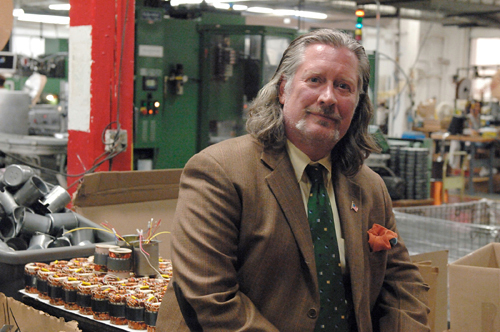
John Hazen White Jr. is president of Taco Inc., one of the Rhode Island’s largest manufacturing operations. Founded by his grandfather, Elwood White, the Cranston-based company has been owned and run by his family for the almost 90 years. Taco Inc. makes pumps, valves, thermostats, expansion tanks and other components used in heating and cooling systems, and sells around the world. The company employs more than 500 people, and boasts annual sales in excess of $100 million. White is also known to Rhode Islanders as a prominent spokesman for government reform, as was his father, the late John Hazen White Sr.
On June 10, White will be panelist in a discussion titled “Prepare Your Company for Doing Business in Greater China,” starting at 6:30 p.m. at the Advanced Technology and Manufacturing Center in Fall River. The event is sponsored by the Southern New England Entrepreneurs Forum of the University of Massachusetts Dartmouth.
PBN: What exactly is your company doing in China?
WHITE: Mostly we’re purchasing materials, components for our products. People get the idea that in manufacturing, the most important thing is cheap labor, but they are wrong. What’s most important is finding competitively priced materials.
Seifert Systems Invests in Energy Efficiency to Strengthen Operations
For manufacturers, energy is more than just another operating expense. It plays a critical role…
Learn More
PBN: Do you have any plans for manufacturing there?
WHITE: China is an interesting place because it’s going to remain a competitive market for some time. I do see it as a possible place to manufacture our products, but only for sale in the Far East. The market there is so big that at some point, we’ll have to if we’re going to sell there. But I don’t see us manufacturing there for imports into this country.
PBN: Why not? PBN: When might your company begin some manufacturing in China? PBN: There have been some recent headlines about quality control in Chinese plants, and some scary stories about contaminants in dog food and in children’s toys. Is that a concern? PBN: China is said to be adding almost two billion square meters of new building space every year. I suppose it’s that construction boom that has you looking at the country as a market. PBN: How did the company begin developing business overseas? PBN: What advice would you give companies looking to do business in China or other Far East countries? PBN: You have been an advocate for keeping manufacturing jobs at home. What would you say to companies looking to move their operations overseas?
WHITE: At this point, I just don’t see that it offers us any advantage. We have a plant here and a great work force. I can’t see a huge value from a cost standpoint.
WHITE: Actually we’re in talks right now.
WHITE: That’s been a problem in some individual cases. It comes down to this: If you don’t manage things properly, no matter where you are, you will have problems. We’re very much involved with our suppliers. We know they have a good track record. And we’re not talking about drinking straws here. We’re talking about significant components.
WHITE: Of course. But it is a competitive market, because they do have their own suppliers. But at this point, though, I don’t think those suppliers can meet that kind of demand.
WHITE: Years and years and years ago, we began purchasing some basic components in China, and at one point in the mid-’90s, we began selling quite a bit in China, too. We have been involved in that part of the world – China, Korea – for the better part of 20 years. It’s a great market. I’ve always found the Chinese and Koreans to be good people to do business with.
PBN: About 10 years ago Fortune magazine was advising its readers that corruption in China could add 5 percent to operating costs for an American company doing business there. What has your experience been?
WHITE: Keep in mind that it’s not all that simple. For example, until not so long ago – and maybe it’s still true – you couldn’t own a whole company in China. You had to share ownership with the Chinese. My advice would be, take the time to really understand the culture.
Sometimes the expectations overseas are very different. Americans tend to walk into a country and assume that everyone thinks like we do. You see American companies doing business in China, and they will have lawyers churning out reams of documents, just as if they are doing business with another American company. That’s foolish. They don’t operate the same way we do.
I spent a number of years traveling in China and Korea, getting to know the people and the culture, before we did any business there. I was young at the time, and I was able to take the time for that sort of thing.
WHITE: Again, the difference between Taco and some other companies is that we’re not looking for cheap labor. We’re there because we’re looking to purchase components at a worldwide competitive price. If you invest the time in training employees here, you can prosper here. •