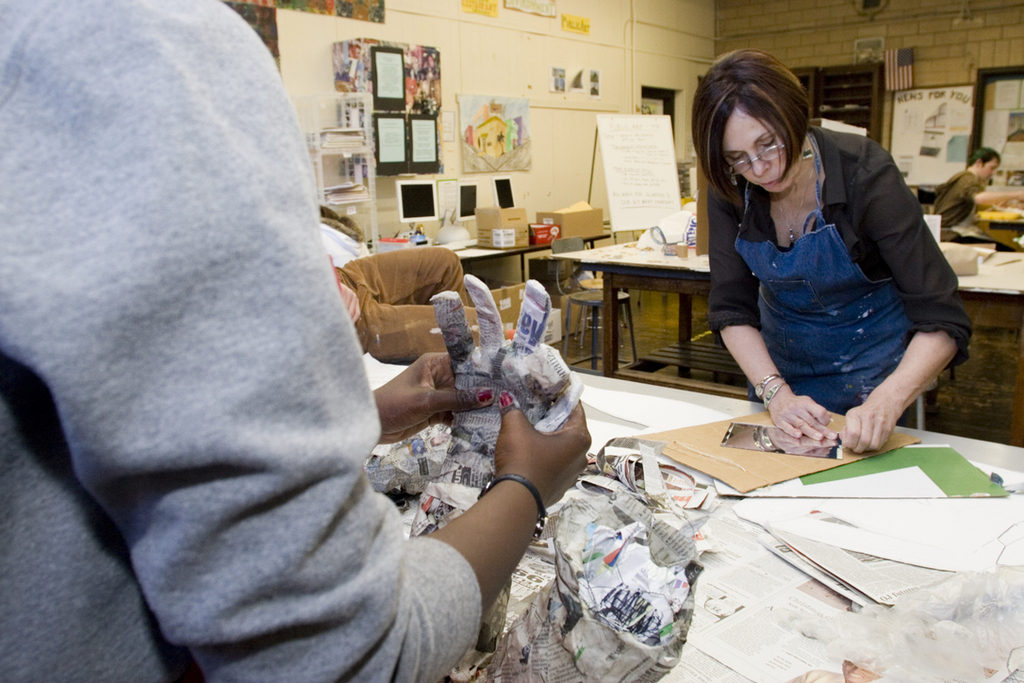
Almost five years after Rhode Island School of Design began working with Providence’s struggling Hope High School, a key part of the effort is coming to fruition, with a visual arts curriculum implemented this year that RISD hopes can be a national model.
The curriculum is being used in Hope’s Arts Community, one of three small schools housed under the same roof. It was created by three Hope teachers and Paul Sproll, head of RISD’s department of art and design education.
For each grade, the curriculum sets detailed learning goals and a “theme” to serve as the focus for each quarter, incorporating critical thinking and problem-solving throughout.
This year’s themes for the ninth grade, for example, are identity, imagination, environment and growth, while 12th-graders are focusing on power, spirituality, time and structure.
Valerie Kline, chair of the arts department at Hope art department and the 12th grade visual arts teacher, said that by using the themes, students go beyond just learning the medium they are working with and are able to develop analytical skills.
“It cultivates a climate of investigation,” she said. “It causes them to think, and you have this very rich conversation. With power they have to think about who has power, what is power, do you have power? Then they have to think: How they’re going to analyze that and make it visual?”
RISD long has been a resource for arts educators in Rhode Island, and it was through Kline’s involvement with Sproll’s programs that the Hope partnership was born. Both schools began talking about a formal relationship in 2002, and in 2003, they signed an agreement.
But that was the year in which Hope was broken up into three schools (the other two focus on leadership and information technology), and the transition was difficult, with major changes both in the administration and the faculty.
That fall, a Hope graduate, José Castillo, enrolled at RISD under a new scholarship program created as part of the agreement, while Sproll worked with teachers to start determining how RISD could be most helpful to Hope. Yet not much progress was made.
“We had to be patient,” Kline said. “We lost half of our faculty and got all new administrators, so we wanted to make sure everything was in place before we proceeded.”
In 2005, after all three Hope units got new principals – Scott Sutherland for Hope Arts – the school and RISD signed a new memorandum of understanding and got to work on the plans.
Armed with a $5,000 grant from the R.I. State Council on the Arts, the visual arts teachers set out to rebuild the curriculum from the ground up. Sproll took a sabbatical in the 2005-06 academic year, and he spent it at Hope, working on the new curriculum with Kline and her colleagues Amy Weigand and Laura Travis.
“The more I, as a professor, can be actively involved in a school, the more authentic I can be as a teacher educator,” he said. “We’re always talking about things in theory, and here we have a chance to go beyond theory.”
RISD President Roger Mandle, a strong supporter of the Hope initiative, said the collaboration is important for RISD in two ways. First of all, he said, it strengthens RISD’s teacher education program by giving students “real-life experience in teaching situations that they are likely to confront in their professional careers.”
Secondly, he said, “it allows RISD to manifest its mission in public service by utilizing our faculty and our students to help improve the public school system.” He added: “We do this out of enlightened self-interest, because there are precious few students in our region and our state who are qualified to get into RISD, and we are working to improve the potential for local students to come here.”
The partnership has garnered national attention as well. In March, Sarah Cunningham, director of arts education for the National Endowment for the Arts, visited Hope to learn more about the project. “I think it’s a model that can be applied to other secondary schools not only in our state, but anywhere,” Mandle said.
But the collaboration has made its biggest impact on the students. Not all see the new curriculum as a big deal, but some, such as senior David Rocha, say it has greatly improved their learning experience.
“In other years, there would be assignments where you have to do this and you have to do that, but this year they give you one word and you’d have a month to work on it,” he said. For the power theme, for example, “it took me a while to come up with something, but I decided to do photography and I did a picture of myself six times in one space.”
While there was “really no fun” in some of the old assignments, he said, “with this I get to be more creative.”
That link between the curriculum and the students is what Sproll finds most rewarding. By discovering “progressive” ways of teaching art and design, he said, “it provides a wonderful opportunity to see the connection between theory and practice.”
The teachers also enjoy the new curriculum and, according to Kline, some in other departments are starting to look at ways to integrate themes into their lesson plans the way many already incorporate art.
“Lots of our teachers do integrate art already,” she said. “It’s not uncommon to go into a biology or a math class and see students showing what they know in an artistic way.”
Additionally RISD is now planning its second professional development event for Hope Arts teachers. This year it will focus on using stories and digital story-telling.
Hope students are also benefiting from programs on the RISD campus. Rocha participated in RISD’s pre-college summer program, and he’s participated in the Hope at RISD after-school programs for three years, including a portfolio class for seniors that helps students put together college applications.
“I’m there almost every day after school,” Rocha said. “If I didn’t come to this school and this school didn’t have a partnership with RISD, I don’t know how I would’ve been able to pursue a career in visual arts.”
Rocha has applied to Rhode Island College, Emmanuel College in Boston, Montserrat College of Art in Beverly, Mass., and The Art Institute of Boston. So far he has received acceptance letters from The Art Institute and Montserrat College.
As for Castillo, the first scholarship recipient, Mandle said he’s doing an internship in New York now, and he’s preparing to graduate this spring, with a degree in apparel design.