By 10 a.m. on Sept. 7, the outline of a new showcase to feature Rhode Island’s technology entrepreneurs for investors had emerged in the business-environment forum at “Let’s Make It Happen RI” and talks were turning to sponsors.
Down the hall, Providence’s economic-development director and an executive from health care nonprofit Lifespan were finding common ground on a Rhode Island investment vehicle seeded by the state’s largest endowments.
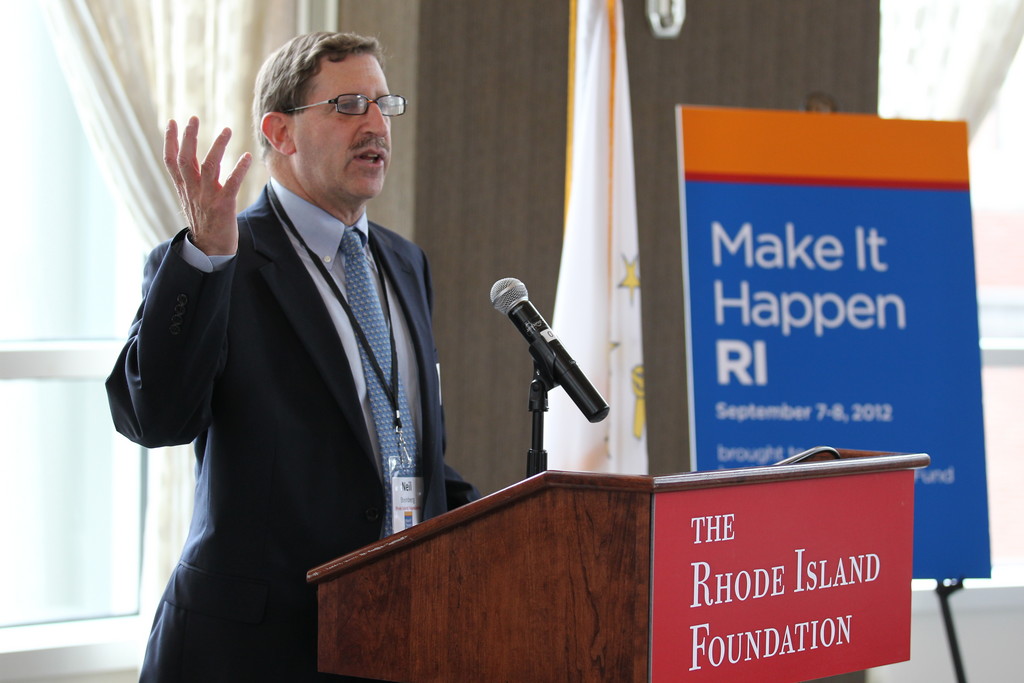
By lunch, hundreds of ideas had been brainstormed, illustrated and networked at Make It Happen, The Rhode Island Foundation’s two-day Ocean State economic intervention held Sept. 7-8 at the Rhode Island Convention Center.
The ideas included public-private partnerships, new internships and more.
But as organizers noted, the real work regrowing the state’s economy began Sept. 10, when the 330 attendees returned to work faced with putting those ideas into practice.
For that, the hundreds of individual connections and conversations imbued with state solidarity at Make It Happen may prove as valuable as the thousands of words of suggestions foundation staff compile over the next few weeks.
“I think there will be some big themes, but this could end up with the individual pieces being bigger than the sum of the parts,” said Rhode Island Foundation President and CEO Neil Steinberg. “There was a current of instant collaborations within groups and I think there might be things that come percolating out. If two good ideas come from each of the 18 break-out rooms, that’s 26 good ideas.”
Lifespan Senior Vice President Brandon Melton returned to the office Sept. 10 talking to his staff about several of those Make It Happen ideas, including the plan that would tap into his organization’s $1 billion endowment to stimulate Ocean State employment.
“One aspect of the endowment is that we need that money in the future for a rainy day,” Melton told Providence Business News. “We have the second-highest unemployment rate and 60,000 people out of work: I think it is raining.”
As suggested by Providence Economic Development Director James Bennett, the idea was to approach nonprofits with large endowments invested on Wall Street and convince them to put a piece in a fund seeding Rhode Island companies.
Bennett said he envisioned the fund in the range of $100 million and the idea drew support.
Melton said he would take the idea to the top of Lifespan leadership, but personally envisioned investing the money, instead of in startups, directly in education and workforce training. Closing the “skills gap,” a phenomenon blamed for leaving so many employers, especially in health care, unable to find workers despite the large numbers of unemployed, was a recurring theme at Make It Happen.
At the attack-unemployment forum, mention of the skills gap in health care led directly to calls to build a joint nursing center in Providence, a popular plan stuck in the state’s political weeds this year.
Another Make It Happen idea that appeared to have legs emerged from the notion that Rhode Island’s top technology entrepreneurs could use a venue to showcase their innovations to investors.
Such showcases already exist in technology hubs like Boston and Silicon Valley.
The idea caught on with Slater Technology Fund Senior Managing Director Richard Horan, who volunteered to have his public-venture capital fund organize such an event here.
“The idea was really to showcase some of the more compelling entrepreneurial startups in our midst and some of the more compelling science and technology innovation projects emerging from their labs,” Horan said. “We know some of these companies well.”
Described on the drawing board as a “science fair,” Horan said the investor showcase could be put together in the coming months.
The skills-gap discussion produced another popular idea, to match the top 50 private-sector employers in the state with the 50 worst-performing public schools in a mentorship, job-training collaboration.
Other well-received ideas included:
• Having businesses pool their resources to fund internships for MBA candidates and other students in common office space with an incubator feel.
• Creating better lines of business-to-business communication throughout the state.
• Building a partnership between the state’s colleges and universities focused on job creation and economic growth.
Steinberg said the foundation will reach out to individuals who might be able to make some of the ideas happen and help spur them toward action.
“We want to have it somewhat coordinated, because you don’t want people doing the same thing,” Steinberg said. “We all want to be here in a year and have an event called ‘Made It Happen.’ ” •