
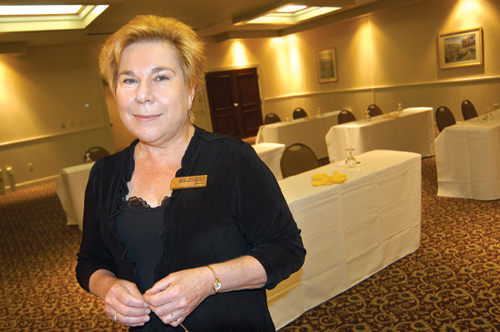
When the Lifespan hospital group’s Vice President and Chief Technology Officer David Hemendinger is choosing where to host a major corporate meeting, the list of logistics he checks out makes it sound as if he were planning a Madonna concert as opposed to a gathering of hospital executives. Lighting, speakers, video feeds, screen sizes – these are just a few of the considerations he takes into account.
“There’s no question about it – these can end up being big productions,” Hemendinger said. “For me, it’s all about what technology exists within the venue.”
Hemendinger – whose staff plans about 10 major events a year, as well as smaller gatherings – said he has seen a major evolution over the past decade in the technical sophistication of meeting presentations. “I’ve seen many of the presentations go from what you typically might think of as a standard overhead PowerPoint slide deck to a multimedia experience, with lights, voice and videos,” he said.
In Rhode Island and across the country, technology has become integrated into all aspects of meetings and conventions – not only in presentations, but also throughout all stages of the planning process.
“Technology has changed the world of meetings and conventions in much the same way it has affected any other area of business: communication can occur more quickly and efficiently, while people are in transit,” Michael Shapiro, a senior editor at Meetings & Conventions magazine, said in an e-mail.
“A great deal of venue and destination research can be done online, before conducting in-person site inspections,” Shapiro continued. “Attendee registration is a more streamlined process. During the events, tradeshow traffic and seminar attendance can be tracked using RFID technology on attendee badges; audience feedback can be obtained nearly instantaneously using polling and survey systems. Show programs or event agendas can be downloaded to mobile devices.”
He added, “This isn’t to say that large events have all of these systems in place, but the possibilities exist.”
The Internet has spurred the biggest changes in the industry, according to Marie Bouchard, director of sales for the Radisson Airport Hotel Providence and a 35-year veteran of the hospitality business. It has given more power to meeting planners, who can now compare prices online and take a virtual tour of a hotel before visiting in person. To get noted, venues have to list themselves on Web sites such as starcite.com, hotelplanner.com and meetingbroker.com.
“The speed at which people can find information, and the volume of information they can get in such a short time, is just phenomenal,” Bouchard said.
Compared with 10 or 20 years ago, Shapiro said, “Planners have the opportunity to obtain and track an enormous amount of data, far more quickly and easily.”
The faster pace of business also also sharply reduced how long event planners are willing to wait for a response to their meeting proposals. “The industry has changed from where you could take a week to think about a proposal [to] where you’ll lose it if you don’t respond within a day,” Bouchard said.
The most common technological request that meeting sites receive is a simple one – wireless Internet access. “That’s a given – they just want it,” Bouchard said.
“Wireless Internet is the No. 1 question we get,” agreed Erin Degulis, director of convention services for the Providence Warwick Convention and Visitors Bureau.
Fortunately, Degulis said, local facilities are positioned to meet the demand. “We’re really lucky,” she said. “All the hotels, in public spaces at least, are wireless complimentary, as well as the Convention Center, which is really good.”
However, at more elaborate meetings, Internet needs are only the start. Hemendinger said he is getting more requests from speakers for tools to control their presentations remotely and use microphones at any spot in a room, which allows them more mobility as they speak.
“That has become a really interesting new concept,” he said. “A lot of high-energy speakers love to do that. They work the entire room.”
As the technology involved in meetings grows more complicated, it has also become more important for corporate IT departments to work collaboratively with their counterparts at event venues. Hemendinger said he makes contact with his colleagues early, and usually does a test run at the venue a few days in advance.
However, when an event is planned at a smaller venue, Hemendinger and his staff are sometimes on their own, in which case they bring in equipment themselves. “You’ve got to be ready for anything,” he said. “You’ve got to be flexible.”
At the convention and visitors bureau, officials have worked to make their Web site, goprovidence.com, a one-stop shop for event planners to get information for planning a major event here. The bureau also has changed how it gets its message out, moving more of its advertising online.
In addition, the bureau was one of the first to start building “microsites” for the conventions that decide to come here. The dedicated sites, which are branded with the conventions’ logos, provide detailed information for attendees, including hotel rates, transportation options and other attractions. (An example of a microsite can be viewed online at pwcvb.com/subsites/rocktheink/.)
“Something else that we’ve seen a recent push in, here and nationwide as well, is using social networks, like MySpace, to communicate their message to attendees,” particularly for conventions appealing to a younger demographic, Degulis said.
Of course, technology has made it possible to have meetings without going to a physical location at all. Shaprio said, “The technology that drives virtual meetings – Web conferencing, videoconferencing, telepresence, even online ‘virtual tradeshow’ platforms or virtual communities such as Second Life – is playing an increasingly important role for planners, as these virtual meetings are now often being used to complement face-to-face events.”
However, Shapiro thinks virtual meetings are more likely to complement face-to-face meetings than replace them altogether.
“Planners can consider such virtual-meeting technologies as ways to enhance the communication that will eventually occur at live events,” he said. “Solid business and/or social relationships can be cultivated using videoconferencing, or Web seminars, or Second Life, so that in-person gatherings can then become that much more comfortable – and, ultimately, productive.” •









We are having a meeting Providence – and I need to find a company that can help us make this live meeting, also webcasted live. Can anyone in the area help me find a reputable company that offers those services? Please let me know.
Thank you,
Amanda