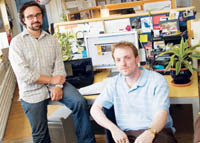
Tellart Co-founders Matt Cottam, left, and Nicholas Scappaticci, at their offices in Providence, are both RISD graduates.
COMPANY PROFILE
Tellart
Owners: Matt Cottam and Nicholas Scappaticci
Type of business: Information and interface design consultant
Location: 27 Sims Ave., Providence
(plus office in Berkeley, Calif.)
Employees: Six full time, one part time
Year established: 1999
Revenue: WND
Building a Strong Data Foundation in the Age of AI
Artificial intelligence (AI) has become a key priority in the boardroom and across management —…
Learn More
Providence firm’s industrial designs aim to present information efficiently
To explain what Tellart does, Matt Cottam opened his laptop and logged on to the Web site for the University of Vermont.
The Web page features a black and white map of Lake Champlain with a pulsing orange bar on the left side. Cottam clicks on the bar, opening to a photo and a story about John Todd, inventor of a water treatment system that uses plants to clean water.
Several Web pages show and tell how students at UVM used Todd’s invention to redesign the site of an aging power plant along the lake. There’s an animated graphic of the power plant with six pipes squirting brownish water into the lake; another slide shows three rows of greenery that filter the water before it reaches the lake.
“Making something compelling is a big part of making something easy to use,” said Cottam, 33, co-founder and creative director of Tellart. The company provided the animation, narrative and programming for the UVM site, which showcases various aspects of the university to prospective students.
Tellart has a staff of industrial designers, graphic artists and engineers who combine their expertise to package information so it’s clear and compelling. Along with text, they may use graphics, animation, three-dimensional charts and maps – even physical objects.
“What [we do] is separate from advertising, separate from cinema, and it’s really in the spirit of industrial design,” said Cottam. “We thought that things that had efficiency were beautiful, and we wanted to make information useful.”
For example, Tellart created an animated operating room to help a medical devices firm in Providence, Ximedica, design equipment used in surgery (Cottam declined to disclose the type or use of the product). The animation gives designers a view of the actual surgical procedure to enable them to see where their device fits into the process.
Tellart has strong ties to the academic community in Providence. In fact, all the employees have either taught at or attended the Rhode Island School of Design or Brown University.
Cottam, a RISD graduate, is now a part-time teacher at the school. He has served as a faculty member for a joint studio between the industrial design program at RISD and the engineering department at Brown. He also has a busy public speaking schedule; this week, for example, he is giving a talk on information design at Stanford University.
Tellart co-founder and design director Nicholas Scappaticci, 28, is also a graduate and part-time teacher at RISD. Scappaticci is the computer graphics expert at the company, specializing in 3-D modeling and animation.
Tellart has its main office in a brick building at The Steel Yard, which operates a campus of former industrial buildings along the Woonasquatucket River with studios for steel sculptors and other artists, as well as condos.
Cottam noted that Tellart’s proximity to other art-related businesses has led to collaborations. The firm is currently working with Mid-Ocean Studio’s Brower Hatcher to provide design and engineering support for one of his latest sculptures, for example.
The sculpture, which includes 1,000 lights, is set for installation along a platform in a St. Louis train station in August. Tellart developed the electronics that enable the sculpture’s lighting to mimic pedestrian movement along the platform.
The firm also operates a satellite office in Berkeley, Calif., where RISD graduate Brian Hinch works on developing technology and computer programs for the company. He helped develop a software program, NADA, which Tellart began selling to the public last month.
A promotional postcard says NADA “allows … anyone with Flash or Java skills to quickly sketch and build with sensors, graphics, animation, video, sound, networks and electrical devices – from hand-held product concepts to interactive environments connected across the Internet.”
Tellart used NADA to develop a museum exhibit that takes wind and rain information via the Internet from locations around the world, and illustrates the weather with an antique fan and a shower head.
And then there’s the beer-drinking robot. For a client who plans to open a West Coast-themed bar in Brooklyn this year, Tellart is building a steel robot that pours beer down its gullet and spouts news reports and weather updates from the West Coast.
“We really believe that things that work well, and are sustainable and useful, are beautiful,” Cottam said.
Tellart can be reached at (401) 273-5423 or www.tellart.com.