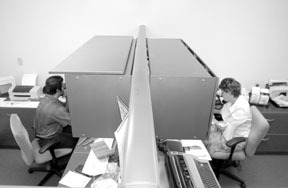
cubicles at Alga Plastics in Cranston.
Trends in workstations aim for efficient offices
Cubicles – or workstations, as office-furniture designers call them – always
have morphed right along with the business world.
A modernized health plan: Supporting cost management and the employee experience.
The Surest health plan came from a group of innovators wondering: What if health care…
Learn More
From transparent walls to fluctuating panel heights, workstations continue to track business fads and economic gyrations. Some innovative concepts are so bold as to change the shape of the traditional cube altogether.
“Panel heights are getting lower, not higher,” said Ed Gillheeney, president of Creative Office Environments in East Providence. “Companies are working more in a team approach than they have in the past.”
The most popular panel size long has been 64 inches, which gave the worker privacy while seated. But Gillheeney said 53-inch panels, which generally allow an outside view of the top of a worker’s head, seem to be gaining in popularity.
Aside from the emphasis on collaboration, Gillheeney said there’s another reason cubicle walls are coming down: Management staffs generally have been trimmed during the job losses of the economic downturn, and managers require a bit of help keeping tabs on workers.
That also can be achieved through new panel designs. Phyllis Cannava, president of Office Direct/Cannava Design Ltd. in Warwick, said office trends are moving from bulky “monolithic” cubicle panels to segmented panels or tiles, which can be fitted with glass, metal or other material.
“The beauty of this is that you can easily customize the workstation based on the employee’s particular needs,” she said.
For example, a telemarketing shop might opt for glass panels to allow an operations manager to survey employees. In an office that places a premium on quiet, say, an accounting firm, the employer might opt for fabric panels to absorb sound.
Indeed, more and more employers want flexibility for their workstations, according to Liz Cochrane, a senior account manager for Creative Office Pavilion on Providence’s East Side.
For example, Cochrane agrees that the shorter 53-inch panels are growing in popularity. But many companies also buy “stack-on” panels that attach on top, offering the cubicle dweller added privacy.
The firm also offers a workstation by office furniture manufacturer Herman Miller called Resolve, which consists of lighter and easily adjustable poles to support desks and shelves.
The system also uses 120-degree angles (as opposed to the 90-degree angles of cubicles), which translates into a triangular, zigzag pattern in the office, supplanting the forlorn “cube field.” Resolve also has semi-sheer panels, which affords users some privacy but less of a caged-in feeling, creators say.
In some offices, cubicles are shrinking, as employers look to save money on the square footage they lease, Gillheeney said.
Some companies, for example, have trimmed workstation space from 6-by-8 feet to the standard 6-by-6, which could save larger companies several thousand square feet of leasable space.
But one of the biggest trends in cubicles is purely economic: used stuff is in. And there’s plenty of it, a result of the wave of white-collar layoffs in the technology industry and other sectors.
“There’s a huge amount of grade-A quality product out there, and we’re finding much more interest in used product right now,” said Cannava of Office Direct.
The company uses a broker in Boston who can track down inventory from anywhere in the country – some of it with the tags still attached, she said.
As for colors, cubicles have come full circle since their inception in the 1960s and early 70s, Cochrane said.
“A lot of employers aren’t afraid to get funky with color schemes,” she said.
“Companies have gone back to the golds and rusts and greens, instead of the
hum-drum teals or grays.”
For the complete current issue, visit our subscription Web site, or call (401) 273-2201, ext. 227 or 234.