Rhode Island’s nonprofits are in turmoil. This important segment of the economy – 16% of the workforce – has an uncertain future and the Trump administration’s abrupt cancellation of hundreds of millions of funding dollars is driving it, those in the sector say.
Vanishing jobs and lost income are a stark reality facing the state’s economy.
“The impacts are everywhere,” said Nancy Wolanski, director of the Alliance for Nonprofit Impact at United Way of Rhode Island Inc. “Those losing money are looking to other philanthropic sources.”
Wolanski reels off the types of affected nonprofits: immigrant and refugee services, food pantries, those doing English proficiency training and workforce programs, among others.
“They’re all competing for limited funding and private donors,” she said.
Roshni Darnal, United Way’s director of community investments, says youth and after-school programs have already taken a hit.
“A lot of our after-school partners can’t keep their staff employed. Free before- and after-school programs are going away because grants to pay employees are gone,” she said. “Parents may have to pay out of pocket or take their kid out of the program.”
And down the road are cuts to health care in Medicaid and Affordable Care Act subsidies, with a lot of community-based clinics taking the brunt. The populations they serve may be underinsured or uninsured, or undocumented and have chronic diseases that aren’t being treated, Darnal says.
“These clinics are streamlined with very small budgets. When the need goes up to that level, with so many people requiring services, as well as those afraid to leave the house, clinics have to extend their hours, increasing pressure on everyone. It’s a tough business model to uphold,” she said.
Teddi Jallow, CEO of The Refugee Dream Center in Providence, is already facing that reality. With an annual budget of $2.4 million, her organization offers supportive services to help refugees integrate into the community.
When President Donald Trump came into office, she says, the center’s 90-day post-settlement program shut down when the funding was cut off. It was a four-year, $460,000 health promotion grant launched in October 2024 to help refugees navigate the health care system.
As a result, Jallow says five of her employees were laid off early in the new administration, and her staff of 21 is down to 13.
“From January to early September, we’ve lost $500,000 and we anticipate losing more funding contracts that may not renew,” she said. “We do financial updates all the time. We depend on grants and we don’t have them.”
[caption id="attachment_507981" align="aligncenter" width="1024"]

WALK AND TALK: Alicia J. Lehrer, center right, executive director of the Woonasquatucket River Watershed Council, speaks during a walk along the river in Providence. To her left is Maria Jose Gutierrez, community action co-facilitator. \ PBN PHOTO/MICHAEL SALERNO[/caption]
The cutbacks are having an additional traumatic effect.
“We have young people scared to go to school because they’re afraid [Immigration and Customs Enforcement] will get their parents,” Jallow said. “ICE has already arrested one of our clients, who’s been sent to a detention facility. This is someone who went to an ICE appointment and didn’t come out. All his family knows is that he’s in New Hampshire. We tell clients to decide who will care for your kids if you’re deported.”
Jallow’s organization was launched in 2015 by her husband, Omar Bah, himself a refugee, and Jallow is determined to make it survive.
“We are resilient. With money, obviously, we’ll have to juggle, but even if it’s down to one staff – me – we will never close,” she said.
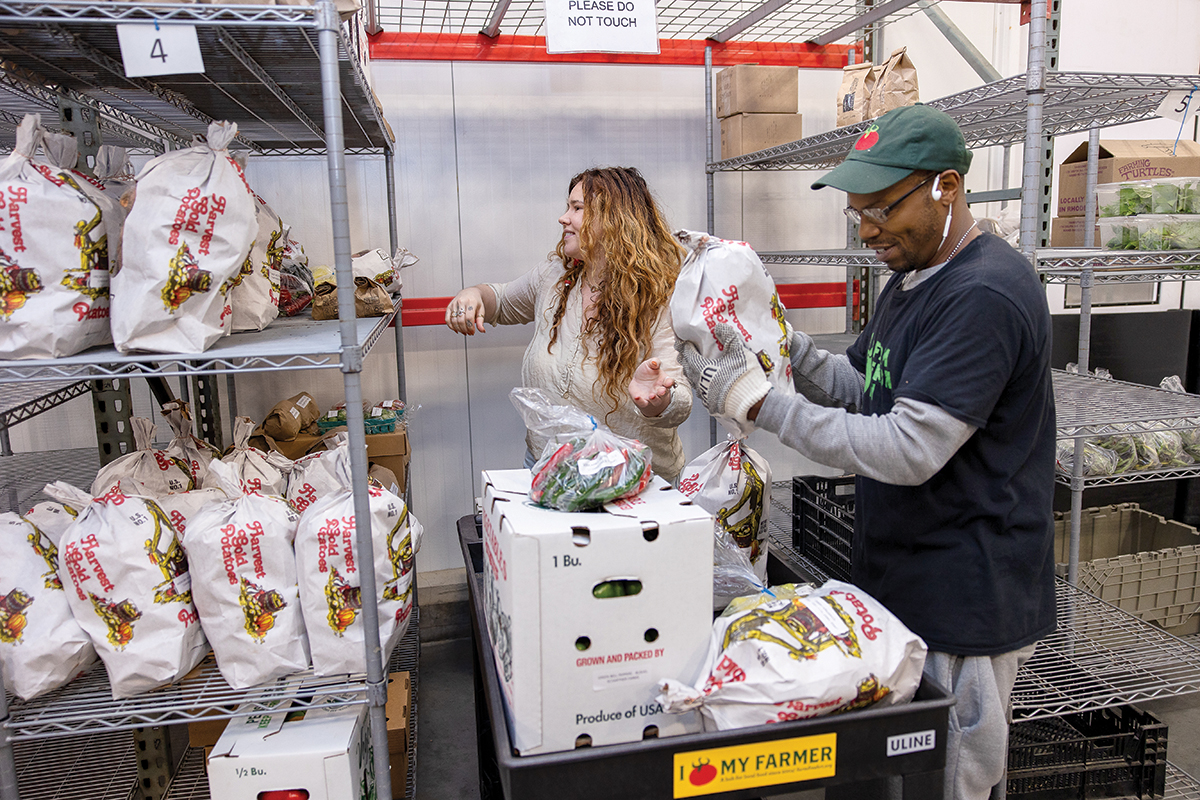
Farm Fresh Rhode Island is another small nonprofit feeling the squeeze. It supports the local food system and makes it more accessible and sustainable for farmers, fishers, food producers and consumers through local markets. It also pays farmers to grow produce, much of which goes to food pantries. Other programs range from Bonus Bucks, which doubles government food benefits at farmers markets, to culinary job training programs for children involved with the R.I. Department of Children, Youth & Families.
But according to Managing Director Natalie Varrallo, Farm Fresh has already lost $3 million in federal funding, roughly 40% of its budget. She’s also had to lay off 10, shaving the staff to 41.
“We’re still finding out more federal dollars we’re losing,” she said in September.
Farm Fresh’s 2024 budget was $7 million; Varrallo predicts that the budget for 2026 will be a lot smaller. While Farm Fresh has private donors, she says that it’s hard to replace federal dollars.
“We still need to do the work, the harvesting, the work with food banks, and they’re struggling,” she said. “There’s fatigue now around the cutbacks, but there’s still the need for funding.”
There are glimmers of relief, however. Money to the tune of $1.5 million in accelerated Community Impact Fund grants from United Way, and more than $3 million in various grants from the Rhode Island Foundation, has been earmarked to help nonprofits. These grants can be used for everything from legal assistance and financial planning to fundraising consultants.
[caption id="attachment_507980" align="aligncenter" width="1024"]

FIGHTING FOR FUNDS: Marta V. Martinez is the executive director of Rhode Island Latino Arts, which is the lead plaintiff in a federal lawsuit against the National Endowment for the Arts in an effort to restore $60,000 in lost funding. \ PBN PHOTO/MICHAEL SALERNO[/caption]
And some organizations, such as Rhode Island Latino Arts, are taking the government to court. Marta V. Martinez has made some hard choices. As executive director of Rhode Island Latino Arts, Martinez and her organization support the arts, culture and heritage of the state’s Latinos. Most of her $200,000 annual budget pays for programming that she calls grassroots, funding artists – including muralists, musicians and actors performing in plays, which are usually free to the public.
With little in the way of corporate donations, Latino Arts has depended on fundraisers and, to some extent, foundation grants, as well as on the National Endowment for the Arts and the National Endowment for the Humanities. That is, until this year, when the federal government required grant recipients to attest that they wouldn’t support what it called gender ideology. Martinez had planned to stage a play with gay characters, so she couldn’t comply with that. The group lost $60,000 in federal funding and had to lay off two staff members.
Rhode Island Latino Arts is now a lead plaintiff in a federal lawsuit against the NEA with the goal of restoring the funding, but as of mid-September, the case was still being litigated. Martinez has volunteers, she said, but other than that, “it’s just me.”
The Woonasquatucket River Watershed Council works with the community to protect the river, its watershed and communities. And like Rhode Island Latino Arts, this small nonprofit was the lead plaintiff in a lawsuit looking for relief from drastic freezes to already awarded funding. Some $1 million was in jeopardy. In this case, the plaintiffs, who challenged the freeze as arbitrary and illegal, were successful.
“We don’t feel like we’re out of the woods,” said WRWC Executive Director Alicia J. Lehrer. “We feel OK for two years, but then it gets scary. Our multiyear grants are not in jeopardy, but what will replace them?”
As a founding member of the Lawyers’ Committee for Rhode Island, Miriam Weizenbaum was involved in the WRWC lawsuit. Her pro bono legal group is supported by the Rhode Island Foundation and the local United Way. The goal: helping nonprofits that are facing cutbacks figure out their legal options to protect the funding that Congress has already approved.
“We identified a need for nonprofits to understand that losing this funding is illegal,” Weizenbaum said. “We did multiple education workshops for them and urged them to let us know if they experienced these freezes.”
So far, the LCRI has managed to get $1.3 million in funding restored for several nonprofits, including the WRWC, as well as in social services and the arts, Weizenbaum says.
And while the restoration of several million dollars is encouraging, it’s a small percentage of what has been cut, according to David N. Cicilline, CEO and president of the Rhode Island Foundation.
“We asked our grantees to give us a sense of loss in cuts, and as of April, it was $470 million,” Cicilline said. “We’re seeing it in health care, housing, job training, but there’s so much uncertainty. What’s especially challenging is that need is up due to the economy and increased demand.”
When prioritizing grants, the foundation’s staff looks at basic human needs: health, food insecurity, housing and specific groups affected by budget cuts, including immigrants and the LGBTQ community. Rhode Islanders have a history of being generous, Cicilline says, but philanthropy can’t fill the gap. Some organizations may have to consolidate to survive.
“I worry about those nonprofits whose grants were improperly paused. At the same time, we have to recognize the federal funding of the last decade is gone,” Cicilline said. “We’ve been through challenges before and we can inspire Rhode Islanders to help.”