The next generation of insurance agents is being ushered into the industry, thanks to local agencies eager to fill roles vacated by the large population of retirement-aged workers.
The process is slow-going. Part of the difficulty in hiring is the persistent negative stigma about working in the industry, officials say.
“It’s a given that the industry is aging, but it always has been, but there’s still a need for new talent,” said Mark Male, CEO and president of the Rhode Island branch of the National Association of Insurance and Financial Advisors.
The association has done its part to bring in talent, working with the Community College of Rhode Island and the R.I. Department of Labor and Training to create certification classes. It later facilitated internships, which resulted in job offers.
“We want our members to be happy and pleased at the opportunity to bring new talent into their agencies, and that goes to the quality of the candidates,” Male said.
The stigma still has to be overcome every time, he said.
“The more opportunities we have to talk to [students] before they go into the class, the likelihood is they will be convinced this is something they want to investigate,” he said. “People are getting jobs. Is it the numbers I’d like to see? No, but it’s movement in the right direction.”
In the next few years, Male sees an uptick in agency placements.
“We need to have a vibrant and healthy economy here in Rhode Island, and a big part of that is making sure that people are coming into different industries, including independent agencies. I’m encouraged and hopeful that this will grow,” he said.
[caption id="attachment_507218" align="aligncenter" width="1024"]

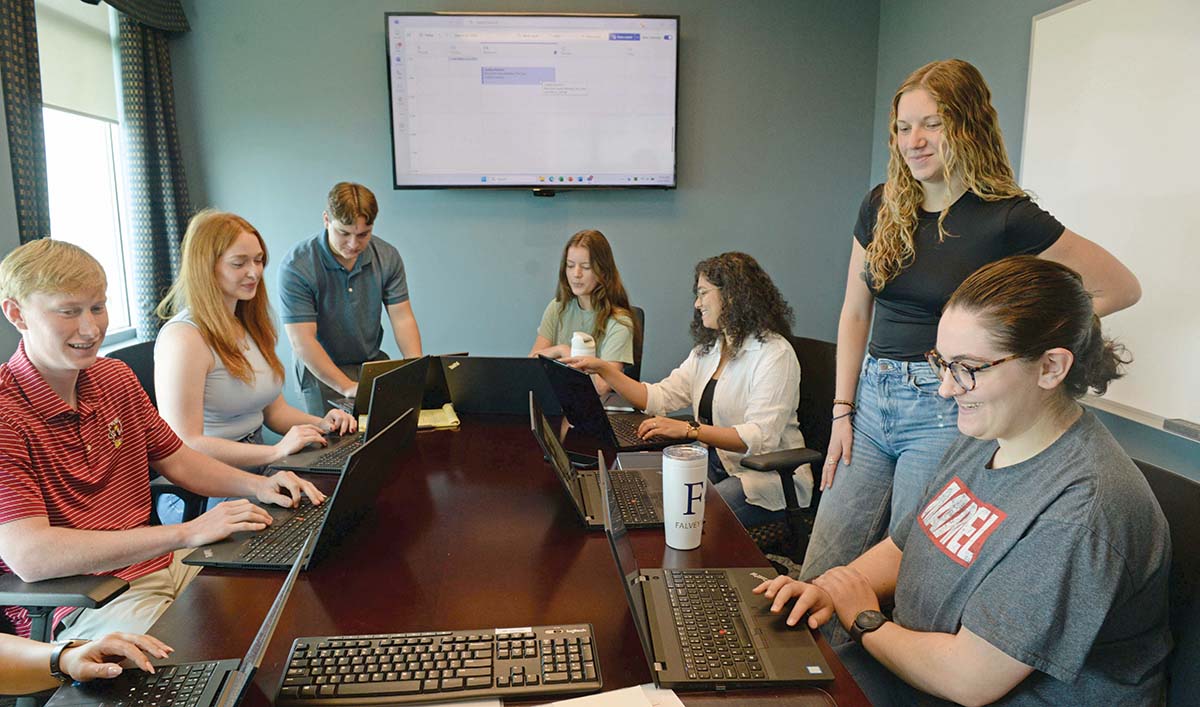
FRESH TALENT: Alyssa Dansby, left, and Ryan Finzio are interns at Falvey Insurance Group in North Kingstown.
PBN PHOTO/ELIZABETH GRAHAM[/caption]
‘DOING EVERYTHING WE CAN’
The insurance agent workforce statewide has about 2,250 workers. Insurance sales agent jobs are expected to grow by 9.6% by 2032, according to the DLT.
Stefan Petrella, senior vice president and marketing director for Starkweather & Shepley Insurance Brokerage Inc., and Florence DuPerry, human resources manager, said bringing in new agents is challenging.
“Insurance isn’t sexy,” DuPerry said. “We are doing everything we can to get in front of college students. We’ve done a lot of local college fairs, connecting with the schools in order to try to bring in that new group of people into the industry.”
Starkweather has nearly 20 specialized departments, including arts and entertainment, human services, construction and more.
“It’s a really great opportunity to take your own personal expertise and skill sets and bring them to a firm like ours,” Petrella said.
The HR team has added to the company’s benefit offerings. The company focused on professional development for employees, including leadership training DuPerry runs.
“Insurance tends to be a place where those who want to help others can find a home,” DuPerry said.
CCRI, working with Male’s association, created short-term insurance credential programs with internships.
Maria Coclin, the college’s business studies program chair, and John Renxa, interim associate vice president for workforce partnerships, helped organize the programs. CCRI offers two tracks: health and life insurance and property and casualty insurance. Both are 60-hour programs with two main goals: to prepare students for the state insurance licensing exams and to be placed with an insurance partner.
The property and casualty insurance program had four cohorts, with 59 students total. The health and life insurance program has had one cohort with 15 students, Renxa said. Industry experts taught the courses. CCRI also offered virtual sessions, covering career services. Students who passed were able to apply for college credit.
“It was a combination of different faculty that made it a little unique because they had their specific areas of expertise in insurance,” Coclin said. “It was a great program to prepare students for an area they perhaps hadn’t considered.”
Organizers are hoping to run another cohort. A good foundation has been laid, Renxa said.
Emerald Clarke, an administrative assistant at Starkweather, graduated from the community college’s certification program. She has a criminal justice degree from the University of Rhode Island but wanted a new opportunity afterward.
“[I thought], ‘I don’t know what I want in life but the opportunity’s there, I’m just going to take it,’ and thankfully it led me to Starkweather & Shepley. I really do like the agency and the business that I’m at now,” she said.
Clarke, 28, appreciated the CCRI program’s flexibility, with both in-person and online sessions.
“I really tell anybody who’s interested [about the program],” Clarke said. “It was nice that it’s a course that’s not just teaching you the skills you need for the industry but is also benefiting you and helping you to progress and want to be better.”
OPPORTUNITIES ABOUND
Jack Falvey, CEO of Falvey Insurance Group, said the agency has been trying to shift the narrative of what an insurance career looks like.
“I think for too long the insurance industry has been seen as kind of slow-moving, overly traditional, repetitive but insurance is actually one of the most dynamic and impactful industries in the economy,” he said.
The agency launched internships, an underwriter training program and is looking to start apprenticeships.
The agency, which likely has one of the youngest average-aged leadership teams within the country, has erased a problem other agencies still have, Falvey said.
“It’s very bright for insurance. You see a ton of change coming, you see that insurance is really needing to pull on all of the different skills, functions, specialties and insights that people have,” he said. “There’s more uncertainty in the world, which to me is the opportunity for insurance to really step in and help solve those problems.”
(CORRECTS title of Jack Falvey, CEO of Falvey Insurance Group, in 27th paragraph.)