Jennifer Hirsh-Ryan was attending a women’s luncheon hosted by the Rhode Island Hospitality Association recently when dire talk of a multibillion-dollar, unfunded pension liability spurred her to speak up.
Part owner of the family-run Lobster Pot restaurant in Bristol, Hirsh-Ryan told the luncheon’s keynote speaker, General Treasurer Gina M. Raimondo, she would pledge her support of the treasurer’s high-profile push for an overhaul of the state’s pension system.
The restaurateur said she feared future tax increases and cuts to government services if the problem continues to be ignored. But Hirsh-Ryan wanted to take it a step further: How would she explain the importance of the issue to her employees, all of whom lack pensions themselves and many of whom have little interest in government affairs?
“What can I deliver to them that will help them understand?” Hirsh-Ryan asked during a question-and-answer session.
Raimondo didn’t have an immediate answer, but promised to come up with one. As she makes the rounds to luncheons, dinners and forums with a new pension study in hand, she is finding the business community eager to get behind calls for difficult pension changes, helping her build momentum in part because the private sector largely has transitioned out of defined-benefit retirement plans.
“In the business world, there’s a lot less patience with the issue,” Raimondo said recently.
But she insists that the ballooning costs of public retirement benefits are every Rhode Islander’s problem. Right now, state-administered plans have $6.8 billion in unfunded liabilities, which is the difference between the amount in the fund and the cost of benefits due retirees.
Ignoring that deficit, which gets bigger annually, will result in higher taxes and fewer services in the years to come, Raimondo says, noting that by 2018, 20 cents of every tax dollar will go toward paying retirement benefits.
Raimondo has taken her message to less receptive places, too. She met with several of the largest labor unions in the state, including one representing public school teachers and another for state employees.
“I think the retirees and the union members appreciate the fact that I’m telling the truth,” Raimondo told Providence Business News. “When I show up, people are angry, they ask questions that clarify the situation, and they understand why we have to fix it.”
Grafton H. “Cap” Willey IV, a managing director of accounting firm CBIZ Tofias, who has advocated for massive pension-system changes, said there still is a heavy dose of skepticism among businesspeople. For years, legislators have put off politically difficult reforms.
“[Businesspeople] are not very comfortable that the leaders are going to do what needs to be done this time, too,” Willey said.
Larry Berman, spokesman for House Speaker Gordon D. Fox, disagrees.
After Raimondo released a report last month outlining the pension problem and possible solution, the General Assembly leadership agreed to hold a special session in the fall to tackle the problem.
House and Senate finance committees are expected to meet in August and September after Raimondo submits a legislative proposal to right the pension fund. Then the full General Assembly will convene sometime after Columbus Day to take action.
“Comprehensive changes need to be taken, and the leadership is committed to doing that,” Berman said.
What those changes will be is unclear right now.
The problem has been decades in the making. Raimondo’s report last month, “Truth in Numbers: The Security and Sustainability of Rhode Island’s Retirement System,” highlighted five drivers of the pension deficit:
• Over 30 years, leaders failed to follow advice of actuarial experts.
• They also approved generous benefit improvement without increasing taxpayer or employee contributions.
• In many cases, pension-plan designs allow retirees to earn more money in retirement annually than a current employee earns.
• Retirees are living longer, which means the pension system must support them for longer.
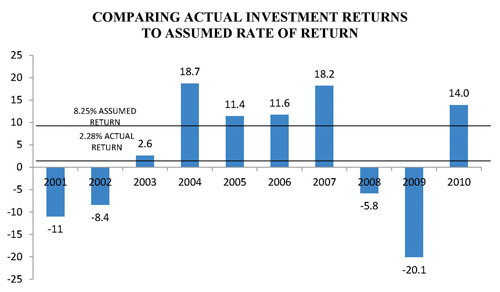
• Investment returns over the last decade have been far below assumptions. The fund has averaged 2.28 percent for 10 years ended June 30, 2010. The assumption was 8.25 percent, and on July 1 it will be lowered to 7.5 percent.
The treasurer plans to assemble a “working group” of experts in benefit design and pensions to advise her as she draws up legislation for the General Assembly to consider in the fall.
Raimondo acknowledged that she felt that some state leaders were “dismissive” of her push for a pension-system overhaul initially, hoping that her drumbeating would peter out.
But now, officials seem to be aligned. In addition to the special legislative session, Chafee has reversed his initial beliefs that the pension system should be re-amortized.
Union leaders also seem to be receptive. Robert A. Walsh Jr., executive director of the National Education Association Rhode Island, has signaled the group is willing to talk.
Raimondo said she is convinced lawmakers will pull the trigger on reforms this year because of public support for the idea.
Maureen Moakley, University of Rhode Island political science professor, says the treasurer already has succeeded where predecessors proposing pension changes have not.
“She has laid this out beautifully,” Moakley said. “The ball is now in the General Assembly’s court.”
And Raimondo is stepping up the campaign.
The treasurer’s office has launched a website, Secure Path RI, that provides key information. And treasury staff distributed 500 copies of the 16-page “Truth in Numbers” report in recent weeks. It’s also available online.
Raimondo gave out 90 reports at the recent hospitality-association luncheon. Most attendees politely thumbed through it before putting it down. The treasurer’s office is planning to release a shorter version that will be easier to read.
“Everybody talks about [the pension problem], but relatively few people understand it and understand how we got here,” she said. •