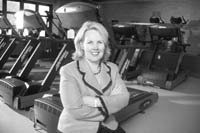
PBN: What is the Greater Providence YMCA’s annual budget?
RITTSCHER: Our budget is $26 million a year. Primarily, it comes from two major sources. Those are membership dues, which are about 40 percent of our budget, and child-care fees, which is about 45 percent of our budget. We receive 8 percent from donations and other kinds of grants and charitable activities. The rest comes from program fees for things like swim lessons or sports teams for which people would pay a fee.
PBN: That seems like a high percentage, in terms of your reliance on membership dues. I would have thought you would have been more reliant on donations.
RITTSCHER: No. … Within that membership about 18 percent of our members are on financial assistance. So people can come to the YMCA regardless of their ability to pay. Eighty-two percent of our members can pay the full freight, but 18 percent at this point require some support. We’re glad to do that – and we do it through our fund raising each year.
Your Business Has Gone Global. Has Your Insurance?
A decade ago, “doing business internationally” was mostly a large-company concern. Today, a manufacturer in…
Learn More
PBN: Is funding a constant struggle?
RITTSCHER: I think so, for any nonprofit. I certainly have seen, in the last few years, more of a request from our neighborhoods and our families. There is more of a need, both on the child-care side and the membership side. So each year we try to raise more money.
PBN: How many branches and how many members do you have?
RITTSCHER: We have 10 branches and 57,500 members.
PBN: So many of us are familiar with the old Broad Street location. That’s now occupied by Crossroads Rhode Island and to a smaller degree, by the Greater Providence Y. You are breaking ground June 19 on a new facility. Tell us about that.
RITTSCHER: It’s in the Reservoir Triangle area of the south end of Providence. It is a 17-acre site that the city gave us as part of our working with Crossroads and with the city to create a new economic-development package for the city, that being part of the revitalization effort for downtown. Crossroads moved to the Y and the Y is moving farther into the neighborhoods, which was important to us because that’s where our constituency is – primarily in that most dynamic and diverse area, which is that South and West End community.
PBN: Where does that project stand?
RITTSCHER: We’re going to be breaking ground June 18. We plan to have a building there a year from now. It will be on part of the 17 acres that the city gave us. It’s a beautiful site, on a pond.
PBN: What will it include?
RITTSCHER: It will include some health and wellness facilities, a child-care center, a family center, a healthy café, a youth area, computer center, education room, family locker space, a full-sized sports field and we plan on future phases that will include a gym, a pool, locker space and things like that. … We’ll be raising money over the next two years for that. There are more than 17,000 households in the area that this Y will serve.
PBN: What about the economic impact of the Y and its programs?
RITTSCHER: We recently did an economic impact study and we have an economic impact of $42 million a year on our communities. … I’m also proud of the fact that over the last five years we have invested – and will invest with the new Y – $19 million in capital improvements in the city. That’s important, especially in areas that need to be lifted up the most.
PBN: What is the Y’s mission and has it changed over the years?
RITTSCHER: Our Y’s mission is to put Christian principles into practice through programs that build a healthy spirit, mind and body for all. It has not changed over the past decade or two, but it has changed over the past 50 to 100 years. It’s funny to talk about an organization being that old … but our original purpose had more of a focus on probably the evangelical nature of Christianity. When you were in the YMCA in the earlier days, you had to be a Christian. Now we serve all people, all races, all faiths … we do remain somewhat true to our roots with an emphasis on body, mind and spirit. The triangle of the Y is about that.
PBN: What do you see as the biggest challenges – or obstacles to success – facing kids today?
RITTSCHER: I see kids these days who often are over-programmed. I see parents having to work more and longer hours. I see kids not having the ability maybe that you and I did when we were kids, to go out and hang around with their friends in the neighborhood. Now, everything is programmed and that impacts kids because they don’t have the downtime to create and explore and dream and imagine that maybe we all did when we were younger. At the Y, we try to create spaces for that. I think kids still need to have positive adult role models. And we try to do something about that. Kids are bombarded with technology and video and maybe not real relationships. I worry about kids and their social skills and their ability to connect and relate to one another. I worry about what they learn in school or what they don’t learn, because of barriers they might have to addressing the simple reading and writing and arithmetic – the basics. I worry a lot about kids. Maybe that’s why I’m in this profession.