After Joaquin Meza and his mother, Maria Meza, opened a Mexican restaurant in the Silver Lake section of Providence about four years ago, they eventually realized that they had a serious problem with graffiti, often vulgar, that would appear overnight on an adjacent, vacant building.
They were hoping to attract high-end customers from places like the East Side, Narragansett and Westerly, to sample the traditional Mexican food that is the hallmark of their restaurant, El Rancho Grande at 311 Plainfield St. “Having graffiti on the walls was not good for us,” Joaquin Meza said.
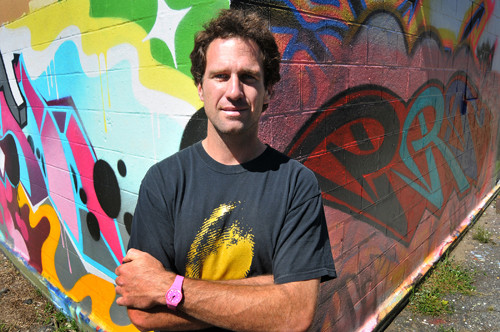
Enter Yarrow Thorne, who for the last three years has worked closely through his business, Yarrow’s Cans, with the 300 or so graffiti artists, also known as “street writers,” he estimates are in the Providence area.
Thorne has an unusual mission he attacks with passion: to control graffiti, keep it in selected areas where it would be legal, and allow graffiti artists the freedom to express themselves in a positive way by creating street art that can be beautiful but never, ever obscene.
“People think graffiti is all about gangs and drugs,” Thorne told Providence Business News in an interview at his Lockwood Street business in South Providence, “but it is not. It is definitely art.”
Thorne located a respected graffiti artist, who goes by Etips, who helped paint a mural on the wall of the restaurant’s business, about 16 feet by 19 feet, incorporating the name of the eatery and a Mexican-inspired portrait of the Virgin Mary. The artist did a sketch first and “we thought it was wonderful,” Meza said.
The work was done during a Cinco de Mayo celebration, with families and friends of the owners lending a hand, at a cost of $700. Meanwhile, the vacant building next door is now occupied and the vulgar graffiti has not reappeared since the restaurant mural was done in 2009. “We have had no problems there at all,” Meza said.
Though an inevitable part of city life, graffiti is unlikely to be legalized. However, “what works really well, and it’s worked in major cities, is instead of fighting graffiti we’re going to support it in controlled environments and use it to inspire downtown life,” said Thorne.
“It has taken a long time to gain respect and trust” of the street writers, Thorne said.
He periodically paints over the walls and invites new artists in to work on the newly blank canvas. He has had graffiti artists of all kinds, old and young, men and women, work on his walls, including visitors from other countries such as Canada, Singapore, Thailand and the United Kingdom, as well as from South America, he said.
Last summer, in a piece still preserved on the rear wall of Yarrow’s Cans, the Providence graffiti artist known as Wizart created a stunning mural incorporating his name and several Providence icons, such as City Hall, in colors so bright and bold that they seem to jump off the wall.
The city has laws on the books allowing “graffiti vandals” to be punished with a $1,000 fine, community service and restitution for damages, but city officials told PBN that what Thorne is doing is legal.
“The city could not stop anyone who wanted to put a mural on their business, related to the business and done in a graffiti style,” said Al Buco, coordinator of public property in charge of the city Graffiti Task Force.
“We do see the value of the art form,” Buco said. “If it is done tastefully and properly, with the proper oversight, it can be a valuable asset to the city and a deterrent to kids who do it illegally.” He stressed, however, that the city has “zero tolerance” for street graffiti and “vandals indiscriminately tagging a neighborhood.”
Lynne McCormack, director of art, culture and tourism for the city, pointed to several well-designed and well-executed murals that have kept vulgar graffiti writers away, including those on Thayer Street, Westminster Street and Broad Street.
“It is a known fact that putting murals on businesses does discourage further graffiti,” she told Providence Business News.
In Madrid, graffiti artists were invited to decorate the draw-down steel shutters that protect store windows in the Spanish capital at night, with 130 European artists painting 140 shutters during one day in February. Other controlled graffiti programs can be found in San Diego and as far away as New Zealand.
Removal of illegal graffiti in the United States costs $7 billion a year, according to the website www.stopgraffiti.org.
After taking a break from school about nine years ago to establish a now-defunct business for the custom design, manufacture and servicing of automobiles, Thorne is back at the Rhode Island School of Design in his senior year, working toward a bachelor’s degree in industrial design. He is a member of the 2010 class of Leadership Rhode Island. Mike Ritz, executive director of Leadership Rhode Island, was the one who put the Meza family in touch with Thorne.
Although he has become a supporter of Thorne, Ritz remembered that when he first met the Mezas several years ago “I was pretty mad” about the graffiti he saw marring homes, churches and businesses in the Westminster Street area. “It was costing everybody a lot of money,” Ritz said. “Graffiti is not easy to eradicate, especially if you have to sandblast it.”
Thorne’s graffiti-related work has included creation of a RISD club on public street art, a City Hall exhibit he organized last summer of actual Providence graffiti pieces, a Leadership Rhode Island workshop last year and creation of a 80-foot by 40-foot mural at Westminster and Bridgham streets in the Armory District.
With a wry grin, Thorne readily acknowledges that he makes no money.
“I don’t make a living. It’s all entirely out-of-pocket and any money I do make goes back to the business,” he said. So why do it? “It is a beautiful art, and I like helping people. And I think that’s why I do it. Deep down, I really believe it helps solve problems that people usually don’t want to deal with,” Thorne said. •