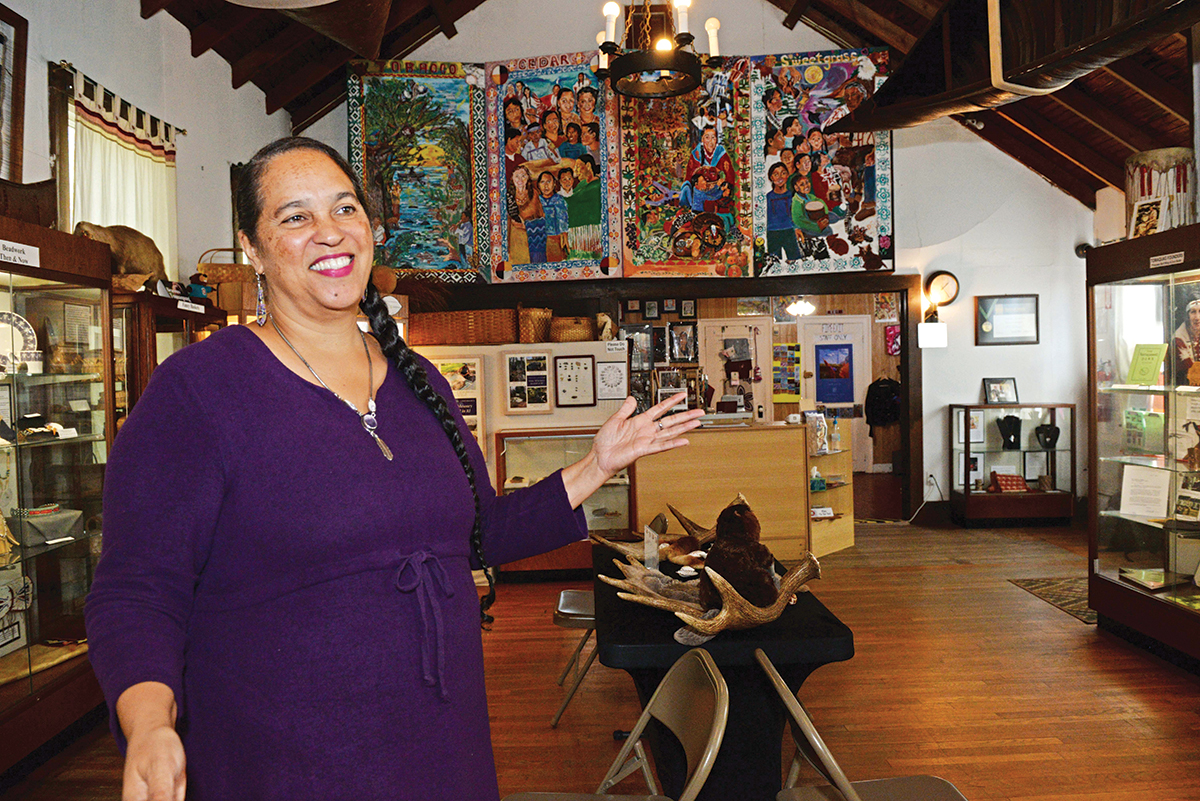
The 800-square-foot building that houses the Tomaquag Museum, Rhode Island’s only Indigenous museum, is a tight squeeze for its 12,000 cultural belongings, well over 100,000 archive pieces, group tours and 16 staff members.
The building can fit about 30 people at a time, says Executive Director Loren M. Spears. For larger groups, the museum must split visitors between its interior and an outdoor pavilion, where guests engage in activities such as art projects or embark on traditional ecological knowledge walks.
When those larger tours aren’t visiting, the museum faces a different challenge. Located in rural Exeter, a lack of visibility and transit access creates barriers for potential museumgoers, as well as the students and academics who rely on the museum for research.
“We’re absolutely tiny, and we’re really on top of each other,” Spears said. “Our gallery is extremely small, and our space is one gallery.”
For years, Spears and her team have been working to give the museum a larger, more accessible home. After six years of fundraising, regulatory hurdles and COVID-19 pandemic disruptions, the museum hopes to break ground on that project this year.
Identifying a space hasn’t been an issue for a while now. In 2020, the museum, which is currently based at 390A Summit Road in Exeter, partnered with the University of Rhode Island to establish a new location on the southwest corner of campus, just off Route 138.
But the museum faces a lofty fundraising challenge. Statewide voters OK’d a bond issue in 2024 that would include $2 million for the Tomaquag Museum’s relocation, but the new facility has an estimated construction cost of $22 million. In the lead-up to securing funding, the usual regulatory and permitting hurdles have pushed back a groundbreaking, Spears says.
But the project cost comes with a dramatic payoff. Compared with the approximately 800-square-foot Exeter building, the new location would provide 28,000 square feet of indoor space and another 14,000 square feet of land.
In fact, of the four structures that will eventually house the museum, a “flex” gallery space at the new location would be larger than the museum’s only current gallery space. ConsultEcon Inc., the museum’s financial partner, based in Cambridge, Mass., has estimated that the museum can expand its annual service capacity from its current 20,000 people each year (both on location and through off-site programming) to nearly 50,000 people.
The move will also connect the museum with an R.I. Public Transit Authority bus line, Spears said.
For those without a car, reaching the museum by a rideshare such as Uber or Lyft can be dicey.
“We have students who will come from Johnson & Wales and Brown, or Bryant [universities],” Spears said. “Right now, they have to get in a Zipcar or get an Uber. And Uber can be problematic because sometimes it will drop you off but doesn’t want to pick you back up out there, so we’ve had to pick people up and take them to a more urban environment.”
More visitors to the museum means more chances to foster an understanding of Native communities and history, Spears said.
Guests often arrive with misconceptions about Indigenous culture. They frequently approach a 5,000-year-old string of wampum thinking the beads served as currency, for instance.
But prior to European contact, Spears said, the beads didn’t have this connection to money – instead, they served to reflect communities, honor history and individuals, or document relationships between tribal nations.
“We have an amazing collection of cultural belongings ... that tell a story of who the maker was, who the user was and how it came to be at this museum,” Spears said.
The project’s time has shifted as the museum clears legal and regulatory requirements, including with the R.I. Department of Transportation and the Coastal Resources Management Council at the state level. Then, there are federal processes to go through with the U.S. Department of Housing and Urban Development and the National Park Service.
The museum’s goal is to break ground on the project before the end of the year, with the project slated to take two years to complete.
The university is eager to welcome the museum to campus, said Abby Benson, vice president of administration and finance at URI. The site’s existing structure, which the museum will renovate in addition to establishing new buildings, has been vacant for years and formerly housed the Institute for International Sport’s Scholar-Athlete Hall of Fame.
Benson described the campus as a natural fit for the museum, noting opportunities to expand existing partnerships and research possibilities.
“We’ve had longtime collaborations ... so we think those will only strengthen,” she said. “There are museums on university [campuses] really all over the country because there are those great synergies between teaching, learning and research.”
Benson said there is no Rhode Island history without Narragansett, Niantic and other Indigenous peoples’ history.
“And frankly, there is no U.S. history without Indigenous peoples’ history,” she added. “This museum allows people to engage with our story. It allows people to ask questions and unpack what they think they knew about Indigenous communities and learn more about not just our past, but who we are in the present.”