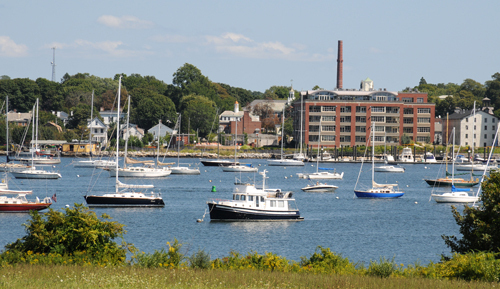
To draw more tourists and gain access to additional marketing resources, the three Bristol County towns – Bristol, Barrington and Warren – want to join the Newport County Convention & Visitors Bureau, a move proponents say would enhance tourism in both counties.
Jim Farley, president of Mount Hope Farm in Bristol and of Destination Bristol, a nonprofit organization that promotes town sites, was one of the initiators of the proposed move, which he explained, at the most basic level, comes down to dollars and cents.
The three towns now are part of the East Bay Tourism Council, which Farley noted has about $75,000 a year to spend (from money collected through a state hotel tax) on the four communities under its aegis, including East Providence. “That’s down about $5,000 from the previous year, and it’s more than likely to be dropping again,” said Farley, a member of the East Bay Tourism Council board.
On the other hand, the Newport bureau has $2.37 million to spend every year. “Just on that basis alone, it’s a no-brainer,” Farley said. “We can market ourselves a lot better with Newport. This is not a reflection on the East Bay Tourism Council, there just aren’t the resources there.”
The change would essentially dismantle the East Bay Tourism Council and leave East Providence on its own. But that is exactly where East Providence wants to be, at least for the next 12 to 18 months, according to Laura McNamara, president of the East Providence Chamber of Commerce and a member of the East Bay Tourism Council board of directors.
McNamara said the city would spend those months assessing its strengths and defining its identity as a tourist destination, with the Chamber in interim charge of tourism promotions. As for the longer term, East Providence is “leaning toward” joining the Blackstone Valley Tourism Council, based in Pawtucket, McNamara said, but also has had talks with the Providence Warwick Convention & Visitors Bureau.
“We have no interest in [joining] Newport,” McNamara said. “That just doesn’t make sense to us at all. We felt that really wouldn’t be a good fit.” Since the East Bay Tourism Council was created about 11 years ago, McNamara said, much of its focus was on Bristol and Warren. “I don’t know if we want to go into another situation where East Providence is a minor player,” she said.
Evan Smith, president of the Newport County Convention & Visitors Bureau, said he would welcome the addition of the towns to his Newport organization, which now represents six communities: Newport, Middletown, Portsmouth, Jamestown, Little Compton and Tiverton. “Look at these beautiful towns,” he said of Bristol, Warren and Barrington. “They have so many resources, without a lot of hotels.”
He reeled off a list of about a dozen attractive sites that would be added to his agency’s portfolio, such as the East Bay Bikepath, Blithewold mansion and Roger Williams University, and stressed that added visitors to Bristol County would help fill the many hotel rooms in Newport County.
It’s important to fill those hotel rooms. The state’s tourism agencies receive annual operating revenue from the state hotel tax, so, for example, the Newport organization receives revenue from the many accommodation sites in its territory. East Providence has two hotels and Bristol has one, according to McNamara and Farley, respectively. “We don’t have a lot of accommodations in Bristol County,” Farley said. “We’ve probably got 80-plus rooms and Newport must have well over 3,000 rooms.”
The six municipalities in Newport County have a total of 3,825 accommodation sites, according to Smith, consisting of 2,719 hotel rooms, 681 inn rooms and 425 timeshares. The state lodging tax rate is 6 percent, and it is split this way: of the first 5 percent, 47 percent goes to the Newport County visitors bureau, 25 percent to the city, 21 percent to the state and 7 percent to the Providence Warwick Convention & Visitors Bureau, according to Smith, with the other 1 percent going to the community in which the tax was collected.
“We’ve not been able to promote ourselves in the Newport area, and this merger would open up new avenues for us, opportunities for more exposure,” Farley said. “This would be an excellent way to get people to visit places they are not visiting now and there is a lot of opportunity for us to do a lot together.”
East Providence, with a population of 48,000 and plans to develop its waterfront, has its share of often-overlooked tourist sites such as the Pomham Rocks Lighthouse in Riverside and the Looff Carousel that was once part of Crescent Park. “This is the perfect opportunity for us” to take a year or so and, using the hotel tax revenue, identify the city’s strengths as a tourist attraction, McNamara said. In this way, she noted, the city could bring more to the table later if it joins the Blackstone Valley Tourism Council.
Bob Billington, head of the nine-community Blackstone Valley group, said he was “disappointed” to hear about the demise of the East Bay Tourism Council and tried to convince the affected parties to remain together, but to no avail. He said he supports East Providence regardless of which tourism agency it decides to join. “They are our good friends, and we want to help them,” he said, “but we are not the promotional juggernaut that Providence is.” East Providence is adjacent to Pawtucket and so borders Blackstone Valley Tourism Council territory.
The bills to merge the Bristol County towns with the Newport tourism organization call for the addition of three members to the 15-member volunteer governing board of the Newport group, one each from Bristol, Warren and Barrington. The appointees must be residents of their respective towns and associated with the hospitality industry, the legislation says. •