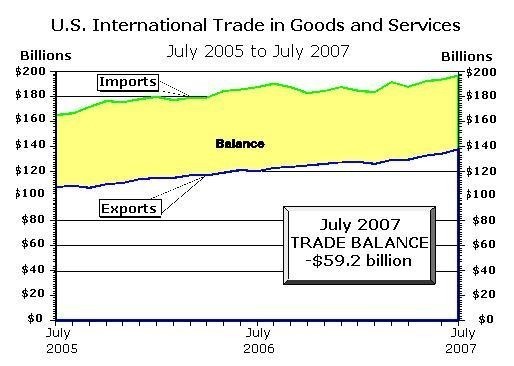
WASHINGTON – Compared with the previous month, the nation’s trade deficit shrank by $183 million or 0.31 percent in July to $59.2 billion, after declining a revised $186 million or 0.31 percent in June, according to joint report today from the U.S. Census Bureau and U.S. Bureau of Economic Analysis. Compared with July 2006, the U.S. trade deficit narrowed by $8.3 billion or 12.3 percent.
Analysts had expected the trade gap to widen in July to $59 billion, an increase of $900 million from BEA’s original June estimate, according to the median forecast from a Bloomberg News survey of 70 economists. (Their estimates ranged from $57.5 billion to $61.5 billion.)
But a fifth consecutive monthly record for U.S. exports, which analysts credited to a weak dollar and an expanding global economy, reversed the projection.
Total U.S. exports of goods and services surged $3.6 billion to $137.7 billion – the largest increase in three years – from June’s revised $134.1 billion. Goods exports increased $3.5 billion to $98.4 billion, as growing demand for capital goods; vehicles and auto parts; consumer goods; and foods, feeds and beverages more than offset a decline in exports of industrial supplies and materials. Services exports rose $0.1 billion to $39.2 billion, as increases in travel and other transportation were partly offset by a decline in other private services.
Total U.S. imports also continued their record streak, rising $3.4 billion to $196.9 billion in July from their revised June level of $193.5 billion. Goods imports rose $3.2 billion to $166.6 billion, as increases in imports of vehicles and auto parts; industrial supplies and materials; consumer goods; foods, feeds and beverages; and other goods more than offset a decrease in capital goods imports. Services imports increased $0.2 billion to $30.4 billion, as other transportation and other private services rose sharply while most catagories showed little change.
“Foreign demand is strong,” Michael Feroli, an economist at JPMorgan Chase & Co. in New York, told Bloomberg News. “It’s a reminder that we do have a bit of a shock absorber.”
The nation’s trade gap with China – now the No. 2 U.S. trade partner, after Canada – widened to $23.8 billion, an increase of 13 percent from June’s $21.2 billion, but remained short of October’s record $24.4 billion.
Deficits also were seen in trade with Canada (shrinking to $5.7 billion from $5.9 billion in June), the European Union (surging to $13.0 billion from June’s $9.2 billion), OPEC ($10.9 billion, up from $9.9 billion), Japan (rising to $8.0 billion in July, from $6.3 billion) and Mexico (rising to $5.6 billion from June’s $4.4 billion), the BEA said.
Surpluses were seen in U.S. trade with Hong Kong ($0.9 billion, down from $1.2 billion in June); Australia ($0.7 billion, down from $0.9 billion), Singapore ($0.5 billion, down from $1.0 billion in June), Egypt ($0.1 billion, down from $0.2 billion) and Argentina (steady at $0.2 billion).
“The global economy has solid fundamentals,” despite uncertainties that have been “augmented” by the financial markets’ current turmoil. European Central Bank President Jean-Claude Trichet told a news conference yesterday in Basel, Switzerland, according to Bloomberg News.
Additional information, including the full 47-page U.S. International Trade in Goods and Services news release, is available from the the U.S. Commerce Departments’ Census Bureau and Bureau of Economic Analysis at www.bea.gov.