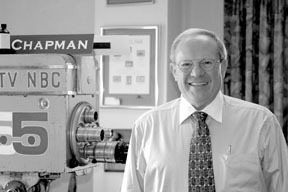
 use to go buy other televison stations."" title="Chapman: "Now we have a lot of capital that we canuse to go buy other televison stations.""/>
use to go buy other televison stations."
Television executive discusses going public, FCC regulations
Gary R. Chapman
Position: Chairman, president and CEO of LIN TV Corp.
Selling Luxury Real Estate Requires More Than Exposure
By Emilio DiSpirito IV License Partner | Private Office Advisor Engel & Völkers Oceanside www.DiSpiritoteam.com…
Learn More
Professional Background: Chapman started working in the television
industry in 1967, at KSDK-TV in St. Louis. In 1976, he became director of marketing
and research for KSDK’s owner, Pulitzer Television. After serving as general
manager of WLNE-TV in Providence from 1979 to 1984, Chapman was promoted to
director of broadcasting for the station’s parent company, Freedom Newspapers
Inc. In 1987, he was named senior vice president, broadcasting of Freedom Newspapers.
He joined LIN Television’s former parent in 1988 as president of television
and was named CEO of television in June 1994 and chairman in August 2000
Education: Bachelor of Science in radio and television communications
from Southern Illinois University (1967)
Residence: Bristol
Age: 59
LIN TV Corp.’s roots trace back to the founding of its former parent, LIN Broadcasting Corp., in the mid-1960s. In 1990, McCaw Cellular Communications purchased a 52 percent interest in LIN Broadcasting in a hostile takeover. McCaw was acquired by AT&T in 1994, after which LIN Broadcasting’s television operations were spun off as a public company traded on the NASDAQ stock market and 45 percent owned by AT&T. The new company, LIN Television Corp., owned and/or operated 12 stations.
In March 1998, LIN Television was acquired by Hicks, Muse, Tate & Furst Inc., a private investment firm based in Dallas. Under HMTF’s ownership, LIN Television has grown considerably through a wide range of transactions.
Today, LIN operates 23 television stations, including two under local marketing agreements, two low-power networks, and has investments in five others stations. LIN TV Corp., a new corporate entity that owns 100 percent of LIN Television, completed its initial public offering in 2002 and now trades on the New York Stock Exchange under the symbol TVL.
So we got to take the company public. There’s a road show, which is how you A. Now we have a lot of capital that we can use to go buy other television A. One of them within this market, that’s exactly right. We will be One of the other difficulties that television companies have now is that they A. I don’t think so. I mean, we’ve been through this three times now. One of the first lessons that you learn in a hostile takeover is: you don’t The state of Rhode Island has taxes that are a bit higher. When I came here
Q. Tell me about taking LIN TV public on the New York Stock Exchange last year – what’s that process like?
A. LIN Television was purchased by Hicks, Muse, Tate & Furst in March 1998. So we were a public company for 13 quarters, and then we were bought, and became a public company again of May 3 last year; the first time we were on the NASDAQ. This time we are on the New York Stock Exchange. And we’ve grown during that period of time from seven television stations to 24 stations throughout the United States and Puerto Rico – we also have a television station in Puerto Rico.
take companies public, on May 15 last year. There were 17 cities that you go
to in roughly three weeks, and we started out in New York and then went to Germany,
and then went to London, and then came back to Philadelphia, and then out to
the West Coast – San Francisco, Indianapolis, Chicago, Los Angeles, Denver,
and we ended up in Dallas on the second of May. And you build a book, and the
book is simply investors, mostly all institutional – that would be Fidelity
and Putnam and American Express – various investors, a lot of mutual funds.
And we were seeking to have some 14.5 million shares sold, and somewhere between
$19 and $21. And what happened was, when we priced, we found that we had interest
in 100 million shares – seven times over subscribed. So we priced at the top
of the range and the first day it closed at some $22 a share. We also exercised
what is called the Green Shoe, which is another 15 percent, so it’s actually
17 million shares. And so that’s how you become a public company.
Q. Now that LIN TV is a public company, what can stockholders expect in the future?
stations. That’s one advantage to being public – we’ve paid down a lot of debt,
and we have the opportunity to raise more debt actually, and buy other television
stations. We hope to be a consolidator. As you know, there have been some rule
changes at the FCC that probably will allow us to acquire additional television
stations.
Q. Within this market, even?
going to the FCC in early September when the rules become official and applying
for that. Also in Austin, Texas, that same day.
Q. Talk to me more about the FCC deregulation of the industry. What are the implications for LIN TV?
A. The dereg didn’t go as far as we would have liked. We were the first company to ever combine two stations in the same market, in Michigan in October 1991, when we combined a failing ABC-UHF station in Battle Creek with Wood, the NBC affiliate in Grand Rapids. We presently have five dual-owned stations in the market and would hope to convert WNAC, the Fox affiliate here, and KNBA, which is the WB in Austin, Texas, shortly this year. So we have been a proponent of that. In every one of those cases, those stations as a stand-alone would not be very formed in the market. Most of ours were either home shoppers or failing television stations. They didn’t have news. And by itself, WNAC, if it didn’t have WPRI, probably wouldn’t be able to have a newscast the way they are.
have to finance digital, high definition. Now, as a company we have spent $61
million in doing that, and we are 95-, 96-percent built out. Channel 12 is now
on digital. And WNAC will be soon – we have some more tower work out there,
but it is within weeks of being on. So we’ll have the only two television stations
in the market broadcasting in high definition. One of the problems is that small
television stations have difficulty financing that – it’s about $3 million a
station to do the tower work, the antennae and the transmitter. So it’s very
expensive, and if you’re a small station it’s hard to pay for.
Q. Would you fear another takeover bid?
You know, we have always said that if in fact someone wanted to pay a tremendous
amount of money for the stock, certainly we would entertain that. We have one
of the better run companies. We have pretty high margins, and are recognized
by Wall Street as having pretty good management. From that standpoint we’ve
never found somebody – usually when we have discussions of merger, they want
us to run their company.
Q. Why is LIN TV headquartered here in Providence? Was that a strategic decision?
A. I actually transferred here from St. Louis in September of ’79, and in ’84 I became the group head of (LIN’s former-owner) Freedom Newspaper’s television division, and the office was located on the Wampanoag Trail. And then I left in December of 1988 to go to New York City to become the president of LIN Television. Shortly thereafter, we went through a hostile takeover by McCaw Cellular. And McCaw was really not interested in the television company – they were interested in the cellular telephone company, and at the time the company was called LIN Broadcasting. And we were going back and forth between McCaw Cellular and Bell South, and finally McCaw prevailed. On March 5 of 1990, McCaw took over the company.
sell your house, because you don’t know what’s going to happen. I had an apartment
right up from the Russian Tea Room in New York City, and the commuting was pretty
tough. We have a home in Bristol, and our kids were in school here, and very
active in sports, and I was going back and forth every week for two years. We
were always happy here in Rhode Island. And Craig McCaw wanted me to continue
running the company, the television division, and said, ‘take the office anyplace
you want.’ And so I did. In December 1990, we opened right here, and we’ve been
here ever since. I traded the Hudson River for Narragansett Bay, basically.
Q. From a business standpoint, are there strategic advantages in your industry to being based in Providence? Or any disadvantages that you contend with?
A. Well, the biggest strategic advantage is you’re three hours away from New York City. And a lot of our business, the majority of our national sales, is still conducted in New York City. The New York Stock Exchange is in New York City. Many of our investors are within a hundred miles. Boston, of course, is a big capital market also.
the tax rate was about the same as I was paying in New York City. Taxes are
high here, that’s true.
Q. LIN is perhaps the lowest profile of all the public companies based in Rhode Island. Is that by design?
A. Yes and no. We are very active on national boards for the television industry. I’m a former joint chairman of the National Association of Broadcasters. Presently I am chairman of MSTV, Maximum Service Television, which is really the spectrum cop for the industry. We have a Washington office and we do spend a lot of time in Washington, both representing LIN Television and the industry itself. So we have a lot of obligations on the national front. So I think that that has a lot to do with it. The other is we have not have a television station here until May of last year, of course, when we merged with Sunrise, and they had two stations here – one that they owned and one that they operated – Channel 12-WPRI and 64-WNAC.
For the complete current issue, visit our subscription Web site, or call (401) 273-2201, ext. 227 or 234.